



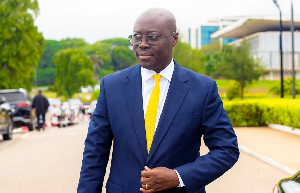
 Dr Cassiel Ato Forson is finance minister
The 2026 Budget Statement reveals a scandal of staggering proportions. Between April 2020 and August 2025, US$31 billion was transferred abroad through Import Declaration Forms with no corresponding goods imported into Ghana.
To grasp the magnitude, this sum represents 37 percent of Ghana's entire GDP. The GH¢11 billion in lost revenue from under-declared imports alone could have built 61 modern district hospitals, 220 fully-equipped boarding secondary schools, or 1,100 kilometres of urban roads.
The Ministry of Finance's comprehensive assessment of import transaction processes exposed systematic abuse of IDFs, instruments designed to facilitate legitimate trade. Over 525,000 transactions worth US$83 billion were processed through the Integrated Customs Management System. Shockingly, only 10,440 transactions linked to actual imports. This means 98 percent of IDF transactions had no corresponding goods entering Ghana.
The mechanics reveal organised crime rather than administrative failure. Importers transferred funds abroad claiming importation whilst bringing in nothing. Others remitted amounts exceeding actual goods imported. Banks approved transfers above the US$200,000 ceiling set by the Bank of Ghana without submitting the required documentation. Over 17,700 IDF applications breached these limits, channelling US$20 billion in unverified transfers out of Ghana.
The revenue implications compound the scandal. Importers under-declared values to conceal GH¢76 billion in actual imports, denying Ghana GH¢11 billion in customs duties, VAT, and other import-related revenues. This lost revenue exceeds Ghana's entire education sector allocation and could fund the Free SHS programme for over two years or address the NHIS funding deficit for five years.
The macroeconomic consequences extend beyond fiscal losses. These ghost transfers systematically drained foreign exchange reserves, applying continuous pressure on the cedi. When US$31 billion leaves Ghana with zero productive imports, the effect mirrors capital flight without corresponding trade benefits. The exchange rate weakness Ghanaians experienced between 2020 and 2024 could not be attributed to market dynamics. It is now evident that it was theft disguised as trade.
The scandal implicates multiple institutional actors. Banks violated Bank of Ghana regulations by approving oversized transfers without documentation. Customs officials processed IDF applications without verifying corresponding imports. Some importers operated as fronts for illicit financial flows rather than legitimate businesses. The system failed at every verification point.
Government response indicates recognition of severity. Persons and institutions involved face referral to the Attorney-General, Economic and Organised Crime Office, Financial Intelligence Centre, and Criminal Investigations Department.
The Ghana Revenue Authority will establish a special recovery unit to reclaim lost revenue. An Inter-Agency Committee will audit all future import-related transfers, with the Bank of Ghana matching every forex transfer against verified import data.
However, recovery faces practical limitations. Much of the US$31 billion has likely been converted or transferred through multiple jurisdictions. The challenge resembles recovering money laundering proceeds: legally possible but practically constrained.
The structural question demands attention: how did this continue undetected for over five years? Ghana's import monitoring systems, bank compliance frameworks, and customs verification processes all failed simultaneously and continuously. This suggests either systematic incompetence or institutional capture by interests benefiting from exploitation. State Capture, does it ring a bell?
The budget statement describes this accurately as an organised crime; it cannot be labelled as a loophole. It is a criminal enterprise. The scale, persistence, and coordination required indicate sophisticated operation rather than opportunistic abuse. Until Ghana identifies how institutions failed this comprehensively, implementing corrective measures addresses symptoms whilst leaving causes intact.
The US$31 billion represents a systemic institutional collapse that is causing tremendous wealth loss to the nation and requires structural reconstruction. Systemic transformation is required, not reformation.

Copyright © 1994 - 2026 GhanaWeb. All rights reserved.










