



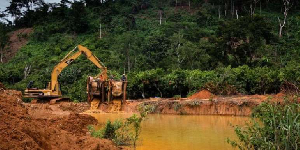
 File photo of an illegal mining site in Ghana
We cannot ignore or deny the fact that small-scale mining is a significant contributor to the economic and social well-being of many people and households in rural, remote, and poor communities in Ghana.
Nevertheless, the way small-scale mining sector is being managed in Ghana, it does not look promising. The sector is being managed abysmally.
Somehow, the laws which govern the small-scale mining sector are confused and inconsistent. Needless to emphasise that all the attention is basically being focused on the large-scale mining sector, leaving the small-scale mining sector at a substantial disadvantage.
Suffice it to stress that the effective implementation of regulations and fortifications towards the developmental potential of the sector must be the topmost importance to the regulating authorities.
Unfortunately, however, societies at large has been both positively and negatively affected by small-scale mining.
The positive effects include the extraction of ores from small deposits or from tailings which provide the rural folks and other small scale miners with sustainable incomes.
On the other hand, the negative effects include, among other things, environmental degradation, water pollution, the release of mercury and other toxic and hazardous wastes into the environment, and unforeseen social tensions that can lead to civil unrest.
However, on the preponderance of probability, the negative effects outweigh the positive effects, and therefore it is prudent for any serious, committed and forward-thinking leader to put tabs on the activities of the unscrupulous illegal miners.
That being said, the conscienceless illegal miners are back in business despite President Mahama promising solemnly tostop the activities of the stubbornly impenitent galamseyers on assumption of office. How unfortunate?
Given the criminal intent of the unscrupulous illegal miners , we are, more than ever, urgently required our military power to combat the menace of the stubbornly obdurate nation wreckers who are bent on stealing our natural resources and destroying the environment.
The recalcitrant illegal miners are all over the place stealing our mineral resources, terrorising the indigenes and destroying the lands and water bodies with mephitic mercury and cyanide.
The boisterous brats are well-prepared and routinely carry out their illegal activities with military precisions, can strike as lighting, and as deadly and destructive as molten magma.
Considering the stubborn nature of the lunatic fringe, I predicted some time ago that it would only take a massive leadership in order to curb the menace of illegal mining.
It was, therefore, quite refreshing when President Akufo-Addo prudently placed an interim ban on small-scale mining activities.
Despite the small scale miners endless protestations over the temporary ban on their poorly regulated activities, the unwearied President Akufo-Addo stood his grounds.
It was, in fact, a pragmatic step to put better data and policies in place to get the sector back on track, given the level of environmental degradation amid polluted river bodies.
Let’s face it, the exposure to noxious mercury in Ghana as a result of illegal mining activities remains a serious health problem and we cannot continue to live in a denial.
Mephitic mercury use in artisanal and small-scale gold mining is extremely harmful and its health effects on society are significantly worrying(WHO,2017).
The problems stemming from mercury use don’t stop at exposure from inhalation. Once used for gold processing, mercury-contaminated water is often dumped on the ground, polluting Ghana’s rivers and lakes, and poisoning its fish and those who eat them(HRW, 2014).
Key facts
Exposure to mercury – even small amounts – may cause serious health problems, and is a threat to the development of the child in utero and early in life.
Mercury may have toxic effects on the nervous, digestive and immune systems, and on lungs, kidneys, skin and eyes.
Mercury is considered by the World Health Organisation as one of the top ten chemicals or groups of chemicals of major public health concern.
Methylmercury is very different to ethylmecury. Ethyl mercury is used as a preservative in some vaccines and does not pose a health risk.
Mercury exists in various forms: elemental (or metallic) and inorganic (to which people may be exposed through their occupation), and organic (e.g., methylmercury, to which people may be exposed through their diet).
These forms of mercury differ in their degree of toxicity and in their effects on the nervous, digestive and immune systems, and on lungs, kidneys, skin and eyes.
People may be exposed to mercury in any of its forms under different circumstances. However, exposure mainly occurs through consumption of fish and shellfish contaminated with methylmercury and through worker inhalation of elemental mercury vapours during industrial processes (WHO, 2017).
As a bio-accumulative and toxic pollutant, when released into the atmosphere, mercury dissolves in water laid sedimen ts and it can be consumed by fish and then ended up in the food chain of humans (Merem, Wesley, Isokpehi et al. 2016).
In that sense, toxic mercury pollution poses an enormous public health hazard and environmental risk(Merem, Wesley, Isokpehi et al. 2016).
Exposure to mercury
All humans are exposed to some level of mercury. Most people are exposed to low levels of mercury, often through chronic exposure (continuous or intermittent long term contact).
However, some people are exposed to high levels of mercury, including acute exposure (exposure occurring over a short period of time, often less than a day). An example of acute exposure would be mercury exposure due to an industrial accident.
Exposure in the womb can result from a mother's consumption of fish and shellfish. It can adversely affect a baby's growing brain and nervous system.
The primary health effect of methylmercury is impaired neurological development, and Therefore, cognitive thinking, memory, attention, language, and fine motor and visual spatial skills may be affected in children who were exposed to methylmercury as foetuses.
The second group is people who are regularly exposed (chronic exposure) to high levels of mercury (such as populations that rely on subsistence fishing or people who are occupationally exposed).
Among selected subsistence fishing populations, between 1.5/1000 and 17/1000 children showed cognitive impairment (mild mental retardation) caused by the consumption of fish containing mercury. These included populations in Brazil, Canada, China, Columbia and Greenland(Source: WHO, 2017).
A typical example of toxic mercury contamination impacting negatively on public health happened in Minamata, Japan, between 1932 and 1968, where a factory producing acetic acid discharged waste liquid into Minamata Bay.
The discharge included high concentrations of methylmercury. The bay was rich in fish and shellfish, providing the main livelihood for local residents and fishermen from other areas.
Somehow, many years passed without no one realising that the fish were contaminated with mercury, and that it was causing a strange disease in the local community and in other districts.
At least 50 000 people were affected to some extent and more than 2000 cases of Minamata disease were identified.
Unfortunately, Minamata disease escalated in the 1950s, with severe cases of brain damage, paralysis, incoherent speech and delirium (WHO, 2017).
Minamata disease, also known as Chisso-Minamata disease, is a neurological syndrome caused by severe mercury poisoning. Symptoms include ataxia, numbness in the hands and feet, general muscle weakness, narrowing of the field of vision and damage to hearing and speech.
In extreme cases, insanity, paralysis, coma and death follow within weeks of the onset of symptoms. A congenital form of the disease can also affect foetuses (See: www.bu.edu/sustainability/minamata-disease).
We cannot and must not allow some criminally-minded foreigners, greedy politicians, mindless Ghanaians, and villainous chiefs who do not have the nation at heart and only harbour ulterior motives to enrich themselves at the expense of the rest of Ghanaians.
We should not and cannot fail our children and our children’s children, so let’s work collaboratively and end the menace of illegal mining.

Copyright © 1994 - 2026 GhanaWeb. All rights reserved.










