



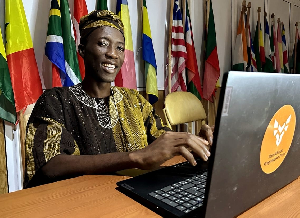
 Sumaila Mohammed is conserved the new voice in the pan-African field
In the daily conversations that shape our world, one truth stands unwavering: ‘The African continent will surely be liberated’. That liberation will come through its people especially the youth, who wake up each day with a growing awareness that the power to transform the continent rests in their hands. Africa’s young and brilliant minds carry the weight of its destiny and the promise of its future.
Sumaila Mohammed, the new blogger of the Pan-African Progressive Front and the Front’s head of Economics has embraced this new role and responsibility which he attributes as his call to duty as an African.
As a product of the University for Development Studies (UDS) in Ghana, where he completed his undergraduate studies, Sumaila has never abandoned the habits that shaped his intellectual foundations. He often turns to reading during his free hours, describing it as “a time to relax”and reconnect with ideas that inspire his work.
The path to liberation is shared. And it is through unity, consciousness, and youth-driven action that Africa will ultimately secure its victory.
In the spirit of youthfulness and conscious organization and mobilization, lies a man who believes strongly in the idea of emancipation of the African people. In line with his work at thePan-African Progressive Front (PPF) Headquarters as the Head, Economic Department, Sumaila Mohammed, pledges his unwavering commitment to the struggle faced by the African continent.
Sumaila Mohammed, also known as Ghanaba, is a powerful new voice in the PPF’s communications team. His new path as a blogger for the Front is not merely professional; it is a strategic approach to mass mobilization, especially among the youth. Sumaila stands as an individual whose clarity, conviction, and creative force are already elevating the organization’s digital presence.
“My hope is that when you come across my videos, you will affirm that African unity is possible—that an Africa without borders or colonial divisions is within reach,” he explained.
Sumaila’s new task comes at a time when African youth are demanding sharper analysis, bolder storytelling, and a deeper level of political education—particularly on Reparations.
“The idea of Reparations must be put on the table specifically from the African perspective and driven onto the global stage until it is adopted by all.”
As the conversation continued, he spoke about the need to recognize the problem of ‘Brain Drain.’ He links this exodus to a lack of understanding of the Reparations issue.
“We need far more engagement. In our schools, it must be integrated into our curricula. In the media, more journalists and bloggers must write and post about Reparations. And across civil society, individuals need to understand the importance of championing the idea of Reparations and what it means for the African Continent.”
Significantly, Sumaila frames the concept of blogging in a deeply personal tone. He believes this is an opportunity to go beyond simply publishing content. “It is political work.” Every video, post, and commentary is an opportunity to mobilize, to educate, and to help Africans see themselves as architects of their own future, he reiterated.
Clearly, his advocacy is grounded in research, sharpened by passion, and fueled by a desire to make radical ideas accessible to everyday people.
Sumaila, known for his strongly held views and analytical depth, has recently contributed significantly to shaping Africa’s long-term economic vision. His work played an essential role in developing the Economic Roadmap that informed the adoption of the Accra Declaration at the International Conference of Progressive Forces held in Accra.
In his roadmap, Sumaila emphasized core principles, including: the need for every African country to adopt an industrialization policy as the central pillar of its economic strategy for the next decade; the introduction of both de jure and de facto state participation in corporations operating within strategically vital sectors; and the nationalization of natural resource extraction across all African countries.
What sets him apart is his profound understanding of African Unity. He aims to reconnect history with current struggles and to highlight shared experiences across borders. “In the wise words of Nkrumah, I say: Africa, we must unite or we perish!”
As he steps into this new chapter, he envisions PPF’s platform becoming a central space for Pan-African political thought, youth engagement, and grassroots conversation. With his commitment and the movement’s momentum, Sumaila is poised to play a pivotal role in building the intellectual and cultural backbone of a new generation of African liberation.
“The mission is simple: to translate the ideals of unity, justice, and reparations into a language that resonates across the continent and the diaspora,” Sumaila concluded.
The interview ended with a clarity that filled the room. One thing is certain: the future of Africa remains in good hands, as individuals like Sumaila Mohammed continue to stay true to what they believe.
As the continent continues its restless struggle for true freedom and sovereignty, it becomes increasingly clear that the youth must be engaged at every step. Their energy, courage, and imagination are essential tools in the fight ahead.
Only through collective effort can Africa overcome the forces arrayed against her: neo-colonialism, capitalism in its most exploitative form, and the persistent grip of imperialism.

Copyright © 1994 - 2026 GhanaWeb. All rights reserved.










