



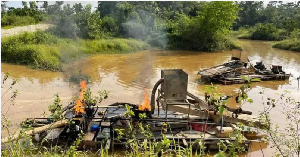
 File photo of a galamsey site
Although the “Cocoa Rehabilitation” campaign launched by the Gold Coast Government in the 1940s–50s to save the country's cocoa industry from being destroyed by the “Swollen Shoot” disease was immensely successful, it was nearly stillborn. It had tremendous drawbacks, caused mainly by a well-known social malady—the “human factor.”
Gold Coast society, like the Ghanaian equivalent that succeeded it, was deeply corrupt. As soon as the Government announced that a “repayment grant" would be paid for every cocoa tree cut down to prevent “swollen shoot” from spreading, cocoa farmers who had previously attacked “CR” teams now befriended them.
Liaison Officers ("L.O.s"), who were the first point of contact between CR and cocoa farmers, began to establish secret “contact groups” (based on close kinship/family links) through which farmers were able to get their cocoa farms officially surveyed and diseased cocoa trees identified and marked for cutting.
Where the diseased cocoa trees were numerous, the trees were counted and payment made on the basis of a “per-tree-cut-down” system.
Where the diseased trees were few, however, a corrupt Liaison Officer, on seeing the preliminary figures, would convey them secretly to the farmer. If the farmer agreed to the advice of the L.O., technical personnel would be induced to alter the figures, thereby transforming the status of the farm to one eligible for payment on an “acreage” basis instead. The secret understanding was that after the payout to the beneficiary, he would share “the booty” among all those who had cooperated to make the scam possible.
The wholesale destruction of farms was known by the code term “All die,” and many people in cocoa-growing areas became wealthy from the proceeds of the fraudulent practice.
Occasionally, an acutely intelligent ASO would smell a rat while going over the books of his personnel. Some were sent to jail for cooking the books. But by and large, human nature triumphed over common sense.
Later, the CR department amended its policies and used its own employees to carry out the replanting of farms, thereby deducting money from the replanting grant payout. The new scheme entailed a system known as “pegging and lining.” Under this system, cocoa seedlings—usually of the more robust genus known as "Amelonado"—were planted on treated farms, and the farmers were left to nurture them.
It is to be noted that cocoa rehabilitation was conceived and financed by the Government of the day, and its modalities created by the Government. But its operation was constantly monitored, and changes made where necessary.
Because “swollen shoot” occurred at a time when the Ghana independence struggle was at its fiercest, much political capital was made of its weaknesses. But the colonial authorities, expert propagandists though they were, did not sit on their behinds and take the easy way out by attempting to combat “swollen shoot” with words. Neither did they cover up for officials who were corrupt or inefficient in the struggle against the disaster.
And that is why today, we still have a cocoa industry to boast of—and to sustain our economy with!

Copyright © 1994 - 2026 GhanaWeb. All rights reserved.










