



 Dr Kwami Ahiabenu is a writer and a Technology Innovations Consultant
Small can be powerful. In the discussions of AI engines, large language models (LLMs) often dominate the conversation due to their inherent popularity, power, and utility; however, Small Language Models (SLMs), the lighter and more streamlined cousins of LLMs, are gaining traction in the rapidly evolving AI ecosystem.
In comparison, LLMs' counterparts require massive computing power and hundreds of billions of parameters, whereas SLMs pack essential AI capabilities into a smaller, more efficient package.
Some popular examples of SLMs are Phi, Ministral, Llama, GPT-4o mini,
DistilBERT, Qwen3-0.6B, SmolLM3-3B, FLAN-T5-Small, Granite, and Gemma.
An LLM can be described as a type of advanced artificial intelligence that uses deep learning to understand, generate, and manipulate human language based on its training on massive datasets, with the ability to perform various natural language processing (NLP) tasks, including the generation of text, creating software core, processing documents, and running chatbots or virtual assistants, among others.
LLMs essentially work by predicting the most probable outcome, thereby powering automation. On the other hand, SLMs are a specialized, compact AI model designed to perform similar tasks as LLMs, but
more lightweight version and usually optimize for the performance of a specific task.
To enable SLMs to perform their tasks, strategies such as prompt tuning, retrieval-augmented generation (RAG), and targeted fine-tuning are used. These strategies help smaller models reach high task-specific performance without the heavy overhead of LLMs.
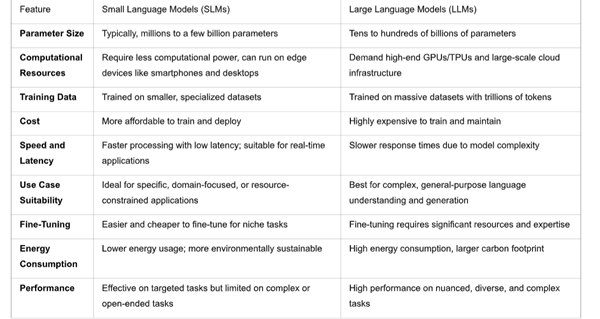
SLMs can be characterized as having fewer parameters, that is, millions to a few billions, in comparison to LMMs, which run hundreds of billions or trillions of parameters. These parameters in machine learning models can be described as internal variables, including weights, biases, and sometimes additional elements such as scaling factors or attention coefficients, which a model learns during training.
These parameters are collectively important because they shape the model’s internal decision logic and directly influence how the model processes input data, predicts outcomes, and adapts to novel or complex tasks at the end of the day. In simple terms, SLMs rely on a
transformer architecture that operates at two levels, encoders convert input sequences into numerical representations called embeddings, and decoders then generate output sequences by attending to these embeddings and using self-attention mechanisms to focus on relevant parts of the input and previously generated output.
A fundamental characteristic of SLMs is their use of the self-attention mechanism within transformers, which enables the model to prioritise and allocate focus to the most important tokens in the input sequence, irrespective of their position.
Another overriding characteristic of SLMs is that they are more domain-specific, focused, and trained on smaller, more curated datasets, making them powerful for niche applications or industry-specific tasks.
Third, SLMs generally have lower resource requirements based on their small size, in terms of using less computational power, memory, and energy to run, which means this efficiency means SLMs can be deployed on localized edge devices like smartphones, consumer laptops, and desktop computers, instead of relying exclusively on cloud servers. Therefore, their light footprint is the key that enables real-time processing, offline capabilities, and cost-effective AI solutions that are ideal for environments with limited hardware resources. Also, SLMs are relatively more private and sometimes faster since they can operate with low latency for real-time applications, which reduces some types of data privacy and security risks.
The list of SLM applications is growing; they could include on-device AI solutions instead of relying on the cloud, hence they can power offline translation, voice assistants, text prediction on smartphones, etc. Another important use case of SLM is the creation of efficient, domain-specific virtual assistants and customer service chatbots, which perform better because of the deep training on the specific domain in question.
Also, SLMs can be very useful for enterprise automation where there is a need for summarizing documents, processing data, and enhancing search for a company's internal knowledge base or data lakes. Using this approach it offers a company better privacy and security over the content used in the automation process.
Lastly, SLMs are increasingly favored due to their environmental benefits, as they require significantly fewer computational resources and consume less energy than larger models, thereby reducing their overall carbon footprint and making them a more sustainable option.
Like any other AI tool, SLMs suffer from the same risks confronting AI systems, including bias; here, smaller models can learn from bias that can be found in their outputs. It is important to emphasis that outputs from small languages have limited generalisation linked to the narrow knowledge base.
SLMs also suffer from hallucinations, where the models generate incorrect, misleading, or fabricated information that appears plausible but is factually inaccurate or nonsensical. This occurs when the AI draws on incomplete, biased, or flawed training data or misinterprets patterns, and can pose serious challenges for trustworthiness and reliability.
Smaller models are invariably fine-tuned on specific data; therefore, they do not perform well on complex tasks or when confronted with generalised tasks due to their limited knowledge linked to the limited scope of topics they were trained on.
It is important to take steps to mitigate these risks when it comes to deploying AI applications, including SLMs.
In conclusion, LLMs are well-suited for handling a wide range of complex tasks, though they require significant computational resources. In contrast, SLMs offer efficient performance for specialized tasks while maintaining lower resource costs. For effective AI strategy deployment, organizations may consider initially leveraging LLMs to evaluate the feasibility and broader applications and subsequently transition to SLMs for focused and cost-effective implementation as the task scope becomes more defined.

Copyright © 1994 - 2026 GhanaWeb. All rights reserved.










