



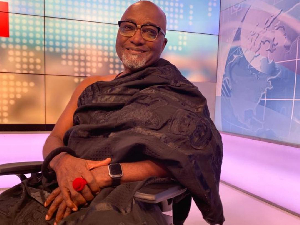
 Nana Annor Amihere II is the author of this article
The 24-Hour Economy will rise or fall on demand. A factory runs three shifts only when buyers keep coming. Ghana already has a product with ready buyers and deep roots. It is the Fugu.
Since the Ministry of Tourism, Culture and Creative Arts declared every Wednesday Fugu Day in February 2026, smock weavers have struggled to keep up with orders. If every public institution, every Member of Parliament and every school made the Fugu and other Ghanaian-made clothing part of normal working life, that demand would reach the cotton farms, spinners, weavers and tailors of the northern regions. It would create work where work is most needed. It would give young people who now carry loads in Accra a reason to stay home. This article sets out the case and the practical steps.
1. A Wednesday Morning at the Bank
On a recent Wednesday I walked into my bank, First Atlantic Bank, and found every member of staff, men and women alike, dressed in Fugu. It was a pleasant surprise. Nobody had made a speech about it. The bank had simply decided to honour the national call, and its people looked smart, proud and at ease.
I left with one question on my mind. What if GCB, the Agricultural Development Bank, the Bank of Ghana and every ministry, department and agency did the same each Wednesday? Picture that banking hall repeated in every bank, every office and every classroom in the country. The orders that follow would land on the looms of the north.
2. The 24-Hour Economy Needs Buyers
The 24-Hour Economy asks firms to work in three eight-hour shifts. Every extra shift costs money in power, wages, security and transport. No owner adds a night shift to make goods that will sit in a store room. The policy offers tax relief and financing on the supply side. Alongside those incentives it needs steady, predictable demand. President Mahama has given the 24-Hour Economy its own slogan, 1.3.3: one job, three shifts. Demand is what will turn one job into three shifts.
Government cannot order private citizens to buy. It can decide what the state buys and what its own officers wear. The state is the largest employer in Ghana, and its dress habits are a market in their own right. When the state wears local, it hands local producers a buyer they can plan around. That is the kind of demand that justifies a second and a third shift.
3. From Cotton Field to Smock
The Fugu is a whole chain of work. Cotton is grown and picked. It is ginned, spun and dyed. Weavers turn the yarn into narrow strips on hand looms. Tailors sew the strips into a garment and finish it with embroidery. Traders carry it south and across our borders. Each link employs people, and most of those links sit in the northern half of the country.
Demand is already testing that chain. After the Fugu Day declaration, the secretary of Ghana's smock weavers and sellers association told the Associated Press that many weavers were struggling to raise production. That is good news in disguise. It tells us the market is real and that the bottleneck is capacity. Capacity can be financed, trained and built.
4. Bringing Our Young People Home
Every year young men and women leave the north for Accra and Kumasi. Many end up as kayayei carrying head loads, as truck pushers or as house-helps. Some sleep in the open in markets and lorry stations. They did not leave home for comfort. They left because there was no work at home.
A busy smock industry changes that arithmetic. A young woman who can earn a living at a loom in her own district has little reason to carry loads in a city market. Government can help by pairing the new demand with a voluntary return-and-skills programme. It should offer training in weaving, tailoring and cotton farming, a start-up kit, and access to credit through the existing youth employment agencies. Our young people deserve a dignified choice to go home to real work, and the Fugu can provide it.
5. Leadership by Example
President Mahama has led from the front. Since the Fugu Day declaration he has worn Fugu and locally sewn clothes at state functions at home and abroad. Yet many of his appointees and many Members of Parliament still arrive at public events in imported suits and ties. Some of those suits come from the same bales of used clothing that fill our markets.
Followers watch leaders. When a minister wears a foreign suit to a Wednesday function, the public servant reads the message that Fugu Day is optional. I respectfully urge the President to ask every appointee to wear Fugu or Ghanaian-made attire on Wednesdays and at state functions. I urge the leadership of the Majority and the Minority in Parliament to adopt the same rule for the House. Dress codes are set by habit, and habit starts at the top.
6. Kufuor's Friday, Mahama's Wednesday
Local dress belongs to no party. In 2004 the Kufuor government launched the National Friday Wear Programme. It asked public officers, and private firms where practicable, to wear locally designed garments made from locally manufactured fabric on Fridays. It did much to restore pride in African print. Over the years, compliance slipped.
Friday local wear and Wednesday Fugu can work side by side. Two days a week of Ghanaian dress across the public service would give tailors, weavers and textile mills a reliable base of orders. Both should be written into public service dress codes so that they outlive any one government.
7. The Used-Clothes Question
Ghana imports large volumes of second-hand clothing, which we call obroni wawu. Figures from the Ghana Used Clothing Dealers Association put the import bill above 300 million US dollars across 2021 and 2022. Kantamanto in Accra receives about fifty forty-foot containers of bales every week. Part of every bale ends up as waste in our gutters and on our beaches.
The trade also feeds many families, and those families deserve respect. The lasting answer is to grow the local alternative until Ghanaians choose it freely. As demand for Ghanaian wear rises, used-clothing traders can move into selling Ghanaian-made garments. Government should support that shift with a phased plan, giving traders time and credit to adjust.
8. A Lesson from 1972
When Colonel Acheampong launched Operation Feed Yourself in February 1972, he appealed to national pride. City dwellers made backyard gardens. Rice farming in the north expanded. With tight controls on food imports and strong cocoa and gold prices, the government announced trade surpluses for 1972 and 1973. Ghana was declared self-sufficient in rice in 1974.
Those gains were not sustained, and the lesson cuts both ways. A national call can change behaviour quickly. Lasting results need planning, finance and discipline long after the slogans fade.
9. Starting in the Classroom
Children wear what adults put on them, and a school uniform shapes taste for life. I propose a Ghanaian-made uniform day in our schools, with a custom-made Fugu or a shirt in local fabric. The Ghana Education Service could pilot it in selected basic and senior high schools, with the cloth woven locally and the uniforms sewn by district tailors. A child who grows up proud of the Fugu will buy Fugu as an adult, and will expect the same of his or her leaders.
Our designers are ready for the challenge. Designers such as Mawuli Kofi Okudzeto, the UK-trained founder of MKO.GH, and many young designers across the country, are already cutting the Fugu into jackets, shirts, dresses and trousers that suit men and women, the office and the durbar ground alike.
10. The Market Beyond Our Borders
The Fugu has admirers abroad. When the President wore it on his visit to Zambia, it became the talk of the region, and traders report that smocks sent there sell out within hours. Our neighbours in Nigeria already dress proudly in their own garments, and the smock tradition is shared across the Sahel. Ghanaians in the diaspora want to wear home. With the AfCFTA Secretariat in Accra, Ghana should be first to market.
11. What Must Happen Now
I offer the following practical steps.
• The Office of the Head of the Civil Service should issue a circular making Wednesday Fugu and Friday local wear standard for all public officers.
• Ministers, Regional Ministers, MCEs, DCEs and all appointees should lead by example at every Wednesday function.
• The leadership of Parliament should adopt Fugu or Ghanaian-made attire in the Chamber on Wednesdays.
• The Bank of Ghana and state-owned banks should follow the example of First Atlantic Bank, and the Ghana Association of Banks should commend it to all its members.
• The Ghana Education Service should pilot a made-in-Ghana uniform day in selected schools.
• The 24-Hour Economy Secretariat, the Ministry of Trade, Agribusiness and Industry and the Ghana Enterprises Agency should finance looms, cotton revival and tailoring hubs in the northern regions.
• A voluntary return-and-skills programme should offer kayayei and other migrant youth training, tools and credit to work in the Fugu value chain at home.
12.Charity Begins at Home
The 24-Hour Economy is about demand, nothing more and nothing less. We can create that demand with the clothes on our backs, and keep our looms and tailoring shops running in the spirit of 1.3.3. When all hands are on deck, from the schoolchild to the Presidency, the Fugu and our other local wear can lift the economy, bring our young people home and carry the name of Ghana to every market in West Africa and beyond.
First Atlantic Bank has shown the way. The rest of us have only to follow.

Copyright © 1994 - 2026 GhanaWeb. All rights reserved.










