



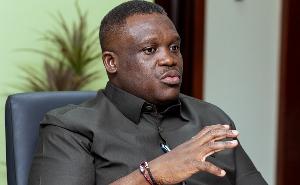
 Samuel Nartey George is the Minister of Communication, Digital Technology and Innovations
There is a pattern that has become familiar in Ghanaian public discourse whenever the name Hon. Samuel Nartey George appears in a headline. The criticism comes quickly. It travels widely. It is amplified on international platforms and shared in networks that reach far beyond Ghana's borders.
And if you read carefully, if you trace the sources, if you notice which voices are loudest and what vocabulary they use, you begin to notice something worth naming plainly: a significant share of the hostility directed at Hon. Sam George as a minister is not about his governance record. It is about the Family Values Bill.
This is not a conspiracy theory. It is an observable pattern. Since Hon. Sam George first championed what became the Human Sexual Rights and Family Values Bill in 2021, international LGBTQ+ advocacy networks have treated him as a specific and named target. When he appeared on CNN in October 2021 and held his ground with composure, referencing Ghana's 1992 Constitution and refusing to be rattled by a hostile interview, Ghanaians celebrated him and those same networks catalogued it as evidence of the threat he posed to their global agenda.
He has been the subject of co-ordinated campaigns on social media platforms headquartered in countries where the Family Values Bill is considered an affront. International media organisations with explicit editorial positions on LGBTQ+ rights have published pieces that characterise him primarily through that lens. Advocacy groups that receive funding from foreign foundations have written open letters, issued statements and cultivated Ghanaian media relationships, all aimed at keeping pressure on a minister and member of parliament whose primary sin, in their view, is that he reflects the values of the constituency that elected him.
While the noise has been loudest on identity politics, what has Hon. Samuel Nartey George actually been doing as Minister for Communications, Digital Technology and Innovation?
He has taken on the SIM re-registration challenge that his predecessors left unresolved across three consecutive exercises, announcing a framework grounded in real-time NIA biometric verification, funded by telecom operators at no cost to the taxpayer, and supported by Ghana's largest network, MTN Ghana. The significance of this cannot be understated. The previous exercises collectively failed to produce a single verified biometric match against the NIA database.
He is the minister who inherited that failure and is now required to fix it. He has been a consistent and vocal presence on digital infrastructure, cybersecurity and Ghana's positioning within the continental digital economy conversation. He has represented Ghana at international telecommunications forums and has been part of the Mahama administration's broader effort to restore economic credibility after the fiscal crisis years.
He has kept the connectivity agenda alive in a government managing the dual pressures of IMF programme compliance and the demands of a population that needs digital access to grow.
And he has done all of this while simultaneously being subjected to pressure from international actors who would prefer he abandon his position on the Family Values Bill. He has not abandoned it. On BBC Newsday in February 2026, he stated his position clearly and calmly, separating his capacity as a Member of Parliament from his role as a minister, and reaffirming that his commitment to the legislation he helped write remains unchanged.
The tactic being used against him is conflation. Take a minister's legislative advocacy on a social issue that the international community disapproves of, and use it to cast doubt on everything he does in office. Treat every policy announcement as suspect. Amplify every critic, regardless of whether the criticism is technically grounded or politically motivated. Create the impression, through volume and repetition, that a minister who is controversial on one issue must therefore be failing on all issues.
Ghanaians are not obligated to accept that framing. Ghanaians can evaluate a minister's work on its merits. They can ask whether the digital infrastructure is improving. They can ask whether the re-registration exercise is designed properly and whether its procurement is transparent. They can hold the minister to account for real failures and real shortcomings. That is legitimate scrutiny. What is not legitimate is allowing an internationally co-ordinated campaign, funded and animated by interests outside this country, to define how Ghana evaluates one of its own ministers.
The Family Values Bill did not emerge from the imagination of one man. It was first introduced by eight members of parliament from across the political divide in 2021. It passed the Ghanaian parliament with bipartisan support in 2024. When it was reintroduced in 2025, ten MPs from both the NDC and NPP sponsored it. The Supreme Court dismissed two separate legal challenges to it. Polls consistently showed majority Ghanaian support for its passage. Sam George did not impose this position on Ghana. He represented it, and he continues to do so.
There is a legitimate debate to be had about the specific provisions of the Family Values Bill, about proportionality, about implementation and about Ghana's relationships with international partners whose funding touches areas of national development. Ghanaians should have that debate on Ghanaian terms, with Ghanaian voices at its centre.
That debate is entirely different from a campaign to tarnish a minister's governance record because international advocates dislike his legislative positions. One is engaged civic discourse. The other is political sabotage dressed as public interest commentary.
When IMANI raises technical questions about SIM re-registration procurement and data architecture, that is the kind of scrutiny every Ghanaian minister should face and every Ghanaian citizen should welcome. When internationally connected networks amplify negative stories about Sam George's ministry while remaining silent on equivalent governance questions about other ministers, the asymmetry is worth noting.
Samuel Nartey George will be judged by Ghanaians on whether he delivers a functioning digital identity system, whether Ghana's connectivity improves, whether the re-registration exercise works this time, and whether the communications sector grows under his watch. That is the correct basis of evaluation.
Not what CNN thinks. Not what advocacy networks headquartered in London and Washington think. Not whether he has satisfied the conditions of international platforms whose definitions of acceptable governance are written without reference to the sovereign choices of the Ghanaian people.
That distinction matters. And it is time to say it clearly.

Copyright © 1994 - 2026 GhanaWeb. All rights reserved.










