



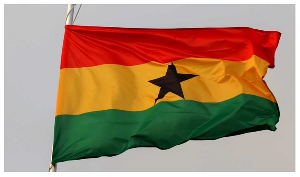
 The flag of Ghana
In many years after independence, Ghana and indeed many African nations have made commendable strides in establishing institutional structures, adopting sound policy frameworks, and decentralising governance systems to deepen citizen participation in development planning. Despite these internal advancements, a paradox persists: we continue to look outward, often to the Western world, not only for financial assistance but also for direction on how we utilize those resources.
The irony lies not in the act of seeking support, after all, cooperation is central to global progress but in the nature of that support, which too often comes with strings that restrict our autonomy and dampen our development vision.
We must ask ourselves: why do we still allow external actors to dictate the consultants we must use, the nature of policies we should adopt, and even the sectors where development resources should be invested? Why do we permit such overreach into our internal planning processes when we have the expertise (the civil servants), institutions, and systems to determine our development path?
It is important to clarify that this argument is not a rejection of bilateral partnerships, multilateral cooperation, or international development assistance. Far from it. Ghana has benefited from these relationships in many forms; grants, loans, technical assistance, capacity building, and shared global knowledge. These engagements have contributed significantly to various sectors including health, education, infrastructure, and governance. However, there is a fine line between support and control, and that line is increasingly being crossed.
Ghana, like many African countries, has established policy frameworks such as the Ghana Vision 2057, the Medium-Term National Development Policy Framework (MTNDPF), all of which by the NDPC and sector-specific strategies and Policies that are home-grown and contextually relevant.
The country boasts a decentralised planning system that brings development decision-making closer to the people through Metropolitan, Municipal, and District Assemblies (MMDAs) and the Sub District structures which unfortunately are non-functional. These institutions are not in books, they are functional, with clear mandates, structures, and laws to guide inclusive and participatory development.
Moreover, Ghana is not without capable human resources. Our universities, think tanks, public institutions, and civil society organizations are filled with professionals who understand the local context far better than any consultant flown in from thousands of miles away. So, if capacity exists, if systems exist, and if policies exist, why then do we allow external financiers to shape our development direction in ways that often reflect their priorities more than ours?
Too often, development funding is tied to conditions that do not only dictate how the money should be spent but also who should spend it and under what ‘bureaucratic framework’. Foreign consultants are sometimes imposed, project designs are pre-determined, and deadlines are fixed without consideration for local realities. Such arrangements weaken local institutions, sideline national expertise, and limit the ownership and sustainability of development outcomes. The reason we, the youth do not opportunities.
This situation is not only unsustainable but also disempowering and in most cases make nationals think otherwise. Development should not be something done to a country; it should be done with and by the country. Financial support, when sought, should be treated as a transaction governed by mutual respect and transparent terms, not an invitation for oversight and imposition.
It is time for Ghana after 68 years of freedom from oppressors’ rule and other African nations to assert a new development philosophy, one rooted in sovereignty, localised mindset, self-determination, and responsible partnership. We must redefine the terms of engagement in our international relations, especially when it comes to development financing.
Recommendations for Charting Our Own Path
1. Government should strengthen systems like the Ghana Aid Policy and Strategy to ensure that external resources align strictly with national priorities and plans. No aid should be accepted without fitting into an existing or co-created framework developed through local participation.
2. Government must prioritize local consultants and firms in the design and implementation of donor-funded projects.
3. Development assistance should be approached as a financial transaction, with clear repayment plans and mutually agreed deliverables. Conditionalities can be openly debated in Parliament and among stakeholders to ensure national ownership.
4. Ghana should gradually reduce its dependence on donor funding by improving domestic resource mobilization through tax reforms like property tax within MMDAs and efficient public financial management.
5. The Ministry of Finance and National Development Planning Commission (NDPC) should maintain an active register of development agreements, accessible to the public, to ensure that external funds are tracked, evaluated, and used in line with national laws and goals.
In conclusion, Ghana has both the capacity and the vision to lead its own development. What is needed now is the will to assert that vision, to negotiate from a position of strength, and to resist development models that displace local knowledge, institutions, and most importantly priorities. It is not ungrateful or anti-Western to demand respect in partnerships, it is a call for dignity, sovereignty, and sustainable progress.
Let us not merely negotiate our development; let us lead it.
Let give the youth a chance. #Localisedefforts
Happy Republic Day

Copyright © 1994 - 2026 GhanaWeb. All rights reserved.










