



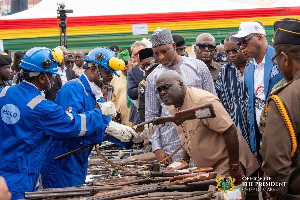
 Image from the Gun Amnesty Programme at the 8th National Arms Destruction Ceremony
The Government of Ghana recently destroyed more than 2,000 illicit arms seized, confiscated by the courts and surrendered during the Gun Amnesty Programme at the Eighth (8th) National Arms Destruction Ceremony, held as part of the country's observance of the United Nations Small Arms Destruction Day.
The ceremony, organised by the Ministry of the Interior in collaboration with the National Commission on Small Arms and Light Weapons, the Ghana Police Service, the Ghana Armed Forces and the National Security Council Secretariat, has once again prompted a familiar public question: Why destroy these firearms instead of refurbishing and issuing them to Ghana's security and intelligence agencies?
At a time when security resources are stretched, the suggestion may seem practical and economical. However, what appears to be a cost-saving measure would, in reality, create significant legal, operational, forensic and national security risks. Destroying confiscated firearms is not an act of waste; it is a deliberate policy designed to protect the public, safeguard security personnel and strengthen confidence in Ghana's firearms control system.
Unknown History, Integrity and Legal Status of Seized Firearms
A seized firearm is one confiscated during criminal investigations, intelligence operations, border interceptions or court proceedings. Once judicial proceedings are complete and ownership has been forfeited to the State, the relevant authorities determine its final disposal.
If a firearm has been officially designated for destruction, reversing that decision undermines the integrity of the disposal process and raises legitimate questions about the accountability and traceability of confiscated weapons.
One of the strongest arguments against reusing seized firearms is their uncertain history. Unlike firearms procured from certified manufacturers through licensed arms and ammunition dealers, confiscated weapons often originate from unknown or illicit sources.
Many may have been illegally manufactured, smuggled across borders, modified to increase their lethality, or poorly maintained over many years. Others may have been used in armed robbery, murder, organised crime, or other serious offences.
Because their ownership and maintenance histories cannot be fully verified, their mechanical reliability is often uncertain. Even firearms that appear serviceable may contain hidden defects that only become apparent during operational use.
No responsible armoury should introduce such uncertainty into the inventories of Ghana's security agencies.
Safety of Security and Intelligence Officers
The safety of security personnel must always take precedence. Police officers, soldiers, prison officers and other security personnel rely on their firearms in life-threatening situations, where equipment failure can be fatal. Corroded components, excessive wear, poor-quality repairs or unauthorised modifications may cause seized firearms to malfunction at the very moment they are needed most.
Security personnel deserve equipment whose reliability has been assured through recognised procurement, testing and quality-control procedures.
Forensic and Evidential Concerns
There are also compelling forensic reasons why confiscated firearms should not be returned to operational service. Many seized weapons have formed part of criminal investigations and remain linked to intelligence and forensic records.
Even after court proceedings have concluded, preserving a clear chain of custody from seizure through to destruction strengthens the integrity of the criminal justice system. Reintroducing such firearms into operational inventories could complicate future investigations and undermine public confidence in evidence management.
Destroying confiscated firearms also reduces the risk of diversion. Any firearm retained in circulation, however secure the inventory may appear, remains vulnerable to theft, corruption, unauthorised transfer or loss. Permanent destruction eliminates that risk altogether. Every illicit firearm destroyed is one fewer weapon available to criminals, organised crime groups or violent extremists.
Standardised arms and ammunition
Operational efficiency is another important consideration. security and intelligence agencies rely on standardised modern weapon systems to simplify training, maintenance, logistics and ammunition supply. Confiscated firearms often span numerous makes, models and calibres from different countries and manufacturers. Incorporating this diversity into official armouries would complicate inventory management, increase maintenance costs and reduce operational readiness.
Standardisation enables armourers to stock appropriate spare parts, instructors to train personnel consistently and operational units to maintain reliability in the field.
Public Confidence and Transparency
Public confidence is equally important. Citizens expect confiscated firearms to be permanently removed from circulation. If weapons publicly declared destroyed were later found in operational use or diverted back into criminal hands, confidence in Ghana's security institutions would be seriously undermined. Publicly supervised destruction ceremonies demonstrate transparency, accountability and responsible firearms management.
International and Regional Legal Frameworks
Ghana's policy is also consistent with internationally recognised arms control standards.
The United Nations Programme of Action on Small Arms and Light Weapons, the International Small Arms Control Standards (ISACS), the ECOWAS Convention on Small Arms and Light Weapons, the United Nations Firearms Protocol, the Arms Trade Treaty and technical guidance issued by the United Nations Office on Drugs and Crime all emphasise secure management of confiscated firearms, prevention of diversion and, where appropriate, their permanent destruction.
Although these international and regional instruments do not always expressly prohibit security agencies from using confiscated firearms designated for destruction, they are grounded in common principles: preventing diversion, maintaining accountability, protecting public safety, reducing the number of illicit firearms in circulation and promoting transparency in national firearms management. Collectively, they strongly support the permanent disposal of such weapons rather than their return to operational use. Some may argue that any firearm capable of firing should be retained to reduce procurement costs.
While understandable, this view overlooks the hidden costs of mechanical failure, forensic complications, inventory management and the risk of diversion back into criminal circulation. The apparent savings are far outweighed by the potential consequences for public safety and national security.
When security agencies require additional firearms, the appropriate approach is transparent procurement from licensed manufacturers and authorised suppliers. Newly acquired firearms are manufactured to recognised standards and backed by quality assurance, technical documentation, warranties and predictable maintenance programmes. They also promote standardisation across the security services, enhancing operational effectiveness while protecting the personnel who rely on them.
As a member of the United Nations and ECOWAS, the Republic of Ghana has consistently demonstrated its commitment to responsible firearms management. The continued destruction of confiscated firearms after legal processes are completed aligns the country's arms-control system with internationally recognised best practice, strengthens the rule of law and reduces opportunities for criminal diversion.
Conclusion
The destruction of confiscated firearms is therefore not an act of waste but an investment in national security. Every illicit weapon permanently removed from circulation is one fewer firearm available to threaten a police officer, a soldier, a private security guard or an innocent citizen. Ghana's continued commitment to destroying seized firearms demonstrates that public safety, accountability and the rule of law are worth far more than the perceived value of reusing firearms whose history can never be fully known.
The Government of Ghana, under the leadership of His Excellency President John Dramani Mahama, together with previous governments, deserves commendation for its sustained commitment to combating the proliferation of illicit firearms through the destruction of seized and surrendered weapons.
This policy reflects Ghana's commitment to international and regional arms control standards, strengthens public safety and national security and prevents the re-circulation of illicit firearms. Sustaining this initiative will reinforce public confidence in the country's security institutions and contribute to a safer and more secure Ghana.

Copyright © 1994 - 2026 GhanaWeb. All rights reserved.










