



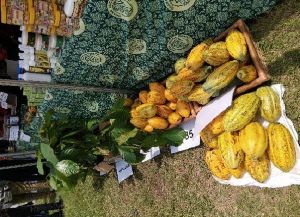
 A file photo of Cocoa which was on display at Farmers day
Modestly instituted by the PNDC administration under the outstanding leadership of Flt Lt JJ Rawlings, in the mid-1980s, National Farmers’ Day (NFD) has remained a cornerstone of Ghana’s agrifood policy.
The 41st edition, held last week, has been widely praised as the most impactful in recent years. From the moment President John Dramani Mahama arrived at the grand durbar to his proclamation of Ho as an “Oxygen City,” the event was characterised by a vibrant and celebratory atmosphere.
It reinforced the enduring relevance of Rawlings’ food governance legacy, including his benevolent decision to dedicate his World Food Prize funds to establishing northern-based University for Development Studies in the early 1990s.
Today, the NFD has evolved into a powerful public engagement platform for amplifying key policy achievements, elevating farmers’ voices, and creating space for media debates on pressing gaps that still need stronger ‘political will’.
Recognising AgriScience-Policy-Practice Excellence
The NFD goes with commemorating the top achievers across the agricultural value chains through various prizes.
For 2025, the National Best Farmer accolade was conferred upon Mr. Abraham Kwaku Adusei of the Eastern Region. He was awarded approximately USD 106,000 in recognition of his sustainable and commercially diversified farming operations.
The best university in practical agriculture prize went to the University of Ghana.
To expand agripolicy excellence, the President, John Dramani Mahama, reiterated the government’s commitment to carry out comprehensive agricultural reforms. He highlighted significant successes, like a sharp decline in food inflation from 28.3% in January to 9.5% in October 2025, mainly driven by improved access to seeds, fertilisers, and technology-inclined irrigation schemes.
What Works Well
This year’s NFD was themed on “Feed Ghana, Eat Ghana, Secure the Future”, aligning with the government’s ambition to reduce food import bill, boost locally led production and consumption, and promote systemic agricultural efficiency and transparency.
The theme is consistent with the targets outlined in the UN Agenda 2030 for Sustainable Development, the AU Agenda 2063, and the Paris Agreement.
Furthermore, NFD served as a catalyst in encouraging youth to embrace agriculture as an assuring employment option. The strong participation of institutional and development partners reinforces the long-term sustainability of the NFD initiative, moving it beyond one-time awards toward a developmentally strategic focus.
Persisting Systemic Gaps, Risks, and Policy Opportunities
The excitement around the 41st NFD is over, yet Ghana’s heavy reliance on imported food remains a deep structural challenge, causing hunger struggles.
The 2025 State of Food Security and Nutrition in the World Report, jointly published by the FAO, UNICEF, WFP, WHO, and IFAD, has not exempted Ghana from acute undernourishment and malnutrition.
The 2025 Global Hunger Index scored Ghana at 13.1.
The 2024 Annual Country Report of the WFP Ghana stated that 920,000 farmers were impacted by dry spells alone in the northern savannas.
The existing situation clearly shows that achieving stable food security requires a systems-wide approach that supports inclusive implementation of integrated policies. These should expand access to microcredit, mechanised equipment, rural infrastructure (e.g., roads, storage, markets), and value-addition facilities without violating indigenous people’s rights, environmental standards, or distorting the Earth’s climate.
Agrienergy systems must also transition toward greener, low-carbon models. Equally important is the scaling of agri-innovations to reach smallholder farmers, while continuously reassessing and responding to the growing risks of overlapping crises that can threaten productivity, profits, and long-term sustainability.
Smallholders who repeatedly lose their agri-investments, jobs, and dignity to severe droughts, bushfires, flood risks like the Akosombo Dam spillage, or river pollution caused by illegal mining (“galamsey”) deserve justice.
Conflict, post-harvest losses, and the extinction of indigenous agrospecies pose major risks too. In the drier northern savannas, where heatwaves and rainfalls are frequently unpredictable, solar-powered irrigation systems for crops and livestock, implemented with sound ecological principles, offer a sustainable solution.
Mentoring and engaging young people is just as important as addressing extreme climate emergencies, debts, and land pressures. Reskilling youth in climate resilience and agri-entrepreneurship is essential for sustaining future food systems.
In this context, the Public Agricultural Colleges of Ghana (PACsG), which are located in Ohawu, Wenchi, Kwadaso, Ejura, Pong-Tamale, and Damongo, are playing a vital role in sustainable agricultural education.
However, although some high schools were recognised by MoFA during the 2025 NFD, the PACsG were largely missing from the award narratives. This triggered legitimate concerns and discouraged the PACsG community, especially as many of these colleges still depend on infrastructure dating back to the era of Dr Kwame Nkrumah.
MoFA can fortify its credibility by prioritising, retooling, and recognising the PACsG in big NFD occasions.
Concluding remarks
Besides digital illiteracy, the gaps and risks outlined above are not new. Yet, they quickly cascade in ways that threaten sustainable harvests. Their recurring nature underscores the urgent need for systemic reforms and proactive public-private responses.
From global, national to grassroots, stakeholders require new multidisciplinary tools such as the Systemic Tool to Explore and Evaluate Risk (STEER) developed by the United Nations Foundation’s Accelerator for Systemic Risk Assessment (ASRA) to radically rethink risks pertaining to agrifood systems.
ASRA’s STEER framework can help stakeholders better understand agrifood risk complexities and collaborate to convert those risks into opportunities toward improving livelihoods, jobs, and incomes.
By resetting justice, inclusivity, agency, and investing greenly in interconnected sectors, the country can successfully de-risk, rebuild resilience, and sustain its agricultural progress for all.

Copyright © 1994 - 2026 GhanaWeb. All rights reserved.










