



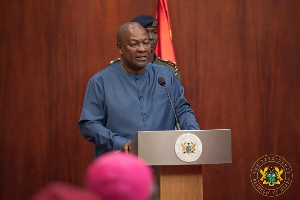
 President John Dramani Mahama
I have watched the recent report presentation and read the summary text of the conclusions of the Professor H. Kwesi Prempeh led Constitutional Review Committee's work, and while I commend their efforts, I am a bit disappointed with some of the issues it chose to deal with out of the myriads of constitutional issues agitating the minds of Ghanaians, and the conclusions it arrived at on some.
Today, I would like to address my concerns about what to me is the huge elephant in the room, the presidential term limit matter.
The debate over presidential term limits is healthy for any constitutional democracy, but it must ultimately be resolved by strict fidelity to the text of the Constitution itself and the fundamental rights it guarantees.
Article 66 of Ghana’s 1992 Constitution sets out the qualifications and limits for the office of President. The central question is not one of political convenience or speculative intent, but whether the Constitution explicitly disqualifies a former President who has served two non-consecutive terms from seeking election again.
A careful and principled reading of Article 66, supported by constitutional doctrine and Ghanaian jurisprudence, leads to one compelling conclusion only: that a former President who has served two terms, separated by time out of office, is not constitutionally barred from standing for election again.
The Text of the Constitution Must Prevail
Article 66(2) provides simply:
“A person shall not be elected to hold office as President of Ghana for more than two terms.”
Critically, the Constitution does not state: “two terms in total,” “two terms whether consecutive or not,” or “two lifetime terms.”
Constitutional interpretation begins with the text. Where the framers intended to impose absolute or lifetime prohibitions, they have done so expressly in other constitutional contexts. The absence of clarifying language in Article 66(2) is not accidental; it reflects a deliberate and intentional choice to limit continuous tenure, not political participation after a break in service.
Established principles of constitutional interpretation forbids courts and administrative bodies from supplying omissions or enlarging restrictions beyond the text adopted by the people.
Hence, courts do not supply words the Constitution does not contain. To read an implied lifetime ban into Article 66(2) is to amend the Constitution by interpretation rather than by law.
Non-Consecutive Terms Do Not Breach the Two-Term Limit.
Now let's dive in with an open mind and no political colours, pure law. A president who has served two terms, stepped aside or been defeated in between, and later seeks election again has not exceeded the constitutional ceiling at the time of election. At the point of contesting, that person has served two terms no more.
This is because the above constitutional prohibition is against being elected for more than two terms, not against having previously served two terms at any point in history. The distinction is fundamental. A return to office after a hiatus does not retroactively transform prior service into a third term; it initiates a new electoral mandate based on the sovereign will of the people.
That person may be called a three-time president, but NOT a three-term president.
In law, especially constitutional law, “term” and “time in office” are related but not identical concepts. For example, what's a three-time president?
It means a person has been president on three separate occasions, regardless of how long each occasion lasted or whether they were consecutive.
Each time refers to an instance of holding the office, even if briefly. A partial or interrupted presidency can still count as a “time.”
Now, let's look carefully at what a term-presidency is. For example, a three-term president.
This means a person has served three full presidential terms as defined by the law (for example, a 4-year term as in the 1992 constitution of Ghana).
A term is a legally defined period.
Serving less than a full term may not count as a term, depending on the law. (This is why President John D. Mahama, having finished off the Professor Mills term, was cleared by our very constitution to do he, John's own first full term at the time).
This key distinction matters because someone could be a three-time president BUT NOT a three-term president if:
They served non-consecutive terms, or served partial terms that don’t legally count as full terms.
That person; was president three times but only served two full terms.
Key legal takeaway for the lay Ghanaian radio commentator unbeknown to the law is that,
“Time” equals how many separate occasions the office was held, while “Term” equals how many full, legally defined periods were served.
This distinction is very important in term-limit laws, eligibility rules, and constitutional interpretation.
Political Rights Must Be Interpreted Broadly, Not Narrowly
Article 42 of the Constitution guarantees the right of every qualified citizen to vote and be voted for. The Supreme Court has repeatedly held that limitations on political rights must be intentional, clear, and unambiguous.
As noted by the Court in Abu Ramadan v. Electoral Commission, it is clear that restrictions on constitutional rights cannot be implied or inferred by speculation. Where the constitution intends to disqualify a citizen from political participation, it says so plainly without a contradiction.
Therefore, interpreting Article 66(2) as a lifetime ban is not only mischievous but violates this settled principle of law by imposing a restriction that is neither expressed nor necessary.
Purposive Interpretation Does Not Support Disqualification
Opponents have argued that term limits exist to prevent the concentration of power. That principle is valid, but already fully satisfied by limiting CONSECUTIVE TERMS.
Once a President leaves office after a term, the risk of entrenched incumbency disappears. Institutions are reset, successors govern, and democratic alternation would have occurred.
Allowing a former President to return after an interval does not undermine democracy; it enhances it by respecting voter choice. The electorate is not compelled to elect anyone; it merely retains the option to do so. However, democracy is weakened, not strengthened, when voters are told out of fear or dislike by some for a particular possible candidate that a qualified candidate is forbidden, despite the absence of a clearly determined constitutional bar.
Comparative Practice Cannot Override Ghana’s Constitution
Comparisons with countries like Kenya, Nigeria, or Liberia are intellectually interesting but legally irrelevant. Ghana’s Constitution stands on its own text, structure, and history, which the framers carefully took into consideration. Some constitutions explicitly prohibit lifetime service, but Ghana’s does not.
Indeed, it is acknowledged that other constitutions that intend to impose total limits do so expressly. The fact that Ghana’s framers chose not to adopt similar wording is powerful evidence that no absolute bar was intended.
Foreign constitutional practices cannot be used to insert or imply any prohibitions absent from Ghana’s supreme law.
The “Alternating Presidency” Argument Is very Speculative and Unsound.
The claim that permitting re-election could allow indefinite alternation is hypothetical and legally irrelevant. Constitutional interpretation is not based on the fear of imagined abuse but on the actual text adopted by the people.
Moreover, elections themselves are the ultimate safeguard. No individual can return to office without securing a fresh democratic mandate. The Constitution trusts the Ghanaian electorate, and so should its interpreters.
Absence of Judicial Authority Is Decisive.
There is no Supreme Court decision holding that a former two-term President is ineligible to run again. In constitutional law, silence is not prohibition. Until the Court rules otherwise or the constitution is amended eligibility remains intact.
Legal certainty demands restraint. Disqualification without express authority in the constitution would itself be a rule by mob sentiments, which is very unconstitutional.
Conclusion
The Constitution of Ghana does not impose a lifetime ban on presidential service. Article 66(2) limits continuous tenure, not democratic choice. Any attempt to bar a former President from standing again after non-consecutive terms relies on implication, speculation, and policy preference not constitutional command.
The strongest constitutional position, grounded in text, rights, and precedent, is clear: a former President who has served two non-consecutive terms remains eligible to stand for election again, and the final decision properly speaking, belongs to the Ghanaian people at the ballot box, not to persons fuming with conjectural interpretations of silence in the Constitution.
Therefore, the question that should have been asked by the Constitutional Review Committee in the light of this article 66 furore, which it failed to ask is, did the framers of our 1992 constitution intend there to be any limitations on presidential terms?
If so, why did they not expressly say that. If it was a mistake on their part to so do, and not a self-created confusion by some of us, then until that mistake is cured by an express insertion of defined limitations, the rule in Abu Ramadan stands as our guiding principle.
Hence, there is no such intention of a limitation in our constitution as it stands, and it must not be turned into a moral chamber of implied wishful aspirations bereft of any legal backbone from the constitution to create any needless tension in the country.
It is therefore, to my mind, quite unimpressive for the Constitutional Review Committee to have, knowing this lacuna, concluded categorically that it did not see this, because the sitting president had not talked about a third term bid and that Ghanaians did not seem to have an appetite for a third term presidency, instead of itself going into the matter legally and finding a lasting solution to this glaring issue agitating the minds of some citizens regarding article 66 of the constitution that needs testing or fixing.
The matter is bigger than the singular present wish of the man in the ring, that is, the sitting president, or what Ghanaian appetite is for at the moment. It is a legal vacuum that needs urgent resolution in the constitution.
After all, what if a later president develops the appetite or Ghanaians in the near future aspire to that position. Do we at that stage, then decide to tweak the constitution again. This is a vital issue at this point in time of our constitutional development that needed the attention of the committee than any other, if you asked me.
They have, by that conclusion entrenched the layman's position on the matter that pertains currently among some Ghanaians without any legal basis from the constitution.
Threats of a potential third-time bid causing mayhem and the spread of fear from history do not amount to law. If the mood is indeed against it as those people think, then as per the guiding principle in Abu Ramadan, let's bring constitutional clarity to the matter once and for all by expressly inserting a definite limitation, clear enough to stop any adventure of the sort. It is not a matter to be left to the whims or appetite of the man in the ring to so decide.
That for me, is where the Constitutional Review Committee let Ghanaians down.

Copyright © 1994 - 2026 GhanaWeb. All rights reserved.










