



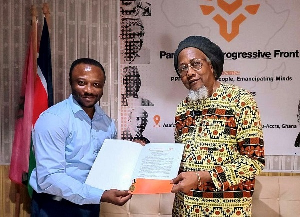
 The interview took place at the headquarters of the Pan-African Progressive Front
There are interviews that inform, and there are interviews that awaken something deeper. Speaking with Prof Kimani Nehusi was the latter.
Rather than revisiting history as memory, in the interview with Prof Kimani Nehusi, he approached reparations as an unresolved political question. At its core was a direct challenge to the imperial order that profited from forceful enslavement and colonialism and continues to resist accountability. From the outset, the discussion positioned reparations not as reflection or symbolism, but as an active struggle over power, history, and responsibility.
A historian by discipline, a Pan-Africanist by conviction, and a diasporan with ancestral roots in Ghana, Prof Nehusi spoke of reparations as one speaks of unfinished business. Calm, but uncompromising, he rejected the language of apology without action. “Reparations,” he explained, “is about accounting for stolen time, stolen lives, and stolen futures.”
The interview took place at the headquarters of the Pan-African Progressive Front and was jointly conducted by its Directorate of Public Affairs and members of the Reparations Research Team, with active participation from PPF blogger Sumaila Mohammed. What unfolded was more than a conversation. It was a moment of history, power, and responsibility, clarifying the urgent transformations required to confront the crimes of slavery, colonialism, and their enduring consequences.
“The notion of reparations,” Prof Nehusi stated, “is that we must repair ourselves. We must repair the injuries that colonialism imposed on us.” Central to those injuries, he emphasised, is the deliberate destruction of African historical consciousness. “Part of that injury is the loss of history,” he noted, “and when you lose history, you lose identity.”
He explained that denying African people knowledge of who they are, where they come from, and what they have contributed to humanity was not accidental. It was a political act. The result, he argued, is not only historical ignorance but a profound erosion of self-worth, direction, and collective confidence.
This historical dispossession feeds directly into another major injury: what Prof Nehusi described as the inhalation of African culture. Colonial domination did not only extract labour and resources. It actively suppressed African languages, belief systems, social structures, and ways of being, replacing them with foreign values designed to legitimise domination. Over time, Africans were forced to breathe in imposed norms and standards that reshaped how progress, beauty, intelligence, and success are defined.
“When a people inhale another people’s culture,” he stressed, “they begin to see the world through someone else’s eyes.” Reparations, therefore, must include the conscious decolonisation of the African mind.
The conversation moved fluidly between past and present. Prof. Nehusi traced a direct line from enslavement and colonial extraction to the contemporary global economic order. Africa’s marginalisation, he insisted, was not accidental or natural. It was engineered.
“Africans are largely unaware of our own history,” he stated. “Many of our people do not know Africa’s history because colonisation made sure of that. Correcting this false narrative is not optional. It is a core component of reparations.”
On the question of African and diasporan unity, Prof Nehusi was unequivocal. The separation, he argued, is artificial. The diaspora is Africa extended, shaped by forced displacement but bound by the same historical wound. Unity, however, does not emerge spontaneously. “Unity must be organised,” he warned. “Without organisation, movements collapse. Without political vision, struggles fade.”
He detailed the challenges confronting Africans in the diaspora, including legal barriers, economic precarity, and political hostility within imperial states. “Legally, some Africans in the diaspora have already attempted to pursue reparations,” he observed. “But you cannot take your case to the devil’s court and expect justice.”
Despite these contradictions, diasporan communities continue to organise, educate, and mobilise, often with limited resources and minimal institutional support. Through intellectual production, political advocacy, and grassroots organising, they refuse to allow distance from the continent to become political disconnection. Yet fragmentation remains a persistent challenge, reinforced by borders, legal statuses, and imposed identities.
It is within this context that the role of the Pan-African Progressive Front becomes critical. Prof Nehusi spoke positively of PPF’s growing role as a serious political platform advancing reparations through research, political education, and Pan-African coordination. In his view, PPF represents the kind of institutional discipline and ideological clarity the reparations movement urgently requires.
“Reparations will not come through moral appeals alone,” he emphasised. “They require data, political education, organisation, and ideological clarity.” PPF’s work, he noted, is helping to shift reparations from sentiment to strategy, from rhetoric to political demand.
Addressing African governments directly, Prof Nehusi urged continental leadership to take decisive legal and political steps. “I would urge African states to follow the example set by Algeria,” he stated, “by formally and legally recognising slavery and colonialism as crimes against humanity.” Such recognition, he argued, lays the foundation for international accountability, restitution, and redress.
The interview closed not with hope as sentiment, but hope as responsibility. Reparations, Prof Nehusi reminded us, is not about dwelling in pain. It is about reclaiming power. And power, once organised, reshapes history.
Meanwhile, the interview was also marked by a symbolic ending, as Prof Kimani was honoured with the Ambassador of Pan-Africanism Medal, a signed copy of Kwesi Pratt Jnr’s ‘Reparations’ book and presented with the two landmark declarations adopted during the International Conference of Pan-African Progressive Forces held in Accra last November. A moment of immense solidarity and hope.
“A new Africa is not possible without new Africans,” he concluded. “We must transform ourselves.” In that call lies the revolutionary task of reparations: to repair history, reclaim consciousness, and reorganise African power across the continent and its diaspora.

Copyright © 1994 - 2026 GhanaWeb. All rights reserved.










