



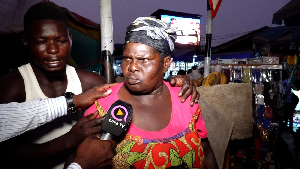
 Julie Adom, trader expressing her frustration
Women and children are increasingly bearing the brunt of Ghana’s worsening transport crisis, as chaotic scenes at major lorry stations continue to disrupt daily life, expose vulnerable commuters to danger, and reduce productivity across the country.
At the Kwame Nkrumah Circle—one of Accra’s busiest transport hubs—the daily search for public transport has become a contest of physical strength.
Women, children, and the elderly are often left at a disadvantage.
At the footbridge loading stop near Circle Ebony, orderly queues quickly degenerate into disorder whenever a vehicle arrives, with boarding determined not by fairness but by force.
Atinka TV’s Ebenezer Madugu, reporting live from the scene, witnessed a heated confrontation between a male passenger and a woman who had been patiently waiting in line.
“He pushed me off the line and I couldn’t enter the bus. Another person took the seat. He wanted to overtake me.
If you, Michel Ofori, try it, I will slap you,” the woman, identified as Maa Agnes, told Madugu in distress.
An eyewitness, Kwaku Pastor, a loading assistant at the station, said the incident reflects a growing pattern of abuse against women amid the transport shortage.
“The man thought the woman couldn’t fight him. He thought she was weak and wanted to bully her. But the woman also pushed him to stop him from entering. In the end, they both couldn’t go because they started fighting,” he explained.
He appealed to authorities to intervene urgently.
“We beg the government to do something about this. There are very few vehicles in town.”
Beyond physical confrontations, the crisis is taking a heavy toll on family life and health, particularly for working mothers.
Madam Adelaide Boateng, who had been stranded with her school-going son for over an hour, described the daily strain.
“We usually get home after 10 p.m. and wake up at 4 a.m. I hardly make time for his sister these days. I am really struggling,” she lamented.
She made a direct appeal to government.
“I am begging the government to quickly fix the broken Ayalolo and Metro Mass buses to end these challenges. We beg him President Mahama.”
Nearby, trader Julie Adom, who had just closed from selling buff loaf and was carrying leftover goods in a sieve, stood helplessly as vehicles arrived and departed without her.
“I have been here for over 30 minutes. I believe I will get one later, though I am in a hurry,” she said quietly.
When asked why she was not attempting to board when vehicles arrived, her response captured the silent suffering of many women.
“I don’t have the strength, and I’m carrying a load. If it pours onto the ground, I’m finished,” she said emotionally.
As transport shortages persist, workers across Accra and other major cities are returning home late, waking up exhausted and risking long term health consequences.
For women especially traders, mothers and caregivers the crisis is no longer just about delayed journeys. It is about daily humiliation, physical danger and the erosion of dignity.
At Kwame Nkrumah Circle, the message from commuters is clear: until public transport systems such as Ayalolo and Metro Mass Transit are restored and expanded, the daily struggle on Ghana’s roads will continue with women paying the highest price.

Copyright © 1994 - 2026 GhanaWeb. All rights reserved.










