



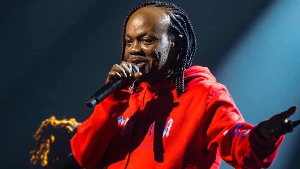
 Daddy Lumba was buried on December 13, 2025
Customary Law, Authority, and the Absence of Any Vista for Paakoso
The death of a public figure often brings buried legal questions to the surface.
When the individual is both a national icon and a native of a particular town, the intersection of grief, tradition, and authority can become contested.
The burial dispute surrounding the late highlife legend Daddy Lumba illustrates this tension vividly.
At its core lies a single, decisive question: who, under Ghanaian customary law, has the right to bury the dead?
The public debate intensified when the chief and youth of Paakoso, the hometown of the late musician, demanded that his body be released for burial on ancestral land.
While emotionally resonant, this demand exposed a widespread misunderstanding of customary jurisprudence.
To state the matter clearly and without equivocation: the Paakoso chief has no vista, no jurisdiction, no customary mandate, and no legal standing to demand Daddy Lumba’s body.
Customary Jurisprudence and the Authority of the Family - Under Akan customary law, as recognised and enforced by Ghana’s courts, the burial of a deceased person is a family matter.
Authority over the body vests exclusively in the family, exercised through the Abusuapanin (family head).
This authority is substantive and settled, not symbolic or negotiable.
The family head may consult elders, seek consensus among family members, or engage traditional authorities as a matter of harmony and respect.
However, consultation does not transfer jurisdiction.
The ultimate decision regarding burial - location, rites, and timing- rests with the family head alone.
The Limits of Chieftaincy Authority - Though Chieftaincy remains a vital institution within Ghana’s traditional governance, its authority is not without boundaries.
Chiefs are custodians of land, customs, and communal cohesion; they are not custodians of the bodies of deceased subjects.
A town’s historical or ancestral connection to a deceased person does not override family jurisdiction.
At most, a chief may request that burial take place on ancestral land or offer to host funeral rites.
Such requests carry cultural weight but no legal force.
A demand, by contrast, presupposes enforceable authority, and in burial matters, no such authority resides in the stool.
Accordingly, the insistence by Paakoso’s chief or youth groups that Daddy Lumba’s body must be surrendered for burial in the town falls outside both customary and statutory law.
Judicial Position and Legal Reinforcement - The courts’ involvement in the dispute did not create new law; it reaffirmed existing principles. By dismissing applications that sought to restrain the family from proceeding with funeral arrangements, the court implicitly recognised the primacy of the family’s authority.
While disputes regarding marital status or succession may continue under statutory law, such disputes do not transfer burial jurisdiction to a town, a chief, or any non-family authority.
Tradition, Sentiment, and Legal Order - Though “Public” affection for Daddy Lumba is undeniable, and Paakoso’s sense of loss is genuine. Yet customary law does not bend to sentiment. Ghana’s traditional legal system survives precisely because it distinguishes between honour and authority, between respect and jurisdiction.
To allow chiefs or communities to claim burial rights through public pressure would erode the foundations of family law and destabilise long-settled customary practice.
In conclusion, the question “Who has the right to bury the dead?” admits a clear answer under Ghanaian customary jurisprudence. The right lies with the family, exercised through the family head. Chiefs may honour, communities may mourn, but they cannot demand.
Thus, the conclusion stands firm and unambiguous: Paakoso has no vista to demand Daddy Lumba’s body.
The authority to decide rests solely with the family, and any contrary claim reflects a misunderstanding, not an evolution, but of customary law.

Copyright © 1994 - 2026 GhanaWeb. All rights reserved.










