



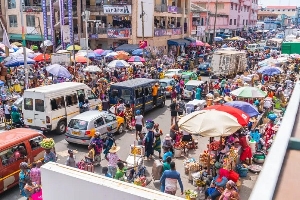
 Overview of the Makola market
The humid air hung heavy, thick with the scent of exhaust fumes and damp earth.
Standing in Accra's bustling Makola Market, I could almost taste the grit in the air, a metallic tang mingling with the sweet, cloying perfume of overripe mangoes.
The sight of the vibrant kente cloths, a kaleidoscope of reds, yellows, and greens, initially overwhelmed me.
Vendors, their faces etched with the daily hustle, hawked their wares with a rhythmic chant, their voices rising and falling, a cacophony that both sounded chaotic and resonated with a deep-seated entrepreneurial spirit.
The journey to developed nation status is rarely a sprint; it's a marathon often requiring consistent vision, unwavering commitment, and, crucially, sufficient time for leaders to implement transformative policies.
History is replete with examples of leaders whose extended tenures allowed them to reshape their nations, lifting them from poverty and obscurity to prosperity and prominence.
However, the question of extending term limits is a complex and often controversial one, particularly in democracies where the principles of regular elections and peaceful transitions of power are paramount.
Consider Lee Kuan Yew, the founding father of Singapore.
He led the nation for over three decades, a period long enough to meticulously cultivate a thriving economy focused on education, industry, and a stringent rule of law.
His leadership transformed Singapore from a developing port city into a global economic powerhouse, evidence of the power of sustained vision.
In stark contrast, Ghana's early trajectory highlights the potential consequences of interrupted leadership.
At independence in 1957, Ghana, under Osagyefo Kwame Nkrumah, possessed significantly greater economic potential than Singapore.
With a GDP per capita of around $857, it ranked as Africa's third-richest nation.
Singapore, in comparison, lagged far behind at approximately $428 in the early 1960s.
Sadly, Nkrumah's overthrow in a coup d'état abruptly halted the progress Ghana was making.
The parallel trajectories of Ghana and Malaysia offer another compelling case study.
Both nations gained independence in 1957 and initially mirrored each other economically.
Tunku Abdul Rahman, Malaysia's first Prime Minister, served for approximately 15 years, laying the foundation for the country's sustained growth.
Today, Malaysia's per capita income is over ten times that of Ghana, a stark difference attributed in part to the curtailed tenure of Ghana's first president, Osagyefo Kwame Nkrumah.
Across continents, Deng Xiaoping in China demonstrated the transformative power of long-term leadership.
As the paramount leader from the late 1970s to the early 1990s, his "reform and opening-up" policies triggered an unprecedented economic boom, lifting hundreds of millions out of poverty and reshaping China's global standing.
These examples, while varied, highlight a common thread: the crucial role of sustained leadership in implementing long-term development strategies.
This brings us to the current debate in Ghana surrounding President John Dramani Mahama.
Proponents argue that his reported economic achievements in a single year, including elevating Ghana from the 11th to the 8th largest economy in Africa within just a year, warrant a constitutional amendment to allow him to run for another term if he can sustain his performance by the end of his tenure on January 7, 2029.
While such suggestions are met with resistance, labeled as sycophantic by some, they raise a fundamental question about the delicate balance between democratic principles and the potential benefits of extended leadership.
If President Mahama can maintain his momentum and deliver significant improvements to the lives of ordinary Ghanaians over the next three years, the argument for reconsidering term limits might gain traction.
Ultimately, the decision rests on a careful evaluation of his performance, a robust public debate, and a commitment to upholding the democratic values that are essential for Ghana's long-term progress.
The key is to ensure that any consideration of extending term limits is driven by genuine national interest and not by the self-serving motives of a few.
For me, the argument for extending President Mahama's term, after a four-year economic transformation smells of hope, and if he can truly transform Ghana, if I can taste the tangible fruits of his policies, if I can see and touch the tangible improvements in the lives of ordinary Ghanaians, then perhaps, just perhaps, I too would be willing to join the chorus advocating for one more term.
For now, the air sounds with hope mixed with cautious skepticism, a delicate balance that only time will resolve.
I can only hope the sweet scent of success will eventually replace the bitter taste of disappointment.

Copyright © 1994 - 2026 GhanaWeb. All rights reserved.










