



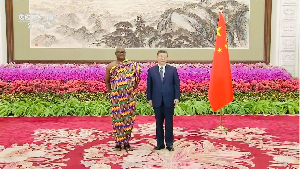
 Ambassador Kojo Bonsu with Chinese President Xi Jinping
In the solemn halls of the Chinese Presidency, far from the noise of political rallies and public commentary, Ambassador Kojo Bonsu, Ghana’s envoy to the People’s Republic of China, performed a ceremonial act with strategic consequences—presenting his Letters of Credence to President Xi Jinping.
But this was not merely a diplomatic formality. It was a quiet signal—one that suggests Ghana may be preparing to reset its economic posture, its production philosophy, and its global partnerships.
As Ghana contemplates a second era under President John Dramani Mahama, the idea of a 24-Hour Economy has emerged not as a slogan, but as a structural ambition: continuous production, uninterrupted logistics, export-driven industrialisation, and jobs that do not sleep.
Such an economy cannot be built solely on speeches. It must be engineered—deliberately, globally, and strategically.
Behind closed doors, Ambassador Bonsu’s engagement with President Xi marked the first diplomatic bridge in that engineering process. China’s development story—rooted in manufacturing depth, infrastructure speed, industrial parks, special economic zones, and night-time economies—offers lessons Ghana cannot afford to ignore.
This meeting signals an intention to learn, adapt, and localise those lessons within Ghana’s own sociocultural and economic realities.
Resetting Ghana, therefore, is not confined to domestic reforms. It extends to economic diplomacy—to how Ghana positions itself in Beijing, how it negotiates technology transfer, how it secures industrial partnerships, and how it aligns foreign relationships with national productivity goals.
This moment in Beijing reminds us of a central truth: nations that succeed do not merely trade; they strategise. They not only attend ceremonies; they prepare futures.
If Ghana’s 24-Hour Economy is to transition from vision to viability, it will require more such quiet meetings, fewer loud promises, and a foreign policy that understands one thing clearly—development is a deliberate process.
Nations are reset not by rhetoric, but by the quiet discipline of strategic choices.
This is the appointment that begins the "Game Changing" era for H E John Dramani Mahama.

Copyright © 1994 - 2026 GhanaWeb. All rights reserved.










