



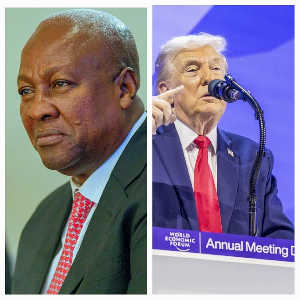
 President John Dramani Mahama and US President Donald Trump
When Western political elites responded with conspicuous indignation to Donald Trump’s renewed speculation about the United States “taking over” Greenland, the reaction followed a familiar moral script. Commentators invoked the inviolability of sovereignty, European officials gestured toward international law, and imperial ambition was denounced as a relic incompatible with the modern international order. What was being defended was not merely territory, but a normative self-image in which domination is presumed to have been transcended.
Across much of Africa, the response was neither dramatic nor surprised. It was informed by historical experience. While territorial conquest has become rhetorically unacceptable within Western political discourse, economic domination has not only persisted but has been normalised, routinised, and stripped of its moral urgency.
Africa has lived under this regime for decades, largely without the outrage now mobilised in defence of Greenland. What rendered Trump’s remarks offensive to Western sensibilities was not the logic of domination itself but its unembellished articulation.
Contemporary power rarely announces itself in the language of annexation. It operates instead through the quieter instruments of debt, trade regimes, monetary arrangements, and contractual architectures that shape national trajectories while preserving the formal appearance of sovereignty. Africa is intimately familiar with this modality of power.
No flags are planted, and no borders formally redrawn, yet economic policy space is persistently constrained by institutions and agreements conceived far from African capitals. The result is sovereignty as a legal form coexisting with dependency as a material reality. This is not the dissolution of empire, but its reconfiguration, imperial authority exercised without occupation.
It was this condition that Ghana’s president, John Dramani Mahama, confronted at the 2026 World Economic Forum in Davos through what he termed the Accra Reset. His intervention departed sharply from the language of aid and benevolence that often frames Africa’s engagement with global economic forums. It was neither a plea for charity nor a performance of grievance, but a normative challenge to the architecture of the global political economy itself.
Africa, Mahama argued, does not suffer from a deficit of assistance but from a deficit of agency. He identified a persistent “triple dependency” in which African states remain reliant on external actors for security, health systems, and education, even as their economies continue to export raw materials and import finished goods. Significantly, this condition was not reduced to failures of domestic governance alone. It was situated within a global system structurally constructed to reproduce African subordination.
For Ghana, the implications of this diagnosis are profoundly political. The Accra Reset signals a deliberate departure from austerity-centred orthodoxy toward a model that privileges state-led industrialisation, regional value chains anchored in the African Continental Free Trade Area, and the renegotiation of external partnerships on more symmetrical terms.
Grounded in the legitimacy of the 2024 electoral mandate and oriented toward a 2028 continental horizon, the initiative positions Ghana not merely as a reforming economy but as a potential norm-setter within an increasingly assertive Africa.
The historical roots of this posture are neither abstract nor rhetorical. From the 1980s forward, International Monetary Fund and World Bank structural adjustment programmes reconstituted Ghana and much of Africa under the banner of reform.
Governments confronting acute fiscal crises were compelled to slash public expenditure, privatise state assets, and liberalise markets as conditions for financial survival. These transformations were not the product of democratic deliberation; they were imposed under conditions of extreme asymmetry.
While no territory was seized, economic sovereignty was effectively suspended. Public services deteriorated, industrial ambition narrowed, and dependency deepened. What emerged was a form of governance without representation, imperial authority exercised without ballots, accountability, or consent.
The persistence of this condition is visible in contemporary monetary and resource regimes. Across parts of West Africa, the continued use of the CFA franc, a colonial-era currency tethered to European monetary policy, stands as a stark symbol of incomplete independence. Even outside the CFA zone, Ghana’s experience of commodity dependence reproduces familiar asymmetries. Gold, oil, and cocoa generate substantial wealth, yet the greater share of value remains unprocessed, externalised, and captured abroad.
Extraction contracts continue to privilege foreign capital, while domestic linkages remain thin and underdeveloped. What Western discourse routinely celebrates as investment is, from an African political economy perspective, experienced as extraction by other means.
China’s expanding role on the continent further complicates this terrain, and Ghana’s leadership has approached this engagement with notable sobriety. Chinese-financed infrastructure has delivered tangible assets while simultaneously raising legitimate concerns about debt sustainability.
Mahama’s position rejects the seduction of false binaries. The question is not whether Africa should align with China or the West, but whether it should continue to accept a system in which it is expected to take terms rather than set them.
Western influence is framed as “rules-based,” Chinese engagement as “neo-colonial,” yet from the vantage point of Ghana and much of the Global South, the distinction matters less than a more fundamental concern: who exercises control over development choices.
The moral favour surrounding Greenland thus exposes a hierarchy long understood in the Global South. Sovereignty is fiercely defended when Western territories are involved; it becomes negotiable when African economies are disciplined through debt, currencies, and contracts. The Accra Reset confronts this hierarchy without recourse to antagonism. It is not anti-Western; it is post-deferential.
As Ghana looks beyond 2024 toward 2028 and beyond, the central question is no longer whether Africa will be included in the global system, but whether it will continue to operate under rules it did not author. Africa does not require new guardians or benevolent overseers. It requires the freedom to decide, economically, politically, and unapologetically.

Copyright © 1994 - 2026 GhanaWeb. All rights reserved.










