



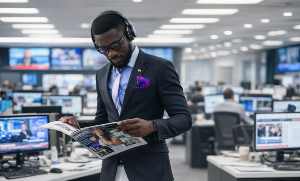
 Maxwell Nkansah is the author of this article
I became a journalist because I believed in telling the African story as it is and in holding power to account. Fresh out of journalism school and working with a major multimedia company, I thought passion and integrity were enough. I was wrong.
One morning, I received a call that shook me: National Security was looking for me. No explanation—just an instruction to show up.
Fear set in immediately. I went straight to Santo, then the General Manager of the Multimedia Group, and told him what had happened.
I genuinely had no idea what I was being accused of. He took the call seriously and arranged for his personal driver to take me directly to National Security.
Before reporting there, I met investigative journalist Manasseh Azuri at the University of Ghana. I told him everything I knew—or thought I knew—about why National Security might be after me.
At the time, sensitive information was circulating, and I was suspected of having knowledge connected to Samira Bawumia, the former Second Lady of the Republic of Ghana. Manasseh told me to go and assured me he would be monitoring the situation. I also informed my colleague, Joseph Gakpo. Two journalists knew exactly where I was headed.
At the National Security yard at Blue Gate, behind the Conference Centre, my phone and personal belongings were taken from me. Upstairs, I met a senior official whose name I still remember but choose not to mention.
He questioned me aggressively. I denied the accusations until he produced emails I had sent to someone named Steven, who was connected to a person studying in Italy. National Security had tapped our communications.
They tracked my calls, including conversations with people in my village. They threatened to fly Steven back to Ghana if I continued to deny what they already knew.
Eventually, I admitted to sending the email.
That was when things escalated.
They strapped me to a lie detector. I was handcuffed behind my back. Two large officers slapped me repeatedly. When I demanded a lawyer, they refused. They accused me of being paid by political opponents to tarnish the image of the country’s leadership. They threatened me with prison.
Then they went further, telling me they could kill me and no one would ever hear about it because they were National Security.
For nearly two weeks, I lived under their control. I was forced to report to the facility every morning and allowed to leave only at 6 p.m., often without food. I was kept in a freezing, air-conditioned room where the temperature could not be adjusted.
The intimidation and physical abuse continued. I knew my phone was tapped. Every call I made was monitored.
After one of the sessions, I contacted a human rights lawyer, Lawyer Sasu, and told him everything. He was stunned. He warned that if the abuse continued, he would write publicly about it and expose what was happening. That support mattered.
Still, the fear didn’t end. On my way home one evening, I noticed a motorbike following me. As a journalist familiar with surveillance tactics, I knew what it meant. The following continued. Manasseh Azuri and Joseph Gakpo checked on me constantly, making sure I was still safe.
I told my father what was happening. He asked me to return to the village for safety. I refused. This was my fight. Journalism is my calling, and I decided then that I would never stop telling the truth, no matter the cost.
I know who went to National Security to have me confess. I choose not to mention his name in this story for safety reasons. Naming names in this story could amount to a death sentence. I have seen it happen.
Even a personal assistant connected to this case resigned because of threats and security risks.
This experience taught me something brutal but important: journalism in Ghana—and across Africa—is dangerous work.
Many journalists have suffered quietly at the hands of state power. Kidnappings, intimidation, beatings, and threats are more common than the public knows.
Yet I, Maxwell Nkansah, still believe in the mission. Journalists are the fourth estate. We exist to protect the public purse, to watch those in power, and to confront corruption head-on. Politicians will always try to silence scrutiny. Our duty is to refuse.
I fear for my life sometimes, but my passion for journalism only grows stronger. We live to tell the story—and if it comes to it, we die for the truth.

Copyright © 1994 - 2026 GhanaWeb. All rights reserved.










