



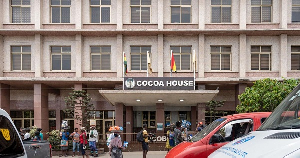
 A photo of the COCOBOD Heaquarters in Accra
The Claim That Must Be Debunked
The assertion by the current Chief Executive of Ghana Cocoa Board that COCOBOD’s inability to pay Licensed Buying Companies (LBCs) is because the Board defaulted on syndicated loans during the previous NPP administration is false. Let this be stated plainly and unequivocally:
Ghana Cocoa Board has never defaulted on any syndicated loan. Ever.
This is a matter of record in international financial markets and among the global banks that have participated in COCOBOD’s cocoa financing for decades.
COCOBOD’s Syndicated Loans: The Hard Facts
For over 30 years:
• Every syndicated loan raised by COCOBOD was fully repaid
• Many were repaid ahead of schedule
• All were self-liquidating, repaid from cocoa export proceeds, not from the national budget
No bank has ever declared COCOBOD in default and no syndicated loan facility has ever gone unpaid
So the claim that a past default explains today’s failure to pay LBCs is factually incorrect.
NPP’s Record on Cocoa Production: Transformation, Not Talk
When the NPP took office in 2001, Ghana’s cocoa production stood at about 330,000 metric tonnes.
Through deliberate policy reforms and investment under President J.A. Kufuor, cocoa production more than doubled rising to over 700,000 metric tonnes
This was not accidental. It was the result of structured interventions, incentives to farmers, and institutional reform.
The Strategic Leap to 1 Million Tonnes: 2007-2012
In 2007, COCOBOD, under the management team leadership of Hon. Isaac Osei, developed and implemented a five-year strategic plan aimed at reaching 1.0 million metric tonnes. Fortunately for me, I was privileged to have been part of the Committee that worked on the strategic plan.
Key programmes improved, further resourced and included included:
• CODAPEC
• Cocoa Mass Spraying
• Distribution of improved Cocoa seedlings
• Cutting of overaged cocoa trees and replanting
The outcome? Ghana achieved 1.0 million metric tonnes in 2012
However, production later declined because the momentum of these programmes was not sustained.
NPP’s Breakthrough in Cocoa Financing
Beyond production, the NPP fundamentally restructured cocoa financing.
Around 2004, COCOBOD:
• Improved the structure of syndicated loans
• Introduced better production data
• Strengthened repayment certainty and transparency
The result was dramatic:
• Interest margins fell from about LIBOR + 5%
• To approximately LIBOR + 1.5%
This translated into hundreds of millions of dollars in savings over time - a proof that international markets trusted COCOBOD under NPP management.
Moving Beyond Syndicated Loans: A Strategic Shift
Understanding that syndicated loans were costly and externally dependent, the NPP pursued the following long-term structural solutions.
1. Ghana Commodities Exchange (GCX)
• Actively developed and approved in the 2019 Budget
• Designed to support local financing of commodity purchases, including cocoa
• Aimed at anchoring financing within Ghana’s financial system
2. The New Cocoa Financing Model
Under the Akufo-Addo administration, COCOBOD implemented a buyer-led, transaction-based trade finance model for cocoa purchases.
Key features:
• Departed from large syndicated loans
• Eliminated interest costs associated with cocoa purchases
• Reduced exposure to volatile international credit markets
This model was successfully implemented for the 2024/25 cocoa season.
So What Went Wrong Under the Current Management?
Given that there is a;
• Record global cocoa prices — peaking at over US$12,000 per metric tonne, the highest in history
• Tested interest-free financing model already in place
One would have expected a;
• Seamless continuation of cocoa purchases
• Prompt payment of LBCs
• Timely payment to farmers
Instead, we are witnessing:
• Non-payment of LBCs
• Farmers bearing the brunt
• An attempt to explain failure through false claims of past defaults
Clearly, this is a case of mismanagement, certainly grounded in political motivation of “resetting” a working cocoa financing solution.
Stop the Propaganda. Fix the Problem.
Blaming a fictional syndicated-loan default is not only inaccurate. it is also embarrassing.
The truth remains:
• COCOBOD did not default
• The NPP left behind workable financing structures
• The current crisis reflects execution failure, not inherited debt problems
The Way Forward: What the Chief Executive Should Focus On
Rather than rewriting history, the current Chief Executive should tighten and fully utilise the financing frameworks already available:
1. Ghana Commodities Exchange (GCX) Engage, consult with GCX and collaborate to scale its use to support local financing of cocoa purchases
2. Africa Cocoa Exchange (AfCX): COCOBOD was part of feasibility study involving Ghana, Côte d’Ivoire, Nigeria and Cameroon, and supported by the International Cocoa Organization (ICCO). This provides a long-term African solution for pricing, trading and financing cocoa
3. Improve the Existing New Financing Model Implemented By the Previous Administration: Do not reset it into failure. Avoid drifting back to the expensive syndicated loans. Collaborate with stakeholders to build the capacity of Ghana’s financial system to finance Ghana’s cocoa. As a basic capacity, Ghana’s financial system should be able to finance the country’s production.
Summarizing My Points:
1. The cocoa sector does not need excuses. It needs competence, continuity and credibility.
2. The NPP has demonstrated competencies in reforms in the cocoa sector aimed at both cocoa production and financing since the year 2000.
It is now the responsibility of the current NDC government and its COCOBOD management team to deliver, not to distort history and reset to failure, Ghana’s effort at cocoa sector reforms aimed at both production and financing.
#MEN@WORK

Copyright © 1994 - 2026 GhanaWeb. All rights reserved.










