



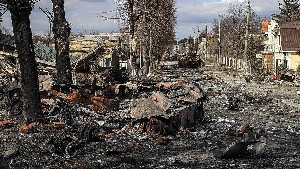
 Damages caused by the Russia-Ukraine war
As the fourth anniversary of Russia’s full-scale invasion of Ukraine approaches on 24 February, the conflict has hardened into a prolonged war of attrition with consequences stretching far beyond Europe — including across Africa.
What began in 2022 as a rapid military offensive has evolved into a grinding stalemate marked by slow territorial gains, mounting casualties, stalled diplomacy, and expanding geopolitical ripple effects.
A War Defined by Attrition
Four years into the conflict, frontlines remain largely static despite continued fighting. Russian forces currently occupy roughly 20 percent of Ukrainian territory — about 45,700 square miles — yet advances have slowed dramatically.
Analysts at the Center for Strategic and International Studies describe Russia’s progress in some sectors as advancing only 15 to 70 metres per day, among the slowest offensive rates recorded in modern warfare.
The human cost continues to escalate. Russian military casualties alone reportedly reached 31,700 in January 2026, while total combined losses on both sides are projected to approach two million by spring. Estimates suggest Russian casualties stand near 1.2 million, with Ukrainian losses between 500,000 and 600,000.
Military analysts now describe the conflict as entering “Phase Zero,” characterised not only by battlefield combat but also intensified cyberattacks, disinformation campaigns, and political interference beyond Ukraine’s borders.
Diplomacy Without Breakthroughs
Efforts to negotiate peace have repeatedly faltered. Following the election of U.S. President Donald Trump, Washington prioritised diplomacy, culminating in the August 2025 Alaska Summit between Trump and Russian President Vladimir Putin. The talks ended without agreement.
A proposed 28-point U.S. peace framework included controversial provisions such as a constitutional ban on Ukraine joining NATO and limits on the size of Ukraine’s armed forces, alongside territorial concessions to Russia. European allies rejected key elements of the proposal, deepening divisions among Western partners.
The latest negotiations, held in Abu Dhabi in February 2026, again failed to deliver progress after large-scale Russian strikes targeted Ukrainian energy infrastructure during the talks — reinforcing doubts about the prospects for a near-term settlement.
Africa Drawn into the Conflict
Beyond Europe, the war’s effects are increasingly felt across Africa, particularly through recruitment practices linked to Russia’s war effort.
Investigations by the research initiative All Eyes on Wagner identified at least 1,417 African recruits connected to Russian forces, with 316 reportedly killed in action. Reports indicate some men travelled to Russia for civilian employment but were later pressured or coerced into military service after promises of high salaries or fast-track citizenship.
African women have also been targeted through recruitment drives linked to drone production facilities in Russia’s AlabugaSpecial Economic Zone. Programmes marketed as work-study opportunities allegedly attracted young women aged 18–22 with promises of jobs in hospitality or education.
However, investigations cited by the Wall Street Journal and the Associated Press report that many recruits instead assembled Iranian-designed Shahed drones used in the war. Workers reportedly faced long hours, tight surveillance, restricted communication, exposure to harmful chemicals, and allegations of racism and harassment.
The facilities themselves have become military targets, with Ukrainian strikes already injuring foreign workers and damaging accommodation blocks — highlighting the risks faced by recruits far from the battlefield.
A Conflict with No Clear End
As the war enters its fifth year, neither decisive military victory nor diplomatic resolution appears imminent.
Instead, the conflict continues to reshape global security dynamics, strain international alliances, and draw in vulnerable populations far beyond Eastern Europe.
For Africa, the war is no longer a distant geopolitical contest but a conflict with direct human consequences — underscoring how modern wars increasingly extend beyond borders, economies, and continents.

Copyright © 1994 - 2026 GhanaWeb. All rights reserved.










