



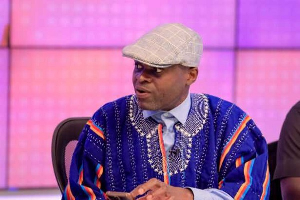
 Martin Kpebu is a private legal practitioner, human rights advocate, and public commentator
The legal profession in Ghana has long been regarded as a noble calling, one that "enjoins practitioners to uphold justice and safeguard the Republic."
It is a vocation that demands not only knowledge of the law but also the age-old values of honesty, integrity, and dedication to duty.
It is against this backdrop that we must examine the recent statements and conduct of private legal practitioner Martin Kpebu.
Following the Chief Justice's decison to throw out the petitions against the EC boss, her deputies and OSP for lack of prima facie establishment, Kpebu has reportedly declared that his faith "will be shaken" if his petition—seeking the removal of the Special Prosecutor—suffers the same fate as seven others recently dismissed by the Chief Justice.
The Presidency recently confirmed that Chief Justice Paul Baffoe-Bonnie ruled there was no prima facie case to warrant further action on petitions filed against the Electoral Commission Chairperson, her deputies, and the Special Prosecutor.
This declaration by Kpebu raises an unavoidable and troubling question: Is he genuinely suggesting that his petition contains substantially more compelling evidence than the seven others that have already been thrown out?
For if he is not making that claim, his threatened crisis of faith appears to be little more than emotional grandstanding.
But if he is making that claim, then we must confrontation its implications.
Kpebu cannot reasonably assert that he possesses greater legal insight or superior judgment than his seven colleagues, all of whom are presumably qualified and of good standing at the Bar.
The legal fraternity does not operate on a hierarchy of who deserves to be heard and who does not.
The Constitution provides clear mechanisms for assessing petitions, and those mechanisms have been applied uniformly.
What is particularly concerning is the pattern emerging around Kpebu's public conduct.
This is not the first time questions have been raised about his approach to legal advocacy.
When he previously claimed there were 16 petitions calling for the removal of the Special Prosecutor, he later admitted during an interview that he had merely repeated what he heard someone say on a talk show, "without verifying it."
The Office of the Special Prosecutor noted at the time that "it is concerning that a lawyer would make such a statement without checking the facts."
More recently, Kpebu was arrested following an incident at OSP premises where, according to official accounts, he "insulted the guards" and reportedly told security personnel that even "the head of the agency is nobody and will be removed soon."
Whether one accepts the OSP's version of events or Kpebu's counter-claim, the frequency of such confrontations suggests a pattern that does not reflect well on the profession.
The Attorney General and Minister for Justice, Dr Dominic Ayine, recently reminded the Ghana Bar Association that "lawyers must exercise restraint when engaging in political matters to protect the credibility of their profession" and that "allegiance should first be to the Constitution and the Republic, rather than to transient political interests."
This counsel applies with equal force to individual practitioners.
Kpebu would do well to remember that "the destiny of Ghana is tied to the integrity of our legal profession. If we stand firm, this republic will stand firm. If we falter, this republic will stumble."
By framing the dismissal of his petition as a test of his personal faith, he elevates his own case above both the law and the collective judgment of the institutions charged with interpreting it.
There is a time for vigorous advocacy and a time for dignified acceptance of legal outcomes.
By threatening a crisis of faith should his petition be dismissed, Kpebu not only undermines the very legal processes he has sworn to uphold but also does a disservice to the profession he represents.
It is time for Kpebu to demonstrate a greater level of humility and respect—both for his profession and for the institutions of state.
The law is not a game of personal vindication.
It is a sacred trust.
And those who hold it must hold themselves to a higher standard.

Copyright © 1994 - 2026 GhanaWeb. All rights reserved.










