



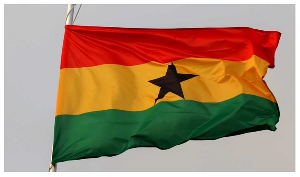
 File photo of the Ghana flag
Ghana must have a national language that is not English but one chosen from the numerous local languages spoken in the country.
It will not be hard at all when selecting a language for the country that will be spoken by all citizens at a point in time in the life of Ghana.
There is obviously one language that is currently spoken by more than 50% or half of the Ghanaian population.
This is an indisputable fact that only hardcore tribalists blinded by inferiority complex will dare deny.
There are more advantages than disadvantages when a Ghanaian language is chosen for the nation other than the until now accepted foreign English language.
When a local language is chosen, the identifiable tribal barriers that disunite Ghanaians will with time become a thing of the past, disappearing like the morning dew that evaporates with the rising sun.
For all these past years, tribalism has impeded the development and advancement of the nation.
Tribalism and ethnicity are retardants putting brakes on our politics and fight for national unity.
Most Ghanaians vote on tribal lines and for political parties and representatives because they belong to their tribe, region, religion or of same ethnic extraction. They don't consider the issue of meritocracy.
However, with one local language chosen and enforced on all, I hope by a hundred years time, there will not be that clear and easily identifiable barrier of categorising people into Akans, Ewes, Gas, Kusases, etc.
We shall all be known as Ghanaians, unified and pursuing a common development action as a nation.
There will be love among us but not hatred as it is currently.
Therefore, it is shortshighted on the part of the Cultural Minister to argue against choosing one local language as a national language for the country.
Her argument in favour of continuing to have all those many local languages for enhanced cultural diversity is to the writer completely myopic.
Our white contemporaries have developed far and beyond Africans because they have national languages for their various countries chosen from their previously likely many local languages.
That has brought unity among them for them to see themselves as one people with a common destiny.
Why can't we learn from their good examples to unite our people but allow tribalism and inferiority complexes to divide us to ruin our nation?
The fact the Akan language (Twi) is dominant should make it very easy in our search for selecting a national language if we chose to.
Whether we like it or not, Twi is dominating and should we select it for a national language, it will not make the Akans or Ashantis any inches taller than others or make other people inferior.
Let us rid our eyes of the scales to see clearer and to reason as rational beings to cease continually lingering in ignorance emanating from tribalism, hatred and envy.
The writer, the proud son of Kumawu/Asiampa, has expressed his candid opinion and hopes most discerning Ghanaians will join him.
Watch NPP MPs in all-black as President Mahama delivers 2026 SONA

Copyright © 1994 - 2026 GhanaWeb. All rights reserved.










