



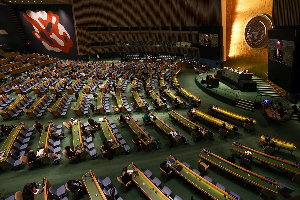
 A UN General Assembly sitting
The world today feels painfully unfair, a place where human life is negotiable, justice is selective, and peace seems optional. From Gaza to Ukraine, from Sudan to the Sahel, global headlines are no longer just “breaking news.” They are daily reminders that the international system, designed to protect humanity, is struggling to keep its promises.
At the center of this heartbreak stands an institution created to prevent exactly this kind of tragedy: the United Nations. Yet, as bombs fall and civilians flee, it becomes impossible to ignore the uncomfortable truth: the so-called ‘United Nations’ often appears as a Disunited Nations, powerless in a world normalizing violence.
A World That Normalizes Suffering
Once, war shocked the world. Today, it has become routine. Death has become statistics. Displacement is a trend. Children grow up knowing only fear, not safety. Humanitarian crises unfold with muted attention, as political narratives dominate our perception of who deserves sympathy.
The most painful part is this: the victims of war are often ordinary people; innocent bystanders caught in the crossfire of political ambition. Their suffering is neither optional nor negotiable, yet the global response is inconsistent at best.
Selective Outrage: The West’s Double Standards
The hypocrisy of global powers is glaring. When Russia invaded Ukraine in 2022, the West, including the United States, condemned indiscriminate bombing and destruction of civilian areas, imposing sanctions and rallying global criticism. But when Israel conducts airstrikes in Gaza, with civilian casualties mounting, the criticisms are far weaker, sporadic, or muted. The same world that demanded accountability from Russia remains largely silent in Gaza.
Now, tensions between the United States, Israel, and Iran carry global consequences. Decisions to confront or even go to war are sometimes made on partial truths, yet the human cost is absolute: lives lost, families displaced, cities destroyed. The disparity in global outrage exposes an uncomfortable reality: some lives matter more than others depending on political alliances, strategic interests, or economic influence.
This selective morality undermines the credibility of international institutions. When global justice is applied unevenly, nations lose faith in diplomacy and lean toward militarization. The UN, designed as a moral compass, appears compromised by these double standards.
The United Nations: Built for Peace, Hobbled by Politics
Founded after the horrors of World War II, the UN’s purpose was clear: to prevent another global catastrophe. It was meant to be a platform for diplomacy, a protector of the weak, and a restrainer of the powerful. But today, the institution struggles to enforce peace. Statements of “grave concern” and emergency resolutions cannot stop bullets, bombs, and sieges.
Much of this paralysis stems from the Security Council’s veto system. Permanent members wield disproportionate influence, often blocking decisive humanitarian interventions. Peace becomes negotiable. Accountability becomes optional. Civilians become collateral damage in political chess games.
The Human Cost: Civilians on the Frontlines
Beyond political calculations, the human tragedy is stark. Children are buried before they can write their names. Mothers give birth in refugee camps without medicine. Hospitals and schools become targets, reducing cities to rubble. This is not simply a crisis of war; it is a crisis of humanity.
Every day that the world debates which life deserves attention, more lives are lost. And every day that international institutions fail to act decisively, the seeds of future conflict are sown.
A Dangerous Precedent: When Global Institutions Fail
The greatest risk lies not only in today’s conflicts, but in what these failures teach nations about global governance. When the UN and other institutions appear selective, nations increasingly rely on force rather than dialogue. Militarization becomes survival. Diplomacy becomes optional. Trust in global systems erodes, opening the door to larger, deadlier conflicts.
A Call for Reform and Moral Consistency
The world does not need more statements or symbolic gestures. It needs reform, courage, and consistency. The UN must confront its credibility crisis. Security Council veto power should not obstruct humanitarian action. International law must apply equally, regardless of the perpetrator. Civilians must be protected, not treated as acceptable casualties. Peace must be enforced, not preached.
Conclusion: A World Crying for Conscience
Today’s wars expose more than governmental failures; they reveal a moral crisis in the global order. The UN, once a beacon of hope, risks becoming a symbol of helplessness. Meanwhile, global double standards erode trust, embolden aggression, and prolong suffering.
The ongoing conflicts, from Ukraine to Gaza, from tensions with Iran to other forgotten crises, show a world where selective outrage governs action, where political convenience outweighs human life, and where peace is optional.
This is why the title is not exaggerated: we truly live in an unfair world. A world where the “United Nations” is too often disunited.
A world where innocence pays the price. A world where institutions must act decisively, or watch history record their failure. Because the greatest tragedy is not just that wars exist. It is that humanity has learned to live with them.

Copyright © 1994 - 2026 GhanaWeb. All rights reserved.










