



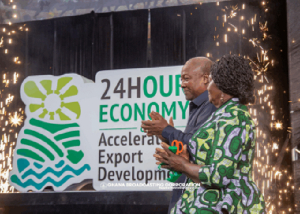
 President Mahama and Professor Opoku-Agyemang at the launch of the 24-Hour Economy
While some of us do not want to acquiesce to the widely held notion that politics in general is a dirty game, one would not be far from right in suggesting that the political terrain is destitute of honesty and integrity.
In his consuming desire to return to the Jubilee House, the NDC’s 2024 flagbearer, President John Dramani Mahama, gave all sorts of richly interesting, albeit unachievable promises, among other things, the seemingly phantom 24-Hour Economy.
As I write, there are no meaningful measures or steps being put in place to implement the much-trumpeting 24-Hour Economy of ‘1,3,3’ shift work promised by President John Dramani Mahama.
It is worth mentioning that the chivalrous Dr Nkrumah commendably built more than 300 factories with the sole aim of joining the industrial revolution, but the visionless politicians unpardonably disposed over three hundred factories to friends and family for pittance.
Apparently, Dr Nkrumah’s purposefully built factories inadvertently resulted in a 24-Hour Economy back then.
It is, therefore, laughable when the same people who disgustingly sold most of Nkrumah’s industries, which were built purposely to augment Ghana’s economic growth would turn around and promise a 24-hour economy.
My dear reader, it was the NDC tradition that perfunctorily adopted a disastrous Economic Recovery Programme (ERP) under the auspices of the World Bank and the International Monetary Fund (IMF) and disposed most of the purposely built factories.
The vast majority of tangible national assets, including the state owned enterprises were capriciously sold to friends and families for pittance.
Prior to the 2024 general elections, I received an interesting telephone call from my Sister, a bigtime kenkey seller, who was having sleepless nights over Mahama’s much-publicised 24-Hour Economy and wanted further and better particulars.
I informed my dear Sister that, 24-Hour Economy is more or less a free market economy which draws its strength from the all-important supply and demand, with minimal or no government interference.
In effect, no government on planet earth can legislate, coerce business owners, or have total control over a 24-Hour Economy.
Besides, with the evolving global economy and the advent of AI and digital transformation, industries and businesses won’t require a large workforce in order to engage in a 24-Hour Economy.
Take Ghana for example, with the advent of Bawumia’s all-important digital transformation, many businesses are engaging in 24-Hour Economy unbeknownst to some Ghanaians.
Truly, the introduction of a programme such as the mobile money interoperability has ensured a 24-hour banking service in Ghana.
My dear reader, I am a living witness. Although, I domiciled in the United Kingdom, I am able to transact business around the clock, transfer money anytime from my MTN mobile money account to my bank account and vice versa.
Like my dear sister’s 24-hour kenkey business, the emphasis is on supply and demand. Needless to say, my sister cannot work around the clock without the needed patronage.
That is, my dear sister has to keep improving on the quality and thereby increasing her customer base so as to work around the clock.
My dear reader, indeed, 24-Hour Economy is driven by supply and demand. Take for instance, many supermarkets in the United Kingdom have ceased their 24-hour services due to poor patronage.
Mind you, a 24-Hour Economy can only survive in a conducive environment replete with adequate infrastructure and/or provision of vital amenities such as electricity.
It is for this reason that I have been advising my friends and family members not to jump for joy over President Mahama’s seemingly tentative 24-hour economy proposal.
After all, President Mahama cannot compel my friends and family members to open their store 24/7 without the needed demand for the products.
And, apart from the supply and demand challenges, my dear Sister and many self-employers face other exigencies, most notably, dumsor(erratic electricity supply).
The fact is, businesses and industries did not flourish in the midst of the irritating dumsor during the Mahama first term administration.
In the days of the unspeakable dumsor under the Mahama administration, we witnessed the endless buzzing of generators all over the country. Most businesses folded up amid massive unemployment.
In those days, self-employers like my dear sister, the kenkey seller, hairdressers, ice kenkey sellers, butchers, among others, were the worst affected.
The annoying and costly buzzing of generators across the length and breadth of the country, unfortunately, went on for well over four years to the utter disgust of the good people of Ghana.
As I stated elsewhere, businesses do not need any massive interventions from government in order to offer a 24-hour service to their customers.
Businesses rather need a conducive environment and the provision of vital services such as uninterrupted electricity supply.
My dear reader, let’s be honest, if I’m operating a successful restaurant, do I need a government to coerce me to offer 24-hour service to my customers?
In fact, I was quite amazed to see booming business activities in some areas in Accra and Kumasi when I visited Ghana last December.
Evidently, the industrious Ghanaians including my dear sister, the kenkey seller, and her minions, are blissfully engaging in 24-hour economy without any intervention from any government.
Well, I would like to believe that President John Dramani Mahama was only trying his level best to hoodwink the unsuspecting voters. If that were not the case, how on earth would President Mahama promise a 24-Hour Economy in the midst of the unspeakable dumsor?
I’m afraid, the 24-Hour Economy promise is a sham, comparable to the one-time NHIS premium, promised by the erstwhile Mills/Mahama Administration, which was destitute of honesty and integrity.

Copyright © 1994 - 2026 GhanaWeb. All rights reserved.










