



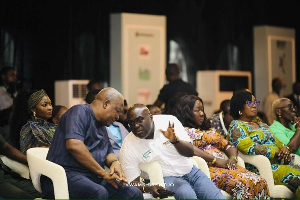
 Julius Debrah, Chief of Staff and President John Mahama
In the architecture of effective governance, leadership is often judged not only by the actions of the principal figure but also by the caliber and conduct of those entrusted with proximity to power.
Within this framework, Julius Debrah, Chief of Staff to John Dramani Mahama, emerges as a compelling reflection of a broader leadership philosophy—one grounded in discipline, institutional respect, and strategic restraint.
Public service at the highest level demands more than visibility; it requires coordination, discretion, and a firm grasp of governance mechanics. Julius Debrah’s trajectory within Ghana’s political landscape has been defined by these very attributes.
From his roots in party organisation within the National Democratic Congress (NDC) to his stewardship roles in government, he has cultivated a reputation as a stabilising force—measured in temperament and deliberate in execution.
His elevation to the role of Chief of Staff is therefore not incidental, but a calculated alignment of trust and competence within the governing structure.
At the core of Debrah’s administrative approach lies a principle that has long underpinned Mahama’s leadership: the primacy of institutions over personalities.
Governance, in this tradition, is not driven by spectacle or impulsive decision-making, but by structured processes, consultation, and policy continuity.
In his coordinating role at the Presidency, Debrah functions as the nerve centre of executive operations—harmonising policy direction, managing bureaucratic flow, and ensuring that government priorities are translated into actionable outcomes.
This requires not only technical expertise but also the discipline to operate effectively outside the glare of public attention.
One of the most defining traits Debrah exhibits is strategic composure.
In an environment often characterised by political pressure and competing interests, his leadership reflects a capacity to absorb tension without amplifying it.
Decisions are approached through consultation, internal alignment, and careful sequencing—an operational style that mirrors Mahama’s own governance ethos.
It is leadership that values patience without sacrificing decisiveness and inclusiveness without losing clarity of direction.
Beyond the formal structures of government, Debrah’s influence extends into the broader national development space.
His association with initiatives such as the Kwahu Business Forum underscores a commitment to bridging the divide between policy and enterprise.
By convening stakeholders across the public and private sectors, the forum advances a model of governance that is participatory and economically responsive consistent with the Mahama administration’s emphasis on partnership-driven growth.
Equally significant is the question of political character.
In an era where visibility is often mistaken for effectiveness, Julius Debrah represents a contrasting paradigm: leadership anchored in humility, loyalty and quiet efficiency. He does not dominate the public space, yet his imprint on governance processes is substantive.
This understated style aligns closely with Mahama’s own projection of leadership one that prioritises service delivery over theatrics and long-term institutional strength over short-term political gain.
However, such a governance model is not without its inherent challenges. A leadership style that emphasises process and consultation can, at times, be perceived as slow within a political climate that often rewards immediacy and dramatic action.
The burden, therefore, rests on translating institutional discipline into visible outcomes that resonate with the everyday expectations of citizens. In this regard, the effectiveness of Debrah’s coordination role will ultimately be measured not only by internal efficiency but also by the tangible impact of government policy on national life.
Nonetheless, the broader significance of Julius Debrah’s role lies in what he represents within the continuum of leadership.
He is not merely an administrator; he is an extension of a governing philosophy—one that seeks to balance authority with accountability, and strategy with service.
His conduct reinforces the notion that sustainable governance is a collective enterprise, requiring alignment at both the political and administrative levels.
As Ghana continues to navigate the complexities of democratic development, figures like Julius Debrah offer an instructive model of leadership in practice.
In him, the leadership character of John Dramani Mahama finds expression not through rhetoric but through disciplined execution and institutional stewardship.
Ultimately, Julius Debrah stands as a quiet but consequential reflection of Mahama’s leadership: thoughtful, composed and firmly anchored in the enduring principles of statecraft.

Copyright © 1994 - 2026 GhanaWeb. All rights reserved.










