



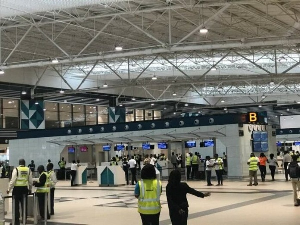
 A view of the Accra International Airport
When Ghana announced its decision to waive visa requirements for all African countries, it positioned itself as a torchbearer for Pan-African unity. The move aligns with the long-standing vision of continental integration, echoing ideals championed since the days of Kwame Nkrumah.
In principle, it is a powerful and progressive gesture. In practice, however, it raises a difficult question: Is Ghana ready? This is not a critique of the vision itself, but of its timing.
A Nation Under Pressure
Ghana is currently grappling with significant internal challenges that stretch across nearly every sector. Opening borders without first stabilizing domestic systems risks amplifying existing vulnerabilities.
1. Healthcare System Strain
Ghana’s healthcare system remains under-resourced and unevenly distributed. Public hospitals frequently face shortages of essential drugs, equipment, and personnel. Rural communities in particular struggle to access quality care.
Waiving visas may increase population flow, placing additional pressure on already strained facilities. Without robust health infrastructure, the system risks being overwhelmed—not just by citizens, but by increased regional mobility.
2. Energy Instability
Energy reliability has long been a recurring issue. Periodic power outages, locally referred to as “dumsor”, continue to affect businesses and households. While there have been improvements, supply remains inconsistent. An influx of people and economic activity without matching energy expansion could deepen instability. Industrial growth, digital services, and even basic living conditions depend on reliable power, something Ghana is still working to secure.
3. Economic Hardship and Cost of Living
Ghana is navigating high inflation, currency depreciation, and rising public debt. Many citizens face increasing living costs, unemployment, and reduced purchasing power. Opening borders in such an environment may intensify competition for jobs and social services. For a population already under economic
stress, this could fuel resentment rather than unity.
4. Infrastructure Deficits
Urban centers like Accra are already dealing with congestion, housing shortages, and pressure on sanitation systems. Transportation networks, waste management, and water supply are struggling to keep pace with population growth.
Greater mobility across borders will likely accelerate urban migration, further straining fragile infrastructure systems that are not yet equipped for such expansion.
5. Security Concerns and Regional Instability
Perhaps the most pressing concern lies in security. Ghana sits in a region increasingly affected by extremist activity, particularly in parts of the Sahel.
Neighboring countries such as Burkina Faso and Mali have experienced significant terrorist threats. While Ghana has remained relatively stable, there have been warnings about potential spillover risks. Visa-free access, without enhanced border intelligence and surveillance, could create vulnerabilities. The challenge is not migration itself, but ensuring that security mechanisms are strong enough to distinguish between legitimate movement and potential threats.
The Ideal vs. The Reality
The idea of a borderless Africa is compelling. It promises economic integration, cultural exchange, and shared prosperity. Ghana’s policy is, in many ways, a moral and political statement of leadership. But leadership also requires sequencing.
Opening borders should ideally follow, not precede, domestic strengthening. Without solid healthcare, reliable energy, economic stability, and secure borders, such policies risk being symbolic rather than sustainable.
A Question of Timing, Not Vision
Few nations are willing to take such decisive steps toward African unity. But ambition must be matched with capacity. Right now, Ghana faces a difficult balancing act: Supporting its own citizens amid economic strain. Strengthening critical infrastructure. Managing regional security threats.
Until these foundations are more secure, visa liberalization may stretch
the country beyond its limits.
Final Thought;
Ghana’s visa-free policy is not the wrong idea, it may even be the right
future. But in its current context, it risks becoming a good move made
at the wrong time.
Pan-African unity cannot thrive if the nations driving it are themselves
under strain. Strength at home remains the prerequisite for leadership
abroad.
Sir Richie - London,
00447427657656

Copyright © 1994 - 2026 GhanaWeb. All rights reserved.










