



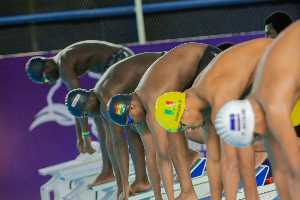
 Aquatic sports in Ghana
Sports governance thrives on transparency, accountability, and strict adherence to constitutional processes. When these principles are ignored, federations risk institutional decay, athlete disenfranchisement, and national embarrassment on the international stage. The ongoing crisis within the Ghana Swimming Association (GSA) presents a troubling case study of governance failures that have unfolded over several years and culminated in state intervention.
A Mandate Allowed to Lapse
The mandate of the executive board of the Ghana Swimming Association was due to expire in June 2025, as clearly stipulated in the association’s constitution. In line with best governance practices, preparations towards an electoral congress should have commenced months earlier. However, by April 2025 no visible steps had been taken by the executive to initiate the process.
Concerned stakeholders formally wrote to the association, requesting clarity and urging the executive to begin arrangements for the electoral congress. That letter, like several others that would follow, was neither acknowledged nor responded to by the executive.
Unilateral Extension of Tenure
In June 2025, instead of convening a congress, the executive circulated a letter announcing a unilateral shift of the electoral congress from June to October 2025. The justification provided was a change in the association’s name from Ghana Swimming Association to Ghana Aquatics.
This decision immediately raised constitutional concerns amongst stakeholders. Many viewed the move as an attempt by the executive to extend its own tenure without approval from the General Assembly, which under the GSA constitution is the highest decision-making body. Stakeholders again wrote formally to the executive, demanding the reconsideration of the decision and adherence to constitutional provisions. Once more, the executive failed to acknowledge or reply.
Ignoring Constitutional Remedies
With tensions escalating, stakeholders invoked another constitutional safeguard: the provision for an emergency congress. A formal request was submitted to the executive seeking to address the governance impasse through this mechanism. The request was ignored.
Rather than engaging its membership, the executive bypassed stakeholders and wrote directly to World Aquatics, the international governing body, requesting approval to hold the electoral congress on October 11, 2025. Unaware of the internal disputes and constitutional concerns in Ghana, World Aquatics initially granted the request.
The executive then circulated World Aquatics’ approval to stakeholders, presenting it as a validation of their actions. This move further inflamed tensions within the association.
International Intervention and Constitutional Breach
In response, stakeholders petitioned World Aquatics, detailing the full chronology of events and the alleged constitutional breaches by the executive. The response from World Aquatics was swift and significant: World Aquatics wrote to the GSA executive, placing the October date on hold and requesting explanations for the shift in the electoral timeline.
In correspondence to stakeholders in September 2025, World Aquatics stated that the executive had failed to provide any reasons for moving the congress from June to October. Crucially, the international body affirmed that it was unconstitutional for the executive to extend its own tenure.
World Aquatics subsequently directed that a free and fair election be held on October 11, 2025 in accordance with the constitution and interntional standards.
Legal Battles and State Involvement
Allegations of attempts to manipulate the electoral process led some stakeholders to seek legal redress. An injunction was filed and the the election was halted. The GSA sought the intervention of the National Sports Authority (NSA) to resolve the standoff. The NSA engaged both the executive and representatives of stakeholders in an effort to resolve the crisis amicably.
Following deliberations and lack of satisfactory responses to the issues including the absence of accounts, the NSA wrote to World Aquatics recommending the formation of a Stablisation Committee to address governance challenges, and organize credible elections. World Aquatics has not responded to the NSA’s request.
Withdrawal of Recognition
In January 2026, after months of deadlock, the NSA took decisive action by withdrawing its recognition from the GSA and its executive, effectively barring them from administering swimming activities both domestically and internationally.
This unprecedented step underscored the severity of the governance failures and the state’s determination to restore order and credibility within the sport.
A Pattern of Poor Governance
Beyond the electoral dispute, deeper systemic issues plague the GSA. For the past four years, the GSA has reportedly failed to hold annual congresses, has not presented audited financial accounts even at the request of the NSA, and has consistently ignored petitions from its own stakeholders. These lapses represent fundamental violations of governance norms and best practices expected of a national sports federation.
Earlier this year, following a dispute between the stakeholders who issued the above-mentioned petitions and the former executive of the GSA, the Ministry of Sports and Recreation intervened and convened a meeting between the parties. At that meeting, a mutual agreement was reached in good faith, under which the petitioners were requested to withdraw an ongoing case before the Accra High Court. In return, the Ministry committed to establishing an independent committee to resolve the issues and oversee the conduct of fresh elections for the Association.
In compliance with the agreement, the petitioners withdrew the court case. The Ministry subsequently constituted a five-member committee, comprising two representatives from each side and chaired by the Chairman of the NSA. After a series of deliberations, the Committee reached key decisions, including:
•The eligibility of all swimming clubs listed in the previously issued Notice of Polls to vote;
•The exclusion of proxy voting in accordance with the GSA Constitution;
•The exclusion of ineligible regional representatives;
•The disqualification of unregistered associations from representation;
•The conduct of elections by the Electoral Commission of Ghana; and
•The requirement for the presentation of activity reports and audited accounts at Congress.
However, the President of the GSA and her representatives allegedly refused to endorse these decisions and withdrew from the process.
Subsequently and most recently, the executives of the GSA have unilaterally issued a notice to hold an Elective Congress on 2nd May 2026, in direct contravention of the agreement that led to the withdrawal of the court case and the resolutions reached by the Committee.
This conduct by the executives constitutes a clear breach of the agreement brokered by the Ministry and undermines the authority of both the Ministry and the NSA, as well as the integrity of governance in sports administration.
At this juncture, the Ministry and the NSA as the regulator sports in Ghana must ensure that the constitution of the GSA as respected, the agreement reached by the parties upheld and free and fair elections conducted to further avoid comprising the future of Ghana swimming.

Copyright © 1994 - 2026 GhanaWeb. All rights reserved.










