



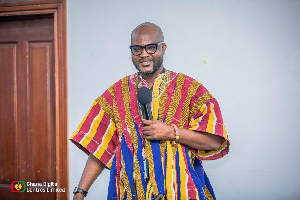
 Dzifa Gunu is the CEO of the Ghana Digital Centres Limited
There are moments in public life when you witness the convergence of a man, his ideas, and the historical moment that demands them. For me, watching President John Dramani Mahama announce the imminent launch of Ghana's Free Primary Healthcare Programme was precisely such a moment.
As someone who campaigned with conviction to see him returned to office, who gave time, voice, and energy to the National Democratic Congress in the belief that this leadership matters, I will not pretend to offer a detached account. What I can offer is something more honest: a proud, considered, and rigorously researched portrait of a vision that has always been larger than the political cycle.
President Mahama's relationship with Ghana's healthcare infrastructure did not begin with the 2024 election manifesto. It began in the corridors of government during his first term, when he presided over one of the most ambitious periods of health infrastructure expansion in the country's post-independence history.
The University of Ghana Medical Centre, the Dodowa District Hospital, the Upper West Regional Hospital, the Maritime Hospital, the Bank of Ghana Hospital and the expansion of both the Tamale Teaching Hospital and the Bolgatanga Hospital were all tangible expressions of a philosophy that quality healthcare is not a luxury for the privileged but a birthright for every Ghanaian.
Perhaps no single project captured that philosophy more visibly than the transformation of the Greater Accra Regional Hospital at Ridge. The facility, which had long been a byword for the indignities of public healthcare in the capital, was comprehensively renovated and repositioned as a modern referral institution, a signal that the NDC administration was serious not merely about building new facilities but about restoring the ones that ordinary Ghanaians had already been promised.
Dozens of Community-based Health Planning and Services (CHPS) compounds were commissioned, bringing frontline care closer to the communities that needed it most.
A Vision Interrupted, Then Deepened
When the NDC left office in 2017, many of those projects were left incomplete, and the communities that had begun to benefit saw progress arrested. The CHPS expansion stalled. Hospital construction halted. Dozens of facilities that should have been functional were left as shells of concrete and ambition. At the time, it was possible to frame this as a political disagreement about priorities.
Then came COVID-19, and the argument became impossible to ignore.
When Ghana confirmed its first cases on 12 March 2020, the pandemic arrived not as a health crisis alone but as a stress test of everything that had been neglected. The pre-existing gaps in the healthcare infrastructure, the understaffed CHPS compounds, the incomplete district hospitals, the under-equipped facilities, were suddenly not bureaucratic statistics but life-threatening realities.
Hospitals ran out of supplies and equipment. Healthcare workers struggled to care for patients while protecting themselves, facing burnout and fear at a scale the system had never been designed to absorb. Published research found that Ghana entered the pandemic with pre-existing health system gaps and that the crisis pushed Africa's overloaded healthcare infrastructure to its limits.
In Ghana, those limits were defined in large part by years of deferred investment and abandoned construction. President Mahama himself acknowledged the scale of the damage at the Africa Health Sovereignty Summit in August 2025, stating plainly that in Ghana, the CHPS compounds were brought to their knees. It was not hyperbole. It was the reckoning of a man who had spent years warning that a weakened primary care network would not hold under pressure, and who had been proved catastrophically right.
The vision endured, sharpened by the evidence of what had been abandoned and deepened by the cost of what that abandonment had wrought. Mahama returned to the electorate in 2024 not with a softer version of his healthcare platform but a bolder one, forged in the furnace of a pandemic that had made the case for him.
From Manifesto to Governance
"If everyone is contributing, why should the absence of a card limit people from the most basic form of care? Every Ghanaian who contributes to the levy should enjoy a certain minimum package of services," President Mahama said.
The 2024 NDC manifesto, captioned Resetting Ghana: Jobs, Accountability and Prosperity, committed explicitly to making primary healthcare free and universally accessible at CHPS compounds, health centres, clinics and polyclinics in the short to medium term.
Within weeks of taking office in January 2025, the new administration began giving institutional form to that promise. In his State of the Nation Address on 27 February 2025, President Mahama outlined a dual-pillar approach to healthcare transformation: Free Primary Healthcare, focused on prevention, early detection and treatment at the community level, and MahamaCare, the Ghana Medical Trust Fund, which would provide financial support for patients suffering from non-communicable diseases such as cancer, kidney disease, hypertension and diabetes.
The 2026 national budget translated that commitment into figures. The health sector received an allocation of GH¢34 billion, representing more than 11 per cent of total government expenditure and a 9.4 per cent increase over previous provisions. Within that envelope, GH¢1.5 billion was earmarked specifically for the Free Primary Healthcare package, and GH¢2.3 billion for MahamaCare, which became fully operational with a functioning board and secretariat actively disbursing support to patients with chronic conditions.
A Vision With Continental Ambition
President Mahama has never understood Ghana's healthcare challenge as merely domestic. At the Africa Health Sovereignty Summit held in Accra on 5 August 2025, he called on African nations to define and lead their own health priorities, declaring that Africa must no longer be the patient but must become the author, the architect and the advocate of its own health destiny.
He announced the Presidential High-Level Task Force on Global Health Governance and the SUSTAIN Initiative, a platform designed to align national budgets with health priorities and mobilise sovereign, philanthropic and private capital into health systems. Crucially, he also announced that Ghana would introduce a new primary healthcare programme with technical support from the World Health Organisation, with WHO Director-General Dr Tedros Adhanom Ghebreyesus personally committing to send a technical team to support the design process.
The April 2026 launch date brings all of this full circle. On 30 March 2026, just days before writing this piece, President Mahama confirmed to civil society organisations that the Free Primary Healthcare Programme would officially commence on 15 April 2026. He called on CSOs to participate in public education and help monitor implementation so that the programme achieves real, measurable impact in the lives of ordinary Ghanaians.
I think of my grandmother in the Volta Region, who walked miles to a clinic only to be turned back because she could not produce an insurance card. I think of the millions of Ghanaians for whom the healthcare system has always felt like something designed for others. On 15 April, that changes. This is not rhetoric. This is the architecture of a man's life's work made real. And for those of us who worked, prayed and organised to bring this moment about, the pride is not only personal. It is historical.

Copyright © 1994 - 2026 GhanaWeb. All rights reserved.










