



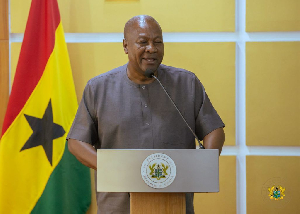
 President John Dramani Mahama
Ghana’s next chapter can’t afford guesswork. When John Mahama is gone, the country will need leadership that is not only patriotic, but relentlessly practical, someone whose instincts are shaped by solving problems, running toward opportunities, and thinking beyond narrow borders. Julius Debrah, by temperament and record has the kind of solution-driven, business-first, pan-Africanist mindset that Ghana will increasingly recognize as a leadership asset rather than a nice-to-have. Solution-driven leadership, not performance management
A country under pressure needs a leader who treats problems as work—diagnose, design, execute, measure, correct. That “solution orientation” matters because Ghana’s challenges are rarely theoretical. They are daily: jobs, taxes and revenue, power and cost of doing business, youth opportunity, infrastructure, and the confidence gap that makes investors hesitate.
Debrah’s nature, often described as solution-driven—is important because Ghana has seen how easily leadership can become talk, politics, and symbolism that doesn’t move systems. Solution-driven leaders don’t just point at problems; they build pathways out of them. They translate ideas into operations, and operations into results.
Business focus as national strategy
In Ghana, business is not separate from nation-building—it’s how the economy breathes. When you support enterprise, you support jobs, skills, procurement, tax revenue, and resilience. A business-minded leader understands that public policy is not only about “spending,” but about creating conditions where wealth can be produced domestically.
This is why Debrah’s business focus stands out. Not as a hobby, not as a slogan, but as a governing lens: How do we grow productive capacity? How do we reduce friction for commerce? How do we strengthen local supply chains? How do we make entrepreneurship durable instead of temporary?
That mindset is especially relevant in a post-Mahama transition period, because Ghana will need investors, domestic and diaspora, to believe that leadership will protect livelihoods, not merely campaign promises.
Pan-Africanism as practical expansion of opportunity
Pan-Africanist thinking isn’t just about ideology or speeches about unity. In the best form, it becomes an economic strategy: building trade corridors, regional markets, and networks of capital and expertise that help countries compete.
A leader with pan-African thinking can see Ghana not as an isolated island, but as a node in a wider economic web. That matters for manufacturing, agriculture value chains, fintech, logistics, education, and business-to-business partnerships across borders. Ghana thrives when it connects outward when opportunity can travel, and when markets aren’t capped by geography.
In that sense, Debrah’s pan-Africanist thinking complements his business focus: the “Africa” part isn’t distant; it’s directly tied to expanding where Ghanaese businesses can sell, collaborate, and scale.
The Kwahu Business Summit: a signal, not just an event
The Kwahu Business Summit is more than a gathering of entrepreneurs—it’s a message. It signals that Debrah values enterprise development as a real-time agenda, not an abstract vision.
When a leader shows up around business, especially at a level where local operators, community stakeholders, and enterprise-focused voices converge, it becomes evidence of his orientation. It tells the market: this isn’t only about politics; this is about enterprise ecosystems.
Think about what such summits typically represent in leadership behavior:
• Respect for local economic actors: Entrepreneurs and SMEs aren’t treated as footnotes. They are treated as stakeholders.
• Attention to problem-solving frameworks: Summits are where constraints are surfaced and solutions—training, financing pathways, policy ideas, partnerships—can be debated.
• Commitment to sustained engagement: Serious business leadership isn’t limited to election season. It’s expressed through recurring platforms and visible follow-through.
• Bridge-building across networks: Business events connect people who might otherwise remain in parallel worlds—local producers, service providers, financiers, and policy thinkers.
So when one asks what the Kwahu Business Summit means for leadership suitability, the answer is clear: it’s a signal of business-mindedness that is consistent with a solution-driven, economically grounded worldview.
Indigenous Ghanaian businesses: the belief that local power can lead
At the heart of Debrah’s approach is a belief in indigenous Ghanaian businesses—local enterprise as the engine of national progress. That belief is crucial because Ghana’s development history includes a recurring dilemma: dependence on external goods and outside capital while local producers struggle to compete fairly.
If a leader truly believes in indigenous business, then the policy direction naturally follows:
• improving access to financing for SMEs,
• strengthening local supply chains,
• reducing unnecessary bureaucratic friction,
• building the skills and market access that entrepreneurs need,
• and ensuring that public spending supports local value creation.
This is where solution-driven leadership and business focus converge into something concrete: indigenous businesses stop being “beneficiaries” and become drivers. The kind of leadership Ghana will need after Mahama
Leadership after John Mahama will require more than party loyalty and rhetoric. Ghana will need a leader who can read economic reality, understand market dynamics, and translate national priorities into workable business and investment outcomes.
Julius Debrah’s projected traits—solution-driven nature, business focus, pan-Africanist thinking, and a genuine belief in indigenous Ghanaian businesses—fit together as a coherent leadership profile.
The Kwahu Business Summit, as a visible marker, reinforces that profile: it reflects a commitment to enterprise development rather than only political messaging.
Ghana doesn’t need a spectator in government. It needs a builder—someone who treats the country’s problems as engineering challenges, and its future as a marketplace where Ghanaian capability competes, wins, and scales. Debrah’s orientation suggests he understands exactly that game.

Copyright © 1994 - 2026 GhanaWeb. All rights reserved.










