



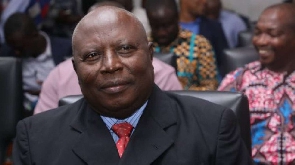
 Martin Amidu is a former Special Prosecutor
INTRODUCTION
One Noah Ephraem Tetteh Adamtey has succeeded in raising the question of the constitutionality of the Office of the Special Prosecutor Act, 2017 (Act 959) for interpretation and declaratory reliefs before the Supreme Court in an action he commenced against the Attorney-General on 8 December 2025. An earlier attempt by Mr. Ken Agyei Kuranchie in 2023 challenging the constitutionality of Act 959 was discontinued in July 2024 by the Supreme Court for lack of prosecution and without liberty to bring a further action against the Attorney-General.
The Defendant in the Adamtey action, the Attorney-General, failed to timely file a defence to the action as required by the Rules of the Supreme Court, despite the fact that the Deputy Attorney-General was the source of a leak of the fact that the Plaintiff had commenced the action against the constitutionality of Act 959. Exactly four months after the commencement of the action by the Plaintiff against the Republic of Ghana, with the Attorney-General as Defendant, the Defendant filed an application on 8 April 2026 in the Supreme Court praying for leave for extension of time to file the Statement of Case for the Defendant, fixed for hearing on 16 April 2026. The Statement of Case of the Defendant, as required by the Rules of the Supreme Court, was exhibited to the application for extension of time as “Exhibit AG1” and contains the Attorney-General’s case, which substantially agrees with the Plaintiff’s case. (The Court has since granted the extension of time.)
Between 8 December 2025, when the Plaintiff filed his action, and 8 April 2026, when the Defendant filed his application for extension of time, the Office of the Special Prosecutor (OSP) sought, by an application filed in the Supreme Court on 15 December 2025 and disposed of on 27 January 2026, to join the action as Second Defendant. The Supreme Court refused the joinder in a unanimous ruling, stating that:
“...We are of the view that the Office of the Special Prosecutor is not a necessary party to the action and that this suit may be properly adjudicated upon without their presence as parties. This application for joinder is therefore refused.”
Noah Ephraem Tetteh Adamtey’s action against the Attorney-General was known and available to the public and to anti-corruption civil society organisations since the case was filed in the Supreme Court on 8 December 2025. The Rules of the Supreme Court allow Interested Parties, who take the view that a constitutional action raises issues impacting them, to apply to join such action. There is no evidence that since the Plaintiff filed his action on 8 December 2025, any person or civil society organisation has applied to join the action as an Interested Party to make submissions contesting the Plaintiff’s case.
AN EXAMINATION OF THE REACTION TO DEFENDANT’S CASE
Nonetheless, immediately after the Defendant, the Attorney-General’s application for extension of time became public, the Executive Director of a civil society organisation called CDD-Ghana took to social media to attack the ruling of the Supreme Court delivered on 27 January 2026 for refusing to allow the OSP to join the action as Second Defendant.
The anti-corruption civil society organisations, which are organised under the umbrella of CDD-Ghana, have a stake in the existence of the OSP, as it impacts their ability to source donations from donors for their anti-corruption campaigns.
Mr. H. Kwasi Prempeh, the Executive Director of the Centre for Democratic Development (CDD-Ghana), who played a central role with President Akufo-Addo and his Attorney-General, Ms. Gloria Akuffo, in the drafting and submission of the Office of the Special Prosecutor Bill, 2017 to Parliament for enactment into law as Act 959, now blames the Supreme Court for complying with the mandatory terms of Article 88(5) of the Constitution in refusing the joinder application by the OSP. Article 88(5) of the 1992 Constitution states that “all civil proceedings against the State shall be instituted against the Attorney-General as defendant.” The unanimous decision of the Supreme Court dated 27 January 2026 refusing the OSP’s application for joinder is consistent with Article 88(5) of the Constitution.
In any case, the post facto condemnation of the ruling of the Supreme Court is premised on the false assumption that, despite the wording of Article 88(5) of the Constitution, the Supreme Court’s ruling endorsed any conduct of the Attorney-General that colludes with the substance of the Plaintiff’s action in the Statement of Case. Nothing under adversarial justice prevents a Defendant from admitting the case of the Plaintiff or part thereof, as the Attorney-General’s draft Statement of Case proposes, however unethical it may seem.
Mr. H. Kwasi Prempeh is not qualified to hold himself out as a person qualified to practise law in Ghana, let alone qualify for appointment to any court in Ghana, and should not behave as though he understands the constitutional law of Ghana and the rules of practice of the Supreme Court better than the Chief Justice and the four other Justices of the Supreme Court who refused the joinder application of the OSP. The fact that the Akufo-Addo Government, with whom he was associated, appointed him to the Law Reform Commission does not qualify him to speak as though he is a properly qualified legal practitioner in Ghana.
The proper course for any person or body of persons who disagree with the position taken by the Attorney-General on the action filed by the Plaintiff on 8 December 2025 challenging the constitutionality of Act 959 is to apply to the Supreme Court as Interested Parties and submit arguments as to why the provisions of Act 959 being challenged are constitutional.
DEFECTS OF THE PLAINTIFF’S WRIT AND CAUSE OF ACTION
On 8 December 2025, one Noah Ephraem Tetteh Adamtey commenced an action in the Supreme Court of Ghana against the Attorney-General challenging the constitutionality of portions of the Office of the Special Prosecutor Act, 2017 (Act 959). The Plaintiff sought eight reliefs. The main contention of the Plaintiff, discernible from the first five reliefs, is that Sections 3(3) and 4 of Act 959 are inconsistent with and contravene Articles 88, 93(2) and 296 of the 1992 Constitution and are accordingly void.
Article 88(3) and (4) delegates the executive authority and responsibility of the President under Article 58 of the Constitution to the Attorney-General for the initiation and conduct of all prosecutions of criminal offences. All criminal offences are to be prosecuted in the name of the Republic of Ghana at the suit of the Attorney-General or any other person authorised by him in accordance with any law.
The substance of the Plaintiff’s first five reliefs anchored on Section 3(3) of Act 959 states that:
“A declaration that Sections 3(3) and 4 of Act 959, in purporting to make the Office of the Special Prosecutor independent of the Attorney-General in the initiation, conduct, and termination of prosecutions, violates the Constitution.”
The problem which any experienced and erudite constitutional advocate in the Supreme Court will immediately recognise is that Sections 3(3) and 4 of Act 959 do not confer upon the Special Prosecutor the powers the Plaintiff claims they do. Section 3 of Act 959 deals with the functions of the OSP and not the powers of the Special Prosecutor.
Section 4 of Act 959 deals with the mandate of the Office, and subsection (2) thereof subjects the powers of the Special Prosecutor to Article 88(4) of the Constitution and therefore cannot be said to be void. The Plaintiff also attempts in reliefs (a) and (b) to rely on Article 296 of the Constitution on discretionary power, as though it applies to prosecutorial discretion of the Attorney-General. However, experienced legal representation by an Interested Party may argue that prosecutorial discretion derives from the common law as part of the existing law under Article 11 of the Constitution, which restricts judicial interference in prosecutorial discretion.
The sixth relief appears contradictory, or at best alternative, when it seeks:
“A declaration that any statutory delegation of prosecutorial authority made pursuant to Act 959 does not bind subsequent Attorneys-General and lapses upon the assumption of office of a new Attorney-General unless re-authorised by that Attorney-General.”
This relief cannot co-exist with the first five reliefs and cannot properly constitute part of the same cause of action. The Plaintiff appears to concede that Act 959 is intra vires Article 88, except in relation to its effect on succeeding Attorneys-General.
DEFECTS OF THE ATTORNEY-GENERAL’S PROPOSED CASE
The draft Statement of Case of the Defendant exhibited to the application for extension of time filed on 8 April 2026 also contains contradictory submissions, misrepresentations of fact and law, which any experienced practitioner of constitutional law appearing as an Interested Party may bring to the attention of the Court.
The Attorney-General is at all times an officer of the Court, expected to assist in the administration of justice without fear or favour. One would therefore expect the Defendant’s Statement of Case to objectively and impartially address the implications of the nomination of the Special Prosecutor by the Attorney-General for appointment by the President, and its effect on prosecutorial powers under Act 959.
The Supreme Court may also be assisted by comparative reasoning, including the US Supreme Court decision in Morrison v Olson, 487 U.S. 654 (1988), which upheld independent counsel provisions under the Ethics in Government Act.
CONCLUSION
This discourse should not be interpreted as an endorsement of the constitutionality of Act 959. I have previously indicated that I anticipated challenges to Act 959 during my tenure as Special Prosecutor, and I was not surprised when such challenges eventually arose.
The Attorney-General’s Statement of Case, as proposed, does not appear to present a neutral or balanced response capable of assisting the Supreme Court in resolving the constitutional issues fairly. Rather, it appears to substantially align with the Plaintiff’s case.
At the end of the day, the relationship between the Special Prosecutor and the Attorney-General under this Government appears to have broken down beyond repair. The Special Prosecutor and the Attorney-General, as presently constituted, cannot co-exist effectively in the fight against corruption.

Copyright © 1994 - 2026 GhanaWeb. All rights reserved.










