



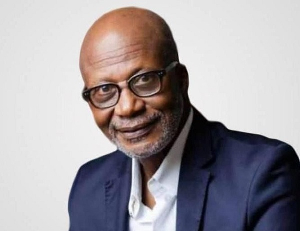
 Kwesi Amoafo-Yeboah
There was a time—not too long ago—when owning a telephone line in Ghana was a privilege reserved for the patient and the well-connected.
You did not simply apply and get one. You waited—sometimes for years.
Then, almost without warning, the entire system became irrelevant. Mobile phones arrived, and with them came a quiet revolution. We did not rebuild the old infrastructure. We did not follow the prescribed path.
We simply moved forward.
We skipped a step.
“Ghana didn’t catch up. We moved on.”
That moment is worth remembering, because today we stand at the edge of something even more consequential.
Artificial intelligence is not just another technology cycle. It is not another tool on the shelf. It is a layer of intelligence that can sit on top of everything we already do—how we work, trade, govern, and live.
The temptation, as always, will be to admire it from a distance. To discuss it in rooms filled with slides and projections. To position ourselves as participants in a global conversation.
But Ghana does not need to participate in the AI conversation.
Ghana needs to use AI to fix what slows us down.
“The real constraint is not effort. It is friction.”
Because if we are honest, that is where the problem lies.
Too many steps where there should be one.
Too many delays where there should be immediacy.
Too much uncertainty where there should be clarity.
You feel it when you register a business. You feel it when you chase a permit. You feel it when traders spend more time following up on payments than selling. You feel it when farmers plant without reliable weather guidance. You feel it when patients wait hours for services that should take minutes.
This is where AI belongs—not in abstract discussions, but in removing friction from everyday life.
There is no better place to begin than government.
If public services worked as they should, the impact would be immediate.
Imagine a young entrepreneur who does not move from office to office, form to form, queue to queue—but simply states an intention:
“I want to start a business.”
From that moment, everything follows—registration, tax identification, compliance—guided step by step in clear, natural language.
What changes is not just speed.
What changes is behaviour.
“When systems become usable, people use them.”
More businesses formalise. More transactions enter the system. Compliance shifts from burden to participation.
And the economy begins to move differently.
Perhaps the most immediate opportunity is already in our hands.
Every day, millions of Ghanaians move money through their phones. It is one of the great successes of our digital journey. But today, it behaves like a pipeline—efficient, but silent.
Money in. Money out.
What if it could speak?
What if it could understand?
What if, instead of simply processing transactions, it began to interpret them?
A small business owner wakes up to a message:
“You spent more on stock this week, but sales dropped. Here’s where the gap is.”
Or:
“These customers are consistently late in paying. Here’s when to follow up.”
Or:
“At this rate, you can save without affecting your operations.”
That is not sophistication for its own sake.
That is survival. That is growth.
“Not big AI. Useful AI.”
Because the real engine of Ghana’s economy is not large corporations.
It is the small trader, the clinic owner, the transport operator, the school administrator.
And most are making decisions without visibility—not by choice, but by lack of tools.
Give them clarity—simple, immediate clarity—and productivity rises. Quietly at first. Then all at once.
On the farm, the issue is even clearer.
The problem is not effort. It has never been effort.
It is timing. It is information.
When to plant. What to apply. Where to sell.
These are not abstract questions. They determine profit or loss.
AI can answer them—but only if it arrives in the right form.
Not as an app to learn, but as a voice to trust.
In a language that feels like home.
“If it doesn’t fit into daily life, it won’t be used.”
Get that right, and you do not just improve yields—you improve lives.
In healthcare, the challenge is starker.
There are not enough doctors, nurses, or specialists—and there will not be enough anytime soon.
So the question is not replacement.
It is extension.
AI can serve as a first point of contact—interpreting symptoms, guiding next steps, and supporting frontline workers.
It does not replace expertise.
It multiplies it.
Sometimes the biggest gains are not in building new systems, but in fixing existing ones.
Power losses.
Traffic congestion.
Port inefficiencies.
These are not future problems. They are daily economic costs.
And they are solvable.
“The opportunity is not always in building more. It is in using better.”
But one thing must be done right.
If Ghana is serious about AI, the systems must understand us—our languages, accents, patterns, and context.
Because if they do not, we risk becoming consumers of intelligence rather than participants in it.
And that is not progress.
So where do we begin?
Not everywhere.
Just a few places that matter.
Make government simple.
Make money intelligent.
Make businesses clearer.
Make farming informed.
Make healthcare reachable.
That is enough.
More than enough.
“We don’t need the most advanced systems. We need the most useful ones.”
We have seen this story before.
When mobile phones arrived, we did not debate endlessly. We used them. We adapted. And we built something new on top of them.
AI is bigger.
But the principle is the same.
In the end, this is not a question of technology.
It is a question of intent.
Will we use AI to impress?
Or will we use it to improve?
Because if we choose improvement—and execute with discipline—then Ghana will not simply participate in the AI era.
We will help shape it.
For ourselves.

Copyright © 1994 - 2026 GhanaWeb. All rights reserved.










