



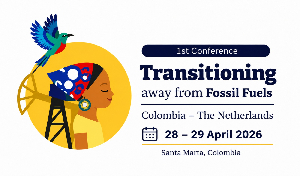
 The Santa Marta conference is happening in Columbia
As the international community prepares to gather in Santa Marta, Colombia from 28–29 April 2019, anticipation is already being shaped by a wide range of perspectives submitted in advance of the Conference on Transitioning Away from Fossil Fuels, co-hosted by Colombia and the Netherlands.
These early contributions offer a powerful preview of the debates to come, reflecting a growing global recognition that moving beyond fossil fuels is not merely a technical challenge, but a profound transformation of economies, societies, and systems of governance.
Ahead of the conference, voices from across the Major Groups are converging and, at times, diverging on how this transition should unfold. These include academic institutions, Indigenous Peoples, Afro-descendant communities, children and youth, NGOs, social movements, trade unions, peasant communities, the private sector, governments, subnational authorities, parliamentarians, and women and gender-diverse groups. Together, they present a rich and complex picture of the priorities, risks, and opportunities associated with a just transition.
Academic contributions point clearly to the scale of transformation required. Researchers emphasize that transitioning away from fossil fuels must be carefully planned, grounded in strong public institutions, and supported by international cooperation. They stress that economic diversification, education, and debt relief are not peripheral concerns but central pillars of success. Without addressing structural economic dependence and global financial imbalances, they argue, the transition risks stalling before it can take hold.
For Indigenous Peoples, the transition is inseparable from questions of land, rights, and sovereignty. Their submissions ahead of the conference highlight that any meaningful shift away from fossil fuels must respect territorial governance and uphold the principle of Free, Prior and Informed Consent. They also caution against repeating patterns of extraction under the banner of clean energy, warning that “green” development must not come at the expense of ecosystems or Indigenous autonomy.
Afro-descendant communities bring forward a similarly justice-centered perspective, emphasizing that fossil fuel economies have long been tied to environmental racism and unequal exposure to harm. Their voices stress the importance of reparations, territorial rights, and community-led solutions, including renewable energy systems that are locally owned and governed. For them, the transition must actively dismantle historical inequalities rather than reproduce them in new forms.
Children and youth frame the transition in legal and moral terms, arguing that climate inaction constitutes a violation of their rights. Their pre-conference contributions call for binding commitments to phase out fossil fuels and for international systems to be aligned with the protection of future generations. They also emphasize the need for meaningful participation in decision-making processes, positioning intergenerational justice as a central principle of the transition.
Civil society organizations, particularly NGOs, present one of the most comprehensive sets of proposals. Their submissions underline the urgency of ending fossil fuel subsidies, scaling up renewable energy, and ensuring that economic diversification is paired with strong social protections. They argue that the transition must be both technically viable and socially just, requiring large-scale financial reform and accountability for corporate actors.
Social movements deepen this perspective by highlighting the structural roots of fossil fuel dependence. They point to global debt systems, financial inequalities, and imbalances of power as fundamental barriers to change. From their perspective, a just transition cannot be achieved through incremental reforms alone; it requires a redistribution of resources and decision-making power, alongside binding international frameworks that regulate fossil fuel production.
Trade unions, meanwhile, bring a strong focus on workers and communities whose livelihoods are tied to fossil fuel industries. Their contributions ahead of the conference stress that the transition must be carefully managed to protect jobs, provide retraining opportunities, and ensure social dialogue at every level. Without these safeguards, they warn, the transition risks generating resistance and deepening inequality rather than building consensus.
Peasant communities highlight the realities of rural economies, where access to information, technology, and alternative livelihoods remains limited. Their voices emphasize agroecology, local economic development, and education as essential components of reducing fossil fuel dependence. They also draw attention to the gap between global climate commitments and the resources available at the local level to implement them.
The private sector approaches the transition from the perspective of investment and risk management. Businesses underscore the need for clear policy frameworks, stable regulatory environments, and mechanisms to mobilize capital at scale. Their contributions suggest that the transition can unlock new markets and opportunities, but only if it is supported by enforceable targets and coordinated public-private action.
Women and gender-diverse groups add a critical dimension by linking the energy transition to broader systems of inequality, including patriarchy and unequal access to resources. Their contributions stress that a just transition must recognize and value the care economy, ensure gender-responsive policies, and redistribute power in decision-making spaces. They also highlight the intersection of gender with other forms of inequality, calling for a transition that is inclusive at every level.
Government actors, along with subnational and regional authorities, frame the transition as a practical and economic challenge that must be implemented within real-world constraints. National governments emphasize fiscal stability, energy security, and long-term planning, while cities and regions highlight their role as frontline implementers already advancing renewable energy, efficiency, and local solutions. Across these levels, a common concern emerges: while ambition is growing, financing gaps, institutional capacity, and coordination challenges continue to limit progress.
Taken together, these voices arriving ahead of the Santa Marta conference reflect both a remarkable convergence and a set of unresolved tensions. There is broad agreement on the need to end fossil fuel expansion, scale up renewable energy, and ensure that the transition is just and inclusive. At the same time, differences remain around the pace of change, the role of markets versus public planning, and how responsibilities should be shared across countries and communities.
As participants prepare to convene, these perspectives set the stage for what is likely to be a defining conversation. The inputs already on the table make one thing clear: transitioning away from fossil fuels is not only about changing how energy is produced and consumed but also about redefining the foundations of development itself.
The writer, Cedric Dzelu, is Technical Director, Office of the Minister of State for Climate Change and Sustainability of Ghana

Copyright © 1994 - 2026 GhanaWeb. All rights reserved.










