



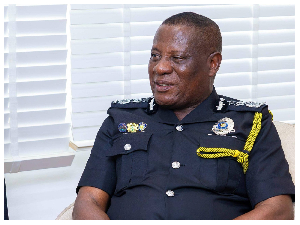
 IGP COP Christian Tetteh Yohuno
“Our elders say, nea yenim no anadwo no, yenso kanea nhwe no awia”—what we know at night, we do not go looking for in the daytime.
This timeless Akan proverb aptly captures growing public sentiment about the leadership of Christian Tetteh Yohuno, Ghana’s Inspector-General of Police (IGP).
Widely described as a “silent strategist,” IGP Yohuno is not known for media theatrics or constant public commentary. Instead, his reputation has been built over decades on meticulous planning, intelligence-led policing, and decisive operations. For those familiar with his track record, his current impact at the helm of the Ghana Police Service is no surprise—it is consistent.
Action, Not Noise
With more than 40 years of service since joining the Ghana Police Service in 1985, IGP Yohuno has steadily risen through the ranks, holding some of the most critical operational and intelligence roles in the Service.
From serving in dual roles as Accra Divisional and Regional Operations Director, to Deputy Accra Regional Commander and later Regional Commander, and subsequently Director-General of Operations and Director-General of the Police Intelligence Directorate (PID), his career has been defined by frontline engagement with Ghana’s most complex security challenges.
As Director-General of Operations, he supervised national security arrangements for major events, including the 2016 general elections and high-level ECOWAS summits—assignments that required precision, coordination, and foresight.
His effectiveness in various roles led former IGP David Asante-Apeatu to task him with establishing what is now known as the Police Intelligence Directorate. At the PID, he strengthened intelligence systems that contributed to resolving high-profile cases, including the Kwabenya Police Station attack and the murder of a Lebanese national in Tema.
A Defining Legacy
Perhaps the most compelling evidence of IGP Yohuno’s operational strength lies in his sustained crackdown on armed robbery syndicates during his tenure in various command positions.
One notable case often cited is that of Kwabena Takyi, also known as “Rasta” or “Not Nice,” a notorious carjacking kingpin who specialised in stealing high-end vehicles—particularly VW Touaregs—and swiftly transporting them across borders, sometimes reaching Togo within two hours. His operations spanned Accra, Kumasi, and extended through the Western Region into Côte d’Ivoire, where such vehicles had a strong resale market.
Beyond this case, Yohuno’s leadership led to the dismantling of several dangerous robbery networks. Names such as Spider Ekow, Rabiu, Awudu, Addis Ababa, Drop-arm, Dotse Babanawo, Benin Boy, and Thunder became synonymous with organised crime at the time.
These groups, often armed with AK-47 rifles, operated brazenly—carrying out robberies both day and night, sometimes firing indiscriminately to instil fear and evade capture.
In one chilling account linked to the Ecobank robberies, criminals reportedly used distraction tactics involving female accomplices to disarm security personnel before striking. Several suspects connected to these crimes, including individuals known as “Not Nice” and Isaac, were eventually arrested and are currently serving lengthy prison sentences at Nsawam Prison.
Intelligence as a Weapon
What distinguishes “CT,” as he is popularly known, is not just his willingness to confront crime, but his reliance on intelligence as the backbone of operations. His methods reflect a deep understanding of criminal networks—their structure, psychology, and movement patterns.
Colleagues often describe his style as “using petrol to quench fire”—a metaphor suggesting decisive and overwhelming responses to serious threats. While unconventional in expression, it reflects the urgency and firmness with which he approaches violent crime.
From Then to Now: Continuity of Results
Today, as IGP, Yohuno’s leadership continues to reflect the same principles that defined his earlier roles: strategic patience, operational discipline, and a results-oriented mindset.
His relatively quiet public demeanour has sometimes been misinterpreted as aloofness. However, within policing circles, it is understood as focus and deliberate leadership.
Conclusion
For the Ghana Police Service, his leadership represents not just experience, but tested competence. For the public, it offers reassurance that the man at the helm is no stranger to the battle against crime—he has been fighting, and winning it, for years.
However, an important question remains: how many police personnel are learning from his dedication, commitment, and results-oriented approach to policing? Ghana does not need a regression in law enforcement, but a sustained commitment to professionalism and effectiveness.

Copyright © 1994 - 2026 GhanaWeb. All rights reserved.










