



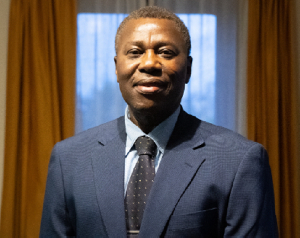
 Dr Isaac Yaw Asiedu is the author
There is a hidden truth in Ghanaian politics that many citizens quietly understand but few openly discuss. It is a secret sitting in plain sight, shaping elections, influencing governance, weakening accountability, and gradually damaging public trust in democracy. The secret is simple: politics in Ghana has become extremely expensive, and those who finance political power often expect returns on their investment after victory.
A comment I recently received captured this uncomfortable reality perfectly: “When a group of people invest their own resources, including money and properties to campaign and win elections, how do they recoup their investments? Isn't it from the public purse?”
This statement may sound provocative, but it raises one of the most important questions confronting Ghana’s democracy today. If millions are spent to gain political power, what happens after the elections are over? Is politics still about service to the nation, or has it quietly become a business venture disguised as democracy?
Many ordinary Ghanaians see only the rallies, party colors, music, speeches, and promises during election periods. What many do not fully see is the enormous financial machinery operating behind the scenes. Political campaigns today require huge sums of money. Vehicles must be hired, supporters transported, media advertisements paid for, party offices maintained, campaign teams financed, and countless political activities funded across the country.
In some cases, candidates reportedly sell personal properties, borrow heavily, or rely on wealthy businessmen and financiers to sustain their political ambitions. Others receive support from individuals and groups who expect political access, contracts, influence, or economic favors once power is secured. This is the secret we often pretend not to know about Ghanaian politics.
The danger begins when politics changes from national sacrifice into financial investment.
When huge financial resources are poured into elections, political office can gradually become viewed as a means of recovering expenditure. Governance then risks becoming less about solving national problems and more about satisfying political networks, rewarding loyalists, and protecting financial interests. This is how corruption quietly becomes normalized in society.
Public contracts may become inflated. State institutions may be weakened for political convenience. Appointments may prioritize loyalty over competence. National resources may slowly be redirected toward sustaining political survival rather than national development.
Meanwhile, the ordinary Ghanaian continues to struggle with unemployment, poor healthcare, unstable electricity, rising food prices, inadequate sanitation, poor roads, and declining confidence in public institutions.
One of the biggest problems fueling this cycle is Ghana’s deeply entrenched “winner takes all” political culture. Political victory is no longer seen merely as an opportunity to serve the nation. For many supporters and financiers, victory represents access to opportunities, influence, contracts, appointments, and economic rewards.
This dangerous political culture weakens meritocracy and discourages patriotic citizens who genuinely want to contribute to national development without political connections. Talented young people begin to lose faith in public institutions because they perceive that success often depends more on political affiliation than competence and integrity.
Yet politicians alone cannot carry all the blame.
Society itself has also contributed to the commercialization of politics. During elections, many voters expect money, gifts, transportation, donations, or personal favors from politicians before offering support. In some communities, candidates are judged not by the quality of their ideas or leadership capacity but by how much money they distribute during campaigns.
This creates a dangerous cycle. If voters expect financial rewards during elections, politicians may naturally feel pressured to recover their expenses after assuming office. Democracy then becomes transactional rather than transformational.
This is one of the painful truths Ghana must confront honestly.
Another worrying development is the growing perception among citizens that political wrongdoing often carries few consequences. Corruption allegations dominate public discussions, but many cases eventually disappear without transparency or clear accountability. Some individuals once aggressively criticized or investigated later return comfortably to public life, celebrated by supporters as though nothing happened.
These developments weaken public confidence and create dangerous signals for younger generations. Honest and hardworking citizens begin to question whether integrity still matters in national leadership. Patriotism weakens when citizens believe political power can protect wrongdoing.
No nation can build sustainable development on such foundations.
If Ghana truly wants to strengthen its democracy, then campaign financing, political accountability, and civic education must become serious national priorities. Citizens must begin to reject vote buying and demand issue-based politics focused on competence, ethics, and national vision rather than emotional party loyalty and short-term financial inducements.
Leadership should never become an avenue for wealth recovery. Public office is supposed to be a sacred responsibility entrusted to individuals for the advancement of society.
Countries progress when leadership is driven by service, discipline, and accountability. Nations decline when politics becomes a marketplace where power is pursued primarily for personal or group enrichment.
The future of Ghana will not depend only on changing governments. It will depend on whether citizens are courageous enough to confront the hidden realities undermining the nation’s democracy.
Because when politics becomes business, it is always the ordinary people who pay the highest price.

Copyright © 1994 - 2026 GhanaWeb. All rights reserved.










