



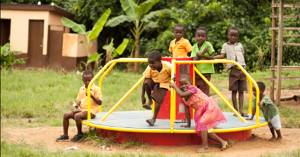
 A file photo of a children's playground
Across many communities in Ghana, a troubling pattern has emerged: open spaces that once served as natural gathering points for children have vanished, replaced by private developments, shops, and rented plots. The result is a generation of children growing up without safe, accessible playgrounds. The root cause of this shortage is not a lack of land or resources, but the actions of traditional authorities who prioritize personal gains over communal welfare.
Ghanaian chiefs hold significant influence over stool and skin lands. Under customary law, they are custodians of these lands, entrusted to manage them for the benefit of the community and future generations. This role carries a duty of stewardship. In practice, however, that duty is frequently abandoned when financial offers arise.
The process is straightforward and damaging. A developer approaches with money for a prime plot near a school or residential area. The land is allocated for commercial or residential use without consultation with the community and without setting aside space for public recreation. Because the transaction is private and often undocumented, there is no accountability. The chief receives payment, the developer builds, and the children lose the space they once used to play football, run, and socialize.
This behaviour is greed, not tradition. Nowhere in Ghanaian custom is the role of a chief defined as selling off communal assets for personal enrichment. The erosion of playgrounds is a direct consequence of treating communal land as a personal asset. When every available plot is monetized, there is no room left for non-revenue-generating public goods. Schools are overcrowded, streets become dangerous play areas, and children are pushed into homes with no space to move.
The impact is measurable. Urban and peri-urban areas with rapid land sales show higher rates of childhood obesity, reduced social interaction, and increased exposure to traffic accidents. Psychologists and educators consistently point to unstructured outdoor play as critical for cognitive and social development. By removing these spaces, chiefs are not just selling land; they are selling away part of childhood itself, because they are myopic.
For example, Southwark, a borough in London with a population of 314, 786 people has 130 green space parks and 250 playgrounds and play areas for children.
The Ashanti region has a population of 3 million but cannot boast on 10 green space parks and playgrounds in the entire region, whiles the greater Accra region also with a population of 6 million cannot boast of 10 green space parks and playgrounds for children.
In Kumasi and its surrounding towns, the story repeats in every suburb, Ejura-Sekyedumase, Konomge, Jamase, Mampong, Asafo, Amakom, Aboabo, Asokore Mampong, and Tafo all had large vacant plots where children played football and games after school. Those plots are now stores, hostels, and private homes.
Traditional authorities in the various towns control most of this land. Community members say allocations happen quietly, without consultation, and without reserving space for recreation. The result is a city of over 3 million people with almost no public playgrounds outside Rattray Park. Children are pushed into roads, gutters, and narrow alleys where accidents and illness are common.
Greater Accra shows the same outcome at a faster speed. In Ga Mashie, La, Teshie, and Nungua, communal lands under Ga chieftaincy structures have been parcelled out for gated housing, shops, and event centers.
East Legon, Madina, Adenta, and Tema have lost nearly all their informal football pitches. The Tema Metropolitan Assembly itself has noted that over 80% of open spaces in some electoral areas are gone. In densely populated areas like Kaneshie, Dansoman, and Mallam, children have no safe place to play once school closes. Even the coastline has been fenced off for hotels, cutting off spaces that once served the whole community.
Fixing this requires chiefs to be held to their original mandate, custodianship, not ownership. Communities need transparent records of land allocation and reserved zones for public use before any sale is approved. Until that happens, the absence of playgrounds in Ghana will remain a symptom of a deeper problem, where traditional authorities choose personal profit over the wellbeing of the children they are meant to protect.

Copyright © 1994 - 2026 GhanaWeb. All rights reserved.










