



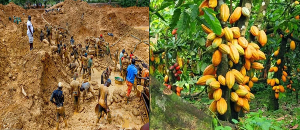
 A file photo of high-tech galamsey and cocoa
Ghana is gradually drifting into a dangerous national dilemma that demands urgent political attention and honest public conversation. Two major crises are converging at the same time: declining cocoa profitability and the aggressive expansion of high-tech galamsey (HTG) operations across the country’s cocoa-growing belt.
Independently, each problem poses serious economic and environmental threats. Together, they form a volatile and potentially devastating cocktail capable of undermining Ghana’s agricultural future, ecological security, and social stability.
For generations, cocoa has served as the backbone of Ghana’s rural economy and one of the country’s most dependable foreign exchange earners. Entire communities across the Ashanti, Western North, Eastern, Bono, and Central Regions have built their livelihoods around cocoa farming. The crop has historically supported education, healthcare, local commerce, and household survival for millions of Ghanaians.
Today, however, confidence in the cocoa sector is weakening rapidly. Farmers are battling rising production costs, climate pressures, disease outbreaks, labour shortages, and unstable market conditions. The recent reduction in cocoa farmgate prices by the Mahama-led government has further deepened anxieties within farming communities already struggling to survive.
At the same time, illegal mining has evolved into a sophisticated and heavily mechanized enterprise. HTG operations are spreading aggressively into cocoa-producing areas, destroying fertile farmlands, polluting rivers, and devastating forests in pursuit of quick gold profits. The danger is clear: as cocoa becomes less rewarding, illegal mining becomes more attractive.
This is the crossroads at which Ghana now stands.
Declining Cocoa Pricing and Growing Farmer Frustrations
The reduction in cocoa producer prices has triggered frustration among farmers and intensified political debate nationwide. Government officials argue that the decision reflects harsh realities within both the domestic and global cocoa sectors.
Internally, COCOBOD continues to struggle with mounting debts, operational inefficiencies, and financial sustainability challenges. Externally, fluctuating global cocoa prices, smuggling pressures, exchange rate instability, and changing international market dynamics have complicated Ghana’s ability to maintain favourable producer prices.
While these explanations may hold economic merit, they offer little comfort to struggling cocoa farmers whose daily realities continue to worsen. The cost of fertilizers, pesticides, transportation, labour, and farm maintenance has increased sharply over the years. Yet producer prices remain unable to adequately compensate farmers for their investments and sacrifices.
For many rural households, cocoa farming is gradually losing its economic attractiveness. Younger generations increasingly view cocoa cultivation as financially unrewarding and physically exhausting. In communities where poverty levels remain high and unemployment opportunities are limited, frustration can easily evolve into desperation.
The political implications are equally significant. The NPP Minority has already begun capitalizing on the discontent surrounding cocoa pricing to intensify criticism of the ruling government. In Ghana’s highly polarized political environment, economic dissatisfaction within cocoa-growing regions can quickly transform into broader national unrest.
However, beyond the political contest lies a far more dangerous reality. When legitimate agricultural livelihoods become unprofitable, vulnerable populations naturally gravitate toward alternative income sources. Unfortunately, HTG is waiting at the doorstep.
The Dangerous Rise of High-Tech Galamsey (HTG)
The expansion of HTG across Ghana represents one of the gravest environmental threats in the country’s modern history. Illegal mining is no longer confined to small-scale informal activities involving picks and shovels. Today’s HTG operations are increasingly mechanized, heavily financed, technologically advanced, and in some cases politically protected.
Excavators now invade cocoa farms with alarming speed. Changfang machines dig aggressively through fertile soils. Forest reserves are being destroyed daily, while rivers that once sustained farming communities are turning into heavily polluted streams contaminated with mercury and toxic mining waste.
The destruction occurring within cocoa-growing regions is especially alarming. Cocoa farms that took decades to establish are being converted into mining pits within days. Farmers facing declining cocoa incomes are increasingly tempted to lease or sell their land to illegal miners because the immediate financial returns appear far more attractive than long-term agricultural investment.
This is where the cocoa crisis and HTG crisis are dangerously intersecting.
Low cocoa prices unintentionally strengthen the economic appeal of illegal mining.
As cocoa profitability declines, HTG emerges as an alternative survival economy for frustrated youth and struggling farmers. The result is a vicious cycle of environmental destruction and agricultural decline.
If this trend continues unchecked, Ghana risks sacrificing a globally respected agricultural heritage for temporary and unsustainable gold gains. The consequences will extend far beyond mining communities. Deforestation, biodiversity loss, land degradation, and water pollution directly undermine climate resilience and contribute to the broader global climate crisis. In effect, the destruction of cocoa ecosystems is not only a Ghanaian tragedy but also an environmental threat with international implications.
No serious nation can destroy its forests, poison its rivers, and abandon its agricultural foundations in the name of short-term mineral wealth without eventually paying a heavy price.
Conclusion and Strong Recommendations
Ghana is entering a dangerous phase where declining cocoa profitability and expanding HTG operations are beginning to reinforce each other. If cocoa farming becomes unattractive and illegal mining remains profitable, the country risks losing both its environmental security and its agricultural future.
The temporary reduction in cocoa farmgate prices may be economically understandable under current global and domestic pressures. However, this cannot become a permanent condition. Cocoa farmers must not be sacrificed while institutional failures within COCOBOD remain unresolved.
To prevent this dangerous cocktail from exploding into a deeper national crisis, Ghana must pursue bold and uncompromising actions:
1.The government must increase cocoa farmgate prices immediately, once conditions within the global cocoa market stabilize. Farmers need renewed confidence that cocoa production remains economically worthwhile and nationally valued.
2.A full-scale institutional cleanup at COCOBOD is urgently necessary. The financial mismanagement, corruption, and administrative failures that weakened the institution over the years must be confronted decisively.
3.Former COCOBOD officials found responsible for reckless mismanagement or corruption should be investigated and held accountable. Public accountability is necessary not only for justice, but also for restoring trust within the cocoa sector.
4.The government should declare a targeted state of emergency in heavily affected HTG zones. This should not be symbolic political rhetoric, but a coordinated national security operation aimed at dismantling illegal mining networks.
5.Security agencies must aggressively flush out illegal miners hiding within forests, river bodies, and cocoa-growing areas. Ghana cannot continue allowing criminal environmental destruction to flourish openly while water bodies and forests collapse before the nation’s eyes.
6.Destroyed rivers, degraded forests, and abandoned mining lands must become a national ecological restoration priority. The environmental devastation accumulated over the past eight years cannot be ignored or normalized.
Ultimately, Ghana must decide whether it wants to remain a respected agricultural nation or become a country consumed by ecological destruction and short-term extraction economics. History will judge this generation not by the speeches delivered about HTG and cocoa, but by the courage shown in confronting both crises decisively.

Copyright © 1994 - 2026 GhanaWeb. All rights reserved.










