



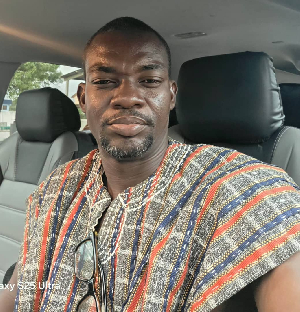
 Dawood Mohammed Abdallah
A Nation Underwater:The crisis in brief
Every year, with grim predictability, the rains arrive and so do the floods. From the waterlogged streets of Accra’s Adabraka and Nima, to the inundated markets of Kumasi, to submerged homes along the White Volta in the North, Ghanaians have been conditioned to accept flooding as an unavoidable fact of life. It is not. Ghana’s perennial flooding is not a meteorological problem. It is a governance crisis rooted in decades of chaotic, unsustainable, and at times criminally negligent urban planning failure.
Ghana’s urban population has exploded from 23% at independence in 1957 to over 57% today, with Accra alone hosting more than four million people. Yet planning frameworks, land-titling systems, drainage infrastructure, and wetland protection policies have utterly failed to keep pace.
Buildings now stand on former floodplains and natural water channels, in many cases on land allocated by statutory authorities without adequate environmental assessment.
Where soil and vegetation once absorbed rainfall, compacted earth and concrete now funnel it violently into choked, plastic-filled drains. Climate change compounds every planning mistake, delivering rainfall that is more intense and unpredictable than at any point in living memory.
Killing our batural flood Defenses:The Wetland Crisis
Perhaps no dimension of this crisis is more tragic or more avoidable than the systematic destruction of Ghana’s urban wetlands. Wetlands are not swamps to be drained and developed.
They are the kidneys of our urban ecosystem: filtering water, absorbing flood peaks, recharging aquifers, and sustaining biodiversity. Science is unequivocal on this. The Korle Lagoon, once a thriving estuarine ecosystem at the heart of Accra, is today a stagnant, polluted shadow choked by sewage and encircled by informal settlements. The Sakumo Lagoon Ramsar site in Tema, which is internationally recognised faces relentless encroachment. In Kumasi, the Owabi and Barekese catchments have suffered deforestation that has diminished their capacity to regulate water flows.
Wetlands that once absorbed tens of millions of litres per rainfall event have been filled, built upon, and forgotten. The flooding of the Longi Hotel at Efuanta in Tarkwa on 4th June 2026 is only the most recent illustration: not a natural disaster, but the entirely predictable consequence of permits issued, plans approved, and warnings ignored.
The human cost: Numbers that should haunt us
The floods of June 2015 in Accra, which killed over 150 people at the Goil filling station alone, exposed in the starkest possible terms the lethal consequences of this planning vacuum.
The 2022 floods across the Northern, Savannah, and Upper West regions displaced over 100,000 people and destroyed crops worth hundreds of millions of cedis.
The 2024 Accra floods, which paralysed the capital for days, rendered thousands homeless and inflicted losses estimated at over GH₵500 million. And lest we confine this crisis to the national capital, let us look to Tarkwa, where on 4th June 2026 the flooding of the Longi Hotel at Efuanta laid bare, in the most visceral terms, serves as a typical example of reckless disregard for natural waterways and low-lying wetland terrain that plagues our urban development in Tarkwa.
When the rains come, nature simply takes back what was never ours to build upon. The flooding at Efuanta is not a natural disaster. It is the entirely predictable consequence of permits issued, plans approved, and warnings ignored, a monument to what happens when development is allowed to override ecology and sustainable planning.
The Way Forward: A six-pillar framework
The solution is not simple, but it is knowable. Drawing on international best practice, African precedent, and Ghana’s own planning heritage, a six-pillar framework can end this crisis:
Pillar 1: National Urban Planning Overhaul:
Empower LUSPA (Land Use and Spatial Planning Authority, Act 925 of 2016) with real enforcement authority: the power to halt illegal construction, sanction non-compliant developments, and hold planners legally accountable for failures that cost lives.
Pillar 2: Mandatory Floodplain and Wetland Mapping:
No building permit should be issued without verification against a current, GIS-based national floodplain registry standard practice in Germany, the Netherlands, and Singapore. Any land within a defined floodplain or wetland zone should be automatically classified as non-developable.
Pillar 3:Aggressive Wetland Restoration
Declare wetland preservation a matter of national security. Commission a National Wetland Restoration Programme, beginning with the Korle Lagoon, Sakumo Lagoon, and key peri-urban wetlands in Kumasi, Tamale, and Takoradi, financed through national budget, EU Green Deal partnerships, and African Development Bank climate finance.
Pillar 4 : Green and Blue Infrastructure Integration
Modern flood management goes beyond concrete drains. Urban forests, rain gardens, bioswales, permeable paving, restored streams, constructed wetlands, and retention ponds can dramatically reduce surface runoff. Cities like Medellín and Qinhuangdao have already proved this is possible. Pillar 5: Formalisation of Informal Settlements:
Eviction without alternatives is a human rights violation that merely relocates misery. Government must invest in participatory in-situ upgrading programmes: formalising tenure, improving drainage, and building community resilience infrastructure far cheaper than repeated flood damage and emergency response.
Pillar 6: Climate-Smart Building Codes and Enforcement
All new developments must conduct hydrological impact assessments and demonstrate ‘hydrological neutrality’. Sustainable drainage systems (SuDS) must become mandatory. An unenforced code is not a code: it is a suggestion. The culture of impunity around illegal construction must end.
A Call to My Colleagues in Land Governance I write this not only as a commentator but as someone embedded within Ghana's land governance architecture. The Lands Commission of which I am proud to serve as a board member in the Western Region has a central role to play in this crisis. We must urgently review our allocation procedures to ensure that no parcel of land in a flood plain, wetland, or natural drainage corridor is leased or titled for development without exhaustive environmental scrutiny.
We must collaborate more effectively with LUSPA, the Environmental Protection Agency, and the Water Resources Commission. And we must be willing to make decisions that are unpopular with powerful interests when those decisions protect the public good.
The International Dimension
What Ghana Owes Its Citizens And The World As an EU/AU Ambassador for Sustainable Transition, I see Ghana's flood crisis through an additional lens: our obligations under the Paris Agreement, the Sendai Framework for Disaster Risk Reduction, and the Kunming-Montreal Global Biodiversity Framework. Ghana has made ambitious commitments to climate adaptation and resilience.
Our cities are the frontline of climate change in West Africa. Failing to plan them sustainably is not merely a domestic governance failure, but a breach of our international obligations and an opportunity cost for the climate finance that flows to countries demonstrating credible, implementable plans.
The EU's Global Gateway initiative, the AU's Agenda 2063, and the African Development Bank's Cities and Urban Infrastructure investments are all available to Ghana but they require demonstrated governance quality, transparent land systems, and evidence-based spatial planning. Getting our urban planning right is not just the right thing to do for our citizens: it is the gateway to transformational international partnership.
Conclusion
The Water Will Come Again Will We Be Ready? The rains will return. The question before Ghana is not whether it will rain, but whether the water that falls will be managed by a nation that planned for it or overwhelm a nation that did not. We have the knowledge. We have the legal frameworks. We have access to finance, technical expertise.
Ghana’s obligations under the Paris Agreement, the Sendai Framework for Disaster Risk Reduction, and the Kunming-Montreal Global Biodiversity Framework make this not merely a domestic imperative but an international one.
Our wetlands are not obstacles to development. They are its precondition. Our flood plains are not wasteland. They are working landscapes that keep our cities alive. It is time to stop burying our rivers and start planning our cities. It is time to stop mourning our floods and start preventing them. Ghana’s children deserve cities that do not drown. Let us build them.

Copyright © 1994 - 2026 GhanaWeb. All rights reserved.










