



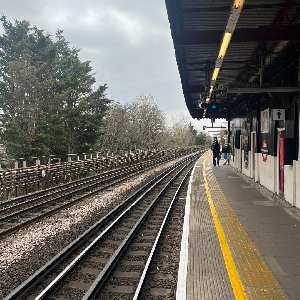
 A well-regulated railway system
The irony of Ghana’s ins titutional landscape is often revealed in the smallest, strangest moments.
In April 2024, under the New Patriotic Party (NPP) administration, a newly tested train collided with an abandoned lorry during a test run on the Tema–Mpakadan railway line, damaging the train’s cabin.
The incident triggered a heavy national security response, with some officials suspecting political sabotage. The driver was pursued as if he was involved in a coordinated act.
Fast forward to a later period under the National Democratic Congress (NDC), and the scene shifts but the underlying story remains the same.
Officials from the Ghana Railway Security team found two young men fast asleep on a wooden bench placed directly across the tracks. They were lashed awake, beaten and dragged by officers baffled that anyone could sleep on a railway line.
The explanation was simple: the tracks ran through what the young men considered their compound. Their makeshift homes stood only metres away.
The instinctive reaction is disbelief. How could anyone behave this way? But the truth lies less in individual choices and more in the systems that shape them.
These incidents are not isolated. They reflect broader patterns of indiscipline, desperation and structural neglect across many communities.
During seasonal floods, social media routinely shows residents dumping refuse into gutters, relying on rainfall to wash it away.
In other cases, drainage channels are blocked with concrete slabs to create makeshift walkways and trading spaces.
It is easy to call this foolishness or point to illiteracy or perhaps behaviours that seem difficult to reconcile with our own.
But the deeper question is: what kind of system produces such behaviour?
In countries where railways operate safely, even in remote areas, guard rails, barriers and exclusion zones are standard. Not because citizens are perfect, but because planners understand that humans — and animals — will cross tracks, sleep near them, or build too close if the environment allows it.
Systems anticipate human behaviour and are designed to protect people from foreseeable risk.
While parts of Ghana’s railway network have guard rails and protected zones, sections running through dense, unregulated settlements often lack adequate barriers.
As a result, predictable risks emerge. When infrastructure is built without proper safeguards, people treat it as an extension of their living space. And if today two young men can place a bench on the tracks, tomorrow entire structures may rise along the lines, setting the stage for a major catastrophe.
This is not simply about discipline. It is about planning, governance and a state that fails to protect its most vulnerable citizens yet punishes them harshly when they behave in ways the system itself has enabled.
Discipline matters.
But discipline without functioning systems eventually becomes punishment for predictable behaviour. The harder task is not demanding better citizens; it is building institutions and environments that make better choices easier to make.
The lesson is uncomfortable but clear: where systems fail, even the irrational becomes normal.
Until Ghana confronts the structural roots of these behaviours — planning failures, regulatory gaps and political self-interest — the cycle will continue. Breaking it demands more than sermons on discipline.
It requires leaders and citizens willing to build systems that make responsible behaviour the path of least resistance, rather than punishing the predictable outcomes of systemic neglect.

Copyright © 1994 - 2026 GhanaWeb. All rights reserved.










