



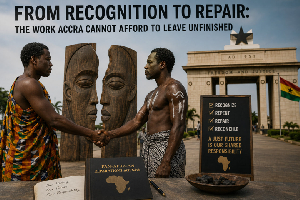
 The task before us is to move from recognition to repair
There is a particular danger that haunts every great diplomatic victory, and it is the danger of mistaking the victory for the destination. On the 25th of March 2026, the United Nations General Assembly did something it had never done in eighty years of existence.
By a vote of 123 member states, it declared the trafficking and enslavement of Africans the gravest crime against humanity. It was a moment worth marking, worth celebrating, worth carrying home to tell the children.
But Kwesi Pratt Jnr, General Secretary of the Socialist Movement of Ghana and Coordinating Committee board member of the Pan- African Progressive Front, stood before the High- Level Consultative Conference in Accra and said something that truly needed saying in that moment of discussion; Recognition, however historic, is not enough. The task before us is to move from recognition to repair.
That sentence is the spine of everything the Accra conference must become. It is easy, almost seductive, to let a resolution become a relic, something quoted at anniversaries and forgotten in between. Pratt named that danger directly when he warned that the resolution must not be allowed to become “a ceremonial document, buried in archives, cited once a year, and then forgotten.”
The world has seen this pattern before. Commissions are formed. Reports are published. Apologies are issued with great solemnity. And then, quietly, without anyone quite deciding it should happen, the matter is set aside, and the structures of inequality it was meant to address simply continue operating as they always have.
What makes Pratt's intervention so necessary is the precision with which he refuses easy comfort. He reminded the gathered delegates that the Trans- Atlantic Slave Trade was not an accident of history but a constructed system. Its violence was not accidental, he said. “It was planned, financed, insured, legalized and defended. Ships were built for it. Banks invested in it. Insurance firms protected its profits.” This is not abstraction. This is an indictment of specific institutions whose descendants continue to hold wealth, power and prestige built on that foundation. And it is here that Pratt drew the line that mattered most for everyone watching the conference unfold in real time.
He stated plainly that he found the participation of the President of France, Emmanuel Macron, in the meeting totally unacceptable, insisting that the gathering should not become a forum for hollow expressions of sympathy and the propaganda of perpetrators of the crimes for which reparations are being sought.
That is a hard line to draw inside a conference built on dialogue, and not everyone in the room shared it. The African Union came to Accra with a different register, one built less around confrontation and more around institutional architecture.
Speaking on behalf of the AU Commission, H.E Amma Twum- Amoah laid out, in careful and deliberate detail, just how far the continental body has already moved. Through Assembly Decision 884, the African Union designated 2025 as Justice for Africans and People of African Descent through Reparations, and Assembly Decision 942 extended that commitment by designating 2026 through 2035 as the Decade of Reparations.
This is not the language of sentiment. It is the language of institution building, of bureaus and terms of reference and coordination teams stretching from Addis Ababa to Accra.
The AU's intervention offered the scaffolding. The African Union Committee of Experts on Reparation and the African Union Reference Group of Legal Experts on Reparations, both comprising distinguished jurists nominated by member states, held their inaugural meeting in Addis Ababa in December 2025 and have since organized themselves into working groups covering global governance, economic and environmental reparations, cultural and educational reparations, and advocacy.
This is precisely the kind of permanent, coordinated mechanism that Pratt insisted Africa and the diaspora need, a body with a clear mandate to research, document, advocate, negotiate and monitor progress, not a symbolic gesture dressed up as an institution.
Read together, these two speeches complete each other in a way that neither could alone. Pratt supplies the moral urgency and the refusal to be flattered into complacency by apology without structural change.
He reminds the room that the wealth gap between Africa and the industrialized West is not the result of African laziness or European genius. It is the result of centuries of extraction. The African Union supplies the architecture through which that urgency might actually be channeled into durable practice, reminding delegates that if our cause is continental, our response must be coordinated, and if our argument is legal, our preparation must be rigorous.
The AU representative was explicit that guarantees of non- repetition must be understood in structural terms, because, as she put it, we cannot credibly say never again while preserving a global system founded upon inequity, exclusion and inherited hierarchies of power. That is not a different argument from Pratt's insistence that responsibility does not lie in abstraction, that history did not build the ships, specific states and companies and banks did, and their successors cannot inherit the wealth while rejecting the responsibility.
The five tasks Pratt laid out before the conference, institutional, legal, educational, developmental, and cultural, are not abstractions either. They are a checklist against which Accra's outcome document can and should be measured once the speeches end and the delegates return home. A permanent reparations commission. Legal claims researched against the states, companies and institutions that profited from enslavement. A global education campaign correcting the distorted history still taught in too many classrooms.
Development financing, debt cancellation and industrial support tied explicitly to historical justice. And the return of stolen cultural property treated, in Pratt's words, not as generosity from museums, but as a legal and moral obligation.
Whether the Accra conference is remembered as the moment recognition finally became repair, or as one more dignified ceremony in a long history of dignified ceremonies, depends on whether these tasks survive the closing of the hall.
Pratt closed his address with a line that deserves to outlast centuries; “From recognition, we must move to repair. From memory, we must move to mobilization. From declaration, we must move to justice. And from justice, we must build the full restoration, dignity and liberation of Africa and her scattered children across the world. We cannot fail. We will be victorious!”

Copyright © 1994 - 2026 GhanaWeb. All rights reserved.










