



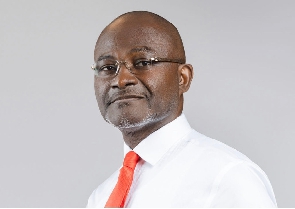
 Kennedy Agyapong is a member of the New Patriotic Party
For more than a decade, Kennedy Ohene Agyapong has built a political brand around a familiar phrase: “I will mention names.”
Time and again, he has warned of explosive revelations, promised to expose powerful individuals, claimed possession of damaging documents, and threatened to unmask hidden conspiracies.
These threats are often presented as evidence of courage and a commitment to accountability. Yet a review of the public record reveals a recurring pattern: dramatic promises followed by silence, delay, or abandonment.
Below is a chronological record of twelve notable instances where threats of exposure generated headlines but produced little or no publicly verifiable follow-through.
1. Electoral Commission intimidation(2016)
Ahead of the 2016 general elections, Kennedy Agyapong publicly threatened to reveal damaging details about then Electoral Commission Chairperson Charlotte Osei and the circumstances surrounding her appointment.
Outcome: The promised details were never publicly disclosed, leaving the threat unresolved after significant public attention had already been generated.
2. The Ibrahim Mahama ultimatums (2017–2018)
Kennedy Agyapong repeatedly claimed to possess extensive evidence of corruption involving businessman Ibrahim Mahama. At one point, he dramatically declared that he would poison himself if Ibrahim Mahama was not prosecuted and jailed.
Outcome: No major investigative dossier, insider revelations, or promised names emerged, and the matter quietly faded away.
3. J.B. Danquah-Adu murder claims (2018)
Following the murder of Abuakwa North MP J.B. Danquah-Adu, Kennedy Agyapong repeatedly suggested that he knew the identities of powerful individuals behind the crime and hinted at a wider conspiracy.
Outcome: Despite years of public claims and the matter becoming relevant in court proceedings, no such names or conclusive evidence were publicly produced by him.
4. The Anas exposure campaign (2018)
After the release of the Number 12 corruption exposé, Kennedy Agyapong promised to expose investigative journalist Anas Aremeyaw Anas, his operations, financiers, and alleged hidden networks.
Outcome: Beyond public attacks and disputed claims, the promised revelations of a broader hidden network never materialized.
5. Ahmed Hussein-Suale and Tiger Eye PI (2018)
Kennedy Agyapong publicly exposed photographs of undercover journalist Ahmed Hussein-Suale and promised to dismantle what he described as corrupt networks associated with Tiger Eye PI.
Outcome: While identities were exposed, the wider list of alleged corrupt associates and networks he promised to reveal never surfaced.
6. Threats against NDC officials(2018–2020)
Over several election cycles, Kennedy Agyapong repeatedly claimed to possess evidence of corruption involving leading NDC figures, often warning that he would release names if challenged.
Outcome: The promised names were largely never disclosed, reinforcing perceptions that the threats served political rather than investigative purposes.
7. Attack on the judiciary (2020)
Following a court ruling in a land dispute, Kennedy Agyapong attacked High Court Judge Justice Amos Wuntah Wuni and suggested misconduct within the judiciary.
Outcome: No evidence of judicial corruption was subsequently produced. Instead, he publicly apologized to the Chief Justice and the judiciary.
8. The security agencies' ultimatum (2021)
Kennedy Agyapong announced that if state security agencies failed to identify those responsible for Ahmed Hussein-Suale’s murder, he would release the names himself.
Outcome: The deadline passed without any names being publicly disclosed.
9. NPP internal “Saboteurs" (2021–2022)
During internal tensions within the NPP, he repeatedly claimed to know the identities of individuals undermining the party from within and threatened to expose them.
Outcome: No comprehensive list of saboteurs was ever publicly produced, and the threats gradually disappeared.
10. The presidential primary “Showdown” (2023)
During the NPP presidential primary contest, Kennedy Agyapong warned President Nana Akufo-Addo and Vice President Mahamudu Bawumia of a coming “showdown,” suggesting he would reveal information capable of shaking the government.
Outcome: The anticipated disclosures never came, and no explosive revelations followed.
11. Ports and customs corruption claims(2023–2024)
While campaigning for the NPP flagbearership, he repeatedly claimed to possess documents exposing major corruption within Ghana’s ports, customs administration, and ministries.
Outcome: The alleged documents were never publicly released nor formally submitted for investigation, and no major names were exposed.
12. Post-primary retaliation threats(2026)
Following his unsuccessful presidential bid, Kennedy Agyapong has threatened to release sensitive party information and wage a sustained media campaign against the NPP, threatening that major disclosures would come at a later date.
Outcome: As of today, no significant disclosures have emerged, leaving the threat consistent with previous patterns. July 2027 will come, and there will be no show. By that, he would have deceived many to follow him in accordance with his usual political style of creating followers.
The big question
Taken together, these twelve episodes reveal a recurring feature of Kennedy Agyapong’s political style: the repeated promise of explosive revelations that either never arrive or arrive without the evidence necessary to sustain their impact.
This raises an important question for Ghana’s democratic discourse: If the objective is truly accountability and anti-corruption, why are such allegations so often announced through media threats rather than submitted directly to institutions such as the Office of the Special Prosecutor (OSP), the Commission on Human Rights and Administrative Justice (CHRAJ), or the Ghana Police Service?
The credibility of any person who claims to be an anti-corruption crusader ultimately rests not on threats, warnings, or promises to “mention names,” but on the presentation of verifiable evidence that can withstand public scrutiny and legal examination.
Kennedy Agyapong must know that a democracy is strengthened when allegations lead to investigations, evidence, and justice. The expiry date of his political style of threatening to mention names is approaching very fast.
Sooner or later, people will either laugh at his threats or be suspicious that he issues these threats to negotiate for personal economic benefits or just to deceive people into following him. The pattern above is more than instructive to this effect.
Joseph Cudjoe Former Minister for Public Enterprises Former MP for Effia Constituency

Copyright © 1994 - 2026 GhanaWeb. All rights reserved.










