



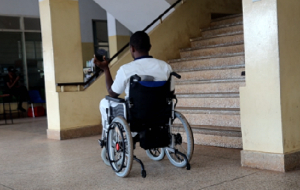
 A disabled man user navigates an inaccessible public facility in Ghana
In 2006, Ghana made history as the first West African country to pass a comprehensive disability law. This showed early leadership in protecting the rights of persons with disabilities (PWDs).
Twenty years later, the implementation of this law has lagged far behind. Approximately 8 percent of Ghanaians, representing more than 2.1 million people, live with some form of disability, yet accessibility in public spaces remains critically limited.
A recent audit found that only about 14 percent of public buildings are disability-friendly. Accessibility is not simply an infrastructure issue; it is central to freedom, equal opportunity, and the protection of fundamental human rights.
Furthermore, accessibility issues have economic implications, as countries that exclude a significant portion of their population from public life leave productivity, consumer spending, and entrepreneurship on the table.
Closing Ghana's accessibility gap demands linking public funding to accessibility compliance, establishing a dedicated enforcement body, and integrating inclusive design into national planning.
Inaccessible public spaces in Ghana do more than inconvenience persons with disabilities; they systematically exclude millions from national life. When schools, hospitals, transport systems, and public offices become barriers, people are denied education, healthcare, employment, and civic participation. This limits workforce participation, reduces national productivity, and increases long-term social welfare costs.
The World Bank estimates that excluding PWDs from the workforce costs economies between 3 and 7 percent of GDP annually. For Ghana, a country actively pursuing middle-income growth, that is a loss it cannot afford. If this problem persists, Ghana will continue to underutilize a significant portion of its population and fall short of its commitments to equality and inclusive development.
Ghana has laws that protect the rights of PWDs, but these laws are rarely enforced. Contractors complete publicly-funded projects and receive payment even when ramps, accessible washrooms, tactile paving, and lifts are missing. Linking public funding to accessibility compliance changes this immediately. No publicly financed project should receive final payment unless it meets clear accessibility standards.
Ghana’s House of Parliament can set mandatory accessibility standards for schools, hospitals, markets, transport terminals, and government offices. The Ministry of Works and Housing can require accessibility certification before approving completion of a project. Procurement authorities can include accessibility requirements in contracts and withhold payment until compliance is verified.
Private construction firms and developers bidding for public contracts must meet the same standards as a condition of eligibility. Regular inspections can sustain accountability. When financial consequences are real, contractors take standards seriously.
Public money stops funding exclusion, and persons with disabilities gain access to spaces they have long been denied. This approach has worked in the United States, where federal infrastructure funding is tied to compliance with the Americans with Disabilities Act, and institutions risk losing funds when they fail to meet requirements.
In Ghana, responsibility for accessibility enforcement is spread across multiple ministries, district assemblies, and agencies with little coordination. Because everyone is responsible, no one is truly accountable. Violations go unpunished, inaccessible buildings remain in use, and citizens have no clear way to report problems. Ghana needs a dedicated National Accessibility Inspectorate with the authority to monitor and enforce compliance.
This body should have the power to inspect buildings, issue compliance certificates, impose fines, and publish annual reports. Parliament can establish the Inspectorate through legislation and give it authority over both public and private buildings.
Private sector associations, including the Ghana Real Estate Developers Association and the Association of Ghana Industries, can partner with the Inspectorate to develop sector-specific compliance guidelines. A public database listing compliant and non-compliant institutions can improve transparency. District assemblies can support by reporting local violations and providing data.
Beyond enforcement, accessibility is often treated as an afterthought because it is not built into Ghana’s development decisions from the start. Buildings are designed first, and accessibility is considered later, making changes more expensive and less effective. A feasible solution is to include accessibility in national planning from the start. Infrastructure should be designed to be inclusive before construction begins.
Ghana can revise its building codes to require accessible designs at the approval stage. The National Development Planning Commission can require disability impact assessments for major projects. Private developers seeking planning permission can be required to demonstrate accessibility compliance before approvals are granted. Ministries can set annual accessibility targets and report on progress.
Universities and technical institutions can strengthen training in inclusive design. Planning for accessibility benefits everyone. It supports persons with disabilities, the elderly, pregnant women, injured individuals, and parents with young children.
It also reduces long-term costs by avoiding expensive modifications later. Countries like Rwanda have taken this approach by including disability inclusion in national development strategies. This ensures accessibility is built into planning decisions, not added later.
Ghana’s accessibility gap shuts many citizens out of everyday life, which limits equal participation and slows national progress. If nothing changes, persons with disabilities will keep facing barriers to education, healthcare, work, and public services, deepening inequality and reducing overall productivity.
The Government must enforce accessibility compliance through funding conditions, establish a dedicated enforcement body, and integrate inclusive design into planning and construction from the outset. Embedding accessibility into national systems will build a more inclusive society where public spaces serve everyone.

Copyright © 1994 - 2026 GhanaWeb. All rights reserved.










