



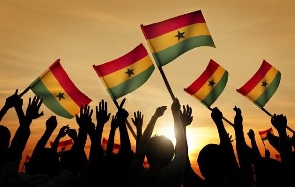
 A file photo representing the story
We are treading on a slippery path as Ghanaians. A path where power buys its own protection, and where the law bends for those who can afford to make it bend.
It starts quietly. An influential person purchases weapons. Not for the state. Not for the national interest.
For himself. And then he hands those weapons out like favors, turning ordinary men into private security guards with guns in their hands and authority they were never legally given. The law is clear: a private security guard in Ghana is not permitted to carry firearms. That rule exists for a reason.
It exists because when force is privatized, peace becomes negotiable. Yet today, men in borrowed uniforms and unauthorized weapons escort politicians, businessmen, and celebrities through our streets as if Accra were a war zone and their lives mattered more than the law.
And then there are the motorcades. Long convoys that stop traffic, silence sirens, and tell every Ghanaian on the road: “Your time is less important than his.” No individual, no matter how wealthy or connected, should be allowed to run a private motorcade.
Roads are public. Order is public. The monopoly of force is public. Once we start auctioning those things off, we are no longer one country. We become a collection of private kingdoms, each with its own army, each with its own rules.
A time is coming where we won’t be able to control or stop this. That time is not far. Weapons, once distributed, do not ask for permission before they speak. They do not expire when loyalty fades.
They do not disappear when the man who bought them falls from favor. They stay. In hands. In homes. In hidden places. And the men who carry them today as “security” will tomorrow decide who their real enemy is. If we turn a blind eye now, we will regret it as a country in the near future.
We will regret it when the guns we ignored become the guns we cannot retrieve. When “havoc” is no longer a warning, but a headline. Ghana has been peaceful not by accident, but because we agreed, as a people, that only the state bears arms on our behalf. That agreement is fraying.
These days you cannot walk through town without seeing it. Men in all sorts of tactical uniforms. Patchwork camouflage. Bulletproof vests.
Boots that were made for battle, not for guarding a gate. These are not just clothes. They are signals. Clear signs that Ghana is losing it.
That the line between state security and private militia is being erased, one uniform at a time. When everyone dresses like an army, the public begins to believe there is no army left to protect them.
A nation is not destroyed in one day, it is eroded. One illegal gun at a time, one unauthorized siren at a time. One “it’s okay because he’s important” at a time. If we do not draw the line now, if we do not pick up those who hand out weapons without due process and make them answer questions before a court, not before cameras then we are choosing a future where Ghana’s peace is kept not by law, but by whoever has the most guns.
We are better than this, our fathers and mothers did not fight for independence so their children could live in fear of private armies. Peace is not passive. Peace is protected and it is protected by insisting that no man is above the law, that no wealth can buy a gun license, and that no motorcade can outrank the Constitution.
Ghana, we must wake up before the slippery path becomes a fall we cannot climb back from.

Copyright © 1994 - 2026 GhanaWeb. All rights reserved.










