



 Isaac Aditim is the author of this article
Ghana's Black Stars are loved far beyond our borders. They belong to people who have never set foot in Accra, never tasted kelewele on a rainy evening, and never stood for the national anthem at the Baba Yara Stadium. Yet, the flag of Ghana flies on their shoulders, is painted on their faces, and hangs in their homes.
I know this because I am privileged to serve on a peacekeeping mission in Somalia, where I meet people from every corner of the world. Again and again, I hear them speak of Ghana with warmth, respect, and pride.
During the ongoing World Cup, the streets of Mogadishu and the corridors of the AUSSOM Camp tell the same story.
Strangers stop me, smile, and say, "Come, let's watch Ghana's match together." They do not ask whether I am from Accra or Kumasi. They simply see the Ghana flag on my uniform and assume, correctly, that my heart beats with theirs for those ninety minutes.
This alone should tell our leaders something profound: the Black Stars are not just a team. They are an idea—an idea of courage, flair, and resilience that has travelled farther than any diplomat's speech ever could.
And when Ghana loses a match that matters, their hearts break too. I have seen it. Men who have no Ghanaian blood in their veins sit in silence, their heads in their hands, because the Stars they adopted have lost.
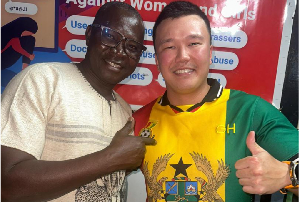
The man in this picture is a Chinese national I met here in Somalia. He is wearing Ghana's colours with pride, and he is not alone. All around me are soldiers, aid workers, and civilians from different nations asking me the same question: "Do you have a Ghana flag shirt? A jersey? Anything with the Black Stars on it?"
They want to wear our colours. They want to be associated with us. That is soft power. That is influence money cannot buy.
It is also a clear message to those managing the affairs of Ghanaian football—the Ghana Football Association and every stakeholder—that the world is watching, believing, and waiting for us to get it right.
It is shameful when Ghana, a nation that once defined African football, misses major tournaments. The silence that follows our absence is heavier than any defeat.
In Ghana, politics divides us. Tribe, religion and party colours pull us in different directions. But when the Black Stars step onto the pitch, Ghana becomes one—one voice, one prayer and one heartbeat.
Football erases our differences. It reminds us that before we are NPP or NDC, Akan or Ewe, Christian or Muslim, we are Ghanaians.
Football unites the nation in a way few other things can. That unity is a resource, and resources must be managed with honesty, vision and discipline.
I humbly call on the government, the Ghana Football Association, corporate Ghana and every stakeholder to come on board—not with slogans, but with structures: clear management systems and transparent administration; investment in grassroots football development; protection of our players from exploitation; and a system that makes wearing the Ghana jersey an honour, not a burden.
When our national teams are attractive, well-run, well-resourced and well-respected, our players in the diaspora will not need convincing. They will run home to the country of their origin because home will be worth running to.
The world already loves the Black Stars. Somalians love them. Chinese peacekeepers love them. Children in refugee camps who cannot point to Ghana on a map still know the name "Black Stars."
Imagine what we could achieve if we matched that global love with local competence. Imagine if we put our selfish ambitions aside and built teams worthy of the flag they carry.
A World Cup triumph is not a fantasy. It is a target, and targets are reached when a nation decides together that mediocrity is no longer acceptable.
Ghana's flag is flying all over the world.
Let us make sure the team beneath it is flying too.

Copyright © 1994 - 2026 GhanaWeb. All rights reserved.










