



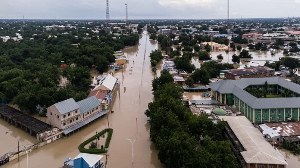
 The June 29 floods submerged several roads and communities across Ghana
On Monday, June 29, 2026, Accra didn't just flood; it surrendered. As major arteries submerged and thousands found themselves stranded, the narrative remained hauntingly familiar: "The rains were heavy."
That framing is a convenient half-truth. The rain was a meteorological event. The disaster at least 12 confirmed deaths, more than 38,800 residents affected, and homes and businesses submerged across Accra, Kaneshie, Adabraka, Weija, and Tema was, in significant part, a human choice.
In Accra, we have moved past the era of "natural disasters" and into an era of predictable negligence. Every rainy season brings the same tragedy. We document it on the same smartphones, voice the same frustrations, and watch the water recede, only to return to comfortable silence until the next cloud gathers.
Following the June 29 downpour, President John Dramani Mahama's aerial inspection of the affected communities laid bare a city gasping for air. Preliminary data cited by the President put the day's rainfall at approximately 140 millimetres, one of the highest single-day totals Accra has recorded in years, and more than double the highest daily figure recorded in 2025.
He noted that rainfall within June alone had climbed sharply: from roughly 85 millimetres in June 2024, to 172 millimetres in June 2025, to about 333 millimetres this June. "This means that our waterways no longer have sufficient time to recover before more rain falls," he said. It rained on 22 of June's 30 days this year, leaving the city's drains almost no window to reset.
The President's acknowledgment that Accra's physical layout, shaped by rapid urbanisation and construction along natural water paths, is a central culprit is a long-overdue admission. His government's response has included a GH¢300 million release from the Contingency Fund (half for immediate relief, half for mitigation projects), a pledge to remove structures obstructing waterways, and a longer-term, two-decade proposal to relocate some government institutions to a new growth centre outside Accra to ease pressure on the capital. These are necessary steps. They are also, by the President's own framing, reactive ones, patches applied after the wound, not before it.
That reactive pattern isn't unique to Ghana. Across the continent, cities are paying for decades of planning failures. In March 2026, flash floods tore through Nairobi after the Nairobi River burst its banks; the death toll climbed for weeks as search efforts continued, eventually passing 100 nationally, with tens of thousands displaced and damage severe enough that Kenyan authorities pledged several hundred million dollars toward an infrastructure recovery plan.
Residents and experts pointed to the same lethal combination seen in Accra: waste-choked drainage, construction on riparian land, and rainfall intensifying faster than infrastructure built decades ago was ever designed to handle.
From Kenya's floods to Ethiopia's landslides to the inundation of rice fields in Ghana's Ketu North, the pattern holds: our cities are expanding faster than our governance can manage.
It would be unfair to lay this only at the government's door. Ghana's opposition NPP has argued the administration bears full responsibility for infrastructure and planning failures; the government, in turn, has pointed to citizens' waste-dumping habits and even to the Meteorological Agency's public communication as contributing factors.
Both critiques carry some truth, and neither cancels the other out. Climate-intensified rainfall, weak enforcement of building codes, poor waste management, and under-invested drainage infrastructure are not competing explanations; they are the same failure, viewed from different institutional seats.
That is exactly why the response cannot stop at relief money and blame-shifting. A demolition crackdown on illegal structures matters, but only if it is paired with enforced riparian buffer zones that prevent new construction from replacing the old.
A GH¢300 million relief package matters, but it is a fraction of what sustained drainage modernisation will cost, and Accra's history shows how quickly emergency funding gets absorbed by the next crisis before mitigation work is finished.
As journalists, our responsibility cannot end with documenting destruction. Climate journalism should not only report the chaos; it must interrogate the systems that permit it. We have become remarkably good at filming the flood. We have not become equally committed to examining the political and economic choices that turn rain into tragedy.
This year, the TN Africa Digital Journalism Summit convenes under the theme "Drawing the Flood Line: Climate Resilience, Urban Planning and Africa's Future." We chose that title deliberately. For too long, we have drawn the line only after disaster strikes, mapping communities after they are ruined, inspecting drains after they have failed.
The next flood line should be drawn before the water rises, not after.

Copyright © 1994 - 2026 GhanaWeb. All rights reserved.










