



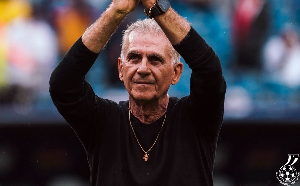
 Carlos Queiroz
There is a temptation, in football-mad nations like ours, to judge a coach purely by scorelines. Win, and he is a hero. Lose, and he is discarded. Ghana's 2026 World Cup journey under Carlos Queiroz has just ended — a narrow 1-0 defeat to Colombia in the Round of 32, Jhon Arias scoring inside 14 minutes and Ghana unable to register a single shot on target across the full 90.
It is a disappointing way to bow out. But it is precisely at this moment — when the emotional temptation to discard him is strongest — that Ghana must think clearly rather than reactively. Because Queiroz's brief time with the Black Stars has already revealed something far more valuable than a single tournament result: a 73-year-old football mind with four decades of global coaching experience, currently sitting inside our national set-up, largely untapped beyond his role as head coach of the senior national team.
This article makes one central argument: now that the 2026 World Cup has ended for Ghana, and regardless of whether the Ghana Footbal Association (GFA) retains him (Carlos Queiroz) as Black Stars coach, the Government of Ghana should find a formal, integral role for Carlos Queiroz within the Ministry of Youth and Sports. Not as a favour to him — but as a strategic investment in the future of Ghanaian sport.
A résumé most nations would kill for
Queiroz was appointed in April 2026 under difficult circumstances — Ghana was the only qualified nation without a head coach, just weeks before the tournament, after Otto Addo's dismissal following a poor run of results.
He inherited a squad missing Tottenham's Mohammed Kudus to injury and clouded by Thomas Partey's legal troubles, which kept the midfielder out of the opening match entirely. In that short window, Queiroz still steadied a shaken squad, guided them past Panama, held England to a goalless draw, and led Ghana into the World Cup's knockout stages for the first time since the historic 2010 quarter-final run — advancing as one of the tournament's better third-placed teams.
The campaign ultimately ended in the Round of 32, beaten 1-0 by a sharper, more clinical Colombia side. It was a disciplined, defensively resolute Ghana that simply ran into a better team on the day — not a team that embarrassed itself on the world stage. That distinction matters, and it is why his value to Ghana was never only about the next 90 minutes.
Consider the breadth of what he brings:
• He coached Portugal's Under-20 team to back-to-back FIFA World Youth Championship titles in 1989 and 1991, developing the nucleus of what would become Portugal's "Golden Generation" — Luís Figo, Rui Costa, and others who would go on to define a footballing era. This is not incidental. It is direct, proven evidence that Queiroz is, at his core, a builder of young talent, not merely a caretaker of the already-arrived.
• He has managed nine different national football associations across Europe, Africa, Asia, the Middle East, and the Americas — Portugal, South Africa, Iran, Colombia, Egypt, Qatar, Oman, the UAE, and now Ghana — giving him a rare, comparative understanding of how different footballing cultures build systems from the ground up.
• He guided Iran through its most successful and stable period in football history, serving almost eight years as national coach and taking the country to three consecutive World Cups — a level of institutional continuity that Ghanaian football, cycling through coaches every 18–24 months, has rarely enjoyed.
• He has direct experience of African football administration through his time with Egypt, where he took the Pharaohs to an Africa Cup of Nations final.
This is a man who has, quite literally, seen what works and what doesn't in football development across four continents. Ghana would be squandering an extraordinary resource if it lets that expertise walk out the door the moment his coaching contract with the Black Stars ends.
Ghana's sports pyramid needs exactly this kind of expertise
Anyone who has looked closely at how sport develops in Ghana — from the school playground to the national team — knows the pyramid is strong at its base and weak at its peak. That base begins in our basic schools, which fall under the Ministry of Education, not the Ministry of Youth and Sports — a structural reality too often left out of these conversations.
Physical education, inter-school competitions, and early talent exposure at the basic and secondary school level are foundational to everything that follows, which means any serious national sports development plan involving Queiroz's expertise must bring the Ministry of Education to the table alongside the Ministry of Youth and Sports.
We have colts football clubs producing raw talent in every community. We have private academies giving structure to that talent. We have a National Sports College in Winneba built specifically to train our technical and coaching workforce. We have, as of December 2025, a new Ghana Sports Fund established by Act of Parliament to boost infrastructure and athlete welfare, and a government publicly committed to building standard stadiums in every region.
What we have lacked, consistently, is world-class technical direction at the top of that pyramid — someone who has actually built winning football and sporting cultures elsewhere and can help translate that into Ghanaian structures: coach education curricula, youth development frameworks, talent identification systems, and the kind of long-term technical planning that outlives any single administration or tournament cycle.
Carlos Queiroz is that person, sitting inside our system right now.
Why this must happen — the result changes nothing about the argument
It is important to separate two very different questions that Ghanaians keep conflating:
• Should Queiroz remain Black Stars head coach? That is the GFA's decision, tied to results, contracts, and football politics.
• Should Ghana retain access to Queiroz's expertise for national sports development? That is a completely different, and arguably more important, question — one for the Ministry of Youth and Sports, not the GFA.
Ghana has now been eliminated in the Round of 32. Some will use that result as grounds to dismiss everything Queiroz has offered. That would be a mistake. None of what Queiroz knows about building sustainable sporting systems has evaporated because Colombia scored one more goal than Ghana in a single night in Kansas City.
Tying his usefulness to Ghana purely to Black Stars results is short-term thinking of exactly the kind that has held our sports development back for decades — and it is worth remembering that Ghana's own golden era of sporting success, under Nkrumah and Ohene Djan, came from treating sports development as a long-term national project, not a scoreboard reaction.
A formal advisory or technical directorship role — attached to the Ministry, not the GFA — would let Ghana benefit from his knowledge on:
• Designing a coherent national coach education and certification pathway
• Advising on youth academy standards and player welfare across multiple sports, not just football
• Helping structure how the new Ghana Sports Fund allocates resources toward long-term development rather than short-term crisis management
• Bringing international credibility and networks that could attract further partnerships, training exchanges, and investment into Ghanaian sport
• Mentoring young Ghanaian coaches, the way he once mentored the generation that became Portugal's golden era
• Working with the Ministry of Education to strengthen physical education and school sports competitions at the basic and secondary level, since this is where Ghana's sporting talent is first discovered and where the foundation for everything else is laid
A note of realism
To be fair, this proposal is not without practical questions the government would need to work through. Queiroz is 73 and his primary focus, understandably, is whatever comes next in his coaching career. Some analysts have already pointed out that Ghana's approach against Colombia was overly cautious — the team failed to register a single shot on target in the entire match — and reasonable people can debate whether a more attacking philosophy might have taken Ghana further. Any advisory arrangement would need to respect his workload, be properly budgeted, and be structured so it doesn't create confusion with the GFA's own technical committees.
There will also be legitimate voices asking whether public money is better spent building homegrown technical capacity than retaining a foreign consultant, however distinguished. These are fair questions, and any proposal should be shaped through proper consultation with the Ministry, the National Sports Authority (NSA), and the GFA — not imposed unilaterally.
But raising the question costs nothing, and the potential upside is significant.
The ask
To President John Dramani Mahama, the Ministry of Youth and Sports, the Ministry of Education, the National Sports Authority, and the Ghana Football Association: do not let this moment pass by default. Ghana's World Cup has ended, and it is tempting in the sting of elimination to simply move on and look for the next man. But Carlos Queiroz has, in a matter of weeks, shown Ghanaians what calm, experienced, world-class technical leadership looks like — steering a squad missing key players through a group stage that ended in a first knockout-round appearance in sixteen years.
That kind of gem does not often appear in our football set-up. Now, more than ever — precisely because the results question has been settled — let us have the foresight to ask him — formally, respectfully, and with a clear structure — to help us build something that outlasts this World Cup: a Ghanaian sports system, from the school pitch to the national stadium, shaped in part by one of the most well-travelled football minds in the modern game.
Ghana has the talent. We have, in Queiroz, a rare chance to also borrow the wisdom. Let's not waste it.

Copyright © 1994 - 2026 GhanaWeb. All rights reserved.










