



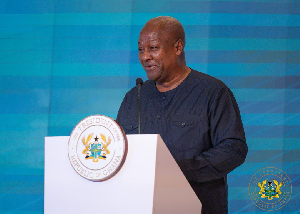
 President John Dramani Mahama
With a heavy heart and profound sadness, the persistent hostility against Ghanaian immigrants in South Africa must be condemned in the strongest possible terms and treated with the contempt it deserves. Every act of xenophobic violence is not only an attack on innocent individuals but also an assault on the ideals of African unity, solidarity, and shared prosperity.
Ghanaians are globally recognised for their peaceful disposition, tolerance, and respect for the laws of their host countries. However, our peaceful nature should never be mistaken for weakness or an inability to defend the dignity and rights of our citizens wherever they may be.
For years, South Africa has witnessed recurring waves of xenophobic attacks targeting immigrants from several African countries. Sadly, Ghanaians have not been spared from these senseless acts of violence, intimidation, looting, and discrimination. Businesses painstakingly built over decades have been destroyed, lives have been threatened, and countless families have been left traumatised.
One cannot help but question whether the measured and diplomatic posture adopted by the Government of Ghana has inadvertently been interpreted as complacency. Has our government's cautious approach become a test of Ghana's patience and resolve? While diplomacy remains the cornerstone of international relations, diplomacy without decisive action risks emboldening perpetrators and exposing innocent citizens to further danger.
On the contrary, as we continue to monitor developments, it is becoming increasingly difficult to ignore the alarming escalation of these attacks. There comes a time when silence and endless diplomatic engagements cease to produce meaningful results. Dialogue is effective only when all parties are willing to listen and act in good faith. When one side persistently ignores legitimate concerns, dialogue degenerates into a monologue, and justice becomes elusive.
Such circumstances amount to a violation of fundamental human rights, including the right to life, security, dignity, and freedom from discrimination.
While we acknowledge the efforts of Ghana's Ministry of Foreign Affairs in lodging formal protests and petitions through diplomatic channels, including engagements with the African Union, these measures must now be complemented by stronger regional and continental action.
The African Union, the Southern African Development Community (SADC), and other relevant regional bodies cannot afford to remain passive observers while fellow Africans are persecuted simply because of their nationality.
The Government of South Africa equally bears a constitutional and moral responsibility to protect every individual residing within its borders, irrespective of nationality. Criminal elements masquerading as patriots should be identified, arrested, prosecuted, and punished in accordance with the law. Failure to do so risks normalising xenophobia and undermining South Africa's democratic credentials and commitment to human rights.
Moreover, it is particularly ironic that citizens from other African countries are today being branded as "illegal foreigners" in a nation whose liberation from apartheid was significantly supported by the very countries whose citizens are now under attack. Ghana, under the visionary leadership of Osagyefo Dr. Kwame Nkrumah, stood firmly with the people of South Africa during their darkest days.
Across the African continent, governments, liberation movements, and ordinary citizens contributed financially, diplomatically, and politically to dismantle the apartheid regime. Many African nations opened their doors to South African exiles, offered scholarships to their students, and mobilised international support for their struggle.
More so, this painful reality raises a fundamental question: Is this the Africa that Osagyefo Dr. Kwame Nkrumah envisioned when he championed Pan-Africanism and declared that the independence of Ghana was meaningless unless it was linked to the total liberation of the African continent or Nigeria’s Abubakar Tafawa Balewa among others advocated for?
The fight against xenophobia must not be viewed solely as South Africa's domestic challenge. It is an African problem that demands an African solution. Every African government must speak with one voice against hatred, discrimination, and violence directed at fellow Africans.
Our shared history, common destiny, and aspirations for continental integration under the African Continental Free Trade Area (AfCFTA) cannot flourish in an environment where Africans fear persecution in fellow African states.
The time has come for South Africa to confront and eradicate this recurring madness with the seriousness it deserves. Equally, African leaders must ensure that the principles of Pan-Africanism are reflected not only in speeches and commemorations but also in policies, law enforcement, and the protection of every African citizen, regardless of where they choose to live, work, or invest.
An injury to one African is an injury to all Africans.
If we truly believe in the African Union's vision of "An Integrated, Prosperous and Peaceful Africa," then xenophobia must have no place on our continent.
However, Ghana’s Foreign Minister and the Commissioner to South Africa must monitor closely and see the xenophobic attacks as an affront to Ghana and not just the immigrants. Once South Africa is ready to lose Africa, Ghana must also be prepared to end diplomatic ties with them.
This is a clarion call on government to decline any state visit of South Africa’s President, Cyril Ramaphosa into Ghana, our anticipation is to witness the recall of the Ghanaian High Commissioner South Africa and subsequently declaring the South African High Commission to Ghana a persona non grata in the shortest possible times.
Enough is enough! Yes, enough is enough!! Ghanaians cannot continue to lose their lives in the xenophobic attacks in South Africa whiles citizens and South African companies continued to enjoy our peace and security as well as business friendly environment. Like Uganda, Nigeria and some few other African countries, Ghana must take a stand to nationalise the shares of South African companies to mark a bold step in tackling the South Africa’s xenophobic madness.
On the other-hand, Ghana must go beyond evacuation to ensure the evacuees fleeing from the xenophobic attacks are compensated adequately to make them comfortable aside the corporate social responsibility of benevolent organizations to offer them with their widow’s might to rebuild the victims.
The government of Ghana must map out and list South African companies operating country both legally or illegal and prepare to takeover them by nationalising the South African shares of the companies in lieu of responding to their xenophobic madness without recourse to diplomacy.

Copyright © 1994 - 2026 GhanaWeb. All rights reserved.










