



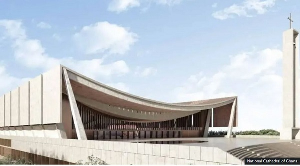
 The intended look of the proposed design of Ghana's National Cathedral
A National Cathedral is a large, monumental church that serves as a sacred space for national events rather than just a regular place of worship.
They are typically non-denominational or represent the country's primary religious tradition, hosting state funerals, presidential inaugurations, and national days of thanksgiving.
Prominent examples of national cathedrals around the world include:Washington National Cathedral (USA): Officially known as the Cathedral Church of Saint Peter and Saint Paul, this is the seat of the Presiding Bishop of the Episcopal Church. It serves as a spiritual home for the nation and has hosted several U.S. presidential funerals and state prayer services.
National Ecumenical Centre (Nigeria): Located in Abuja, this is the primary place of Christian worship for the nation, frequently utilized for government-sponsored religious ceremonies and national thanksgiving services.
People's Salvation Cathedral (Romania): Located in Bucharest, this massive Eastern Orthodox structure serves as a national spiritual symbol for the Romanian people.
National Cathedral of Ghana project is a heavily publicized monumental project located in the heart of Accra. Designed to reflect a blend of Christian orthodoxy and Ghanaian cultural heritage, it is designed to include a 5,000-seat auditorium, Africa's first Bible museum, and an art gallery for national and interdenominational use.
The National Cathedral of Ghana is very relevant in a nation where faith plays a central role in the lives of its people. With approximately 75% of the population professing the Christian faith, Christianity has profoundly influenced our national values, education, healthcare, philanthropy, morality, and nation-building.
Yet, despite this overwhelming Christian presence, Ghana still has no national monument that represents the collective faith of its Christian community.
A National Cathedral would serve to represent not just the cohesion but unity of the nation's Christians.
Across the country stand magnificent cathedrals, chapels, auditoriums, and prayer centres built through the sacrifices of individuals, denominations, and ministries.
These buildings serve their respective traditions— Catholic, Anglican, Methodist, Presbyterian, Pentecostal, Charismatic, Apostolic, and many others. They are monuments of faith and have faithfully advanced the gospel for generations.
However, a National Cathedral is different. It is not intended to replace existing churches or compete with any denomination. Rather, it represents a common spiritual home—a place where Christians from every tradition can gather as one people to worship, pray, celebrate national milestones, mourn together in times of tragedy, and seek God's guidance for the nation.
In Ghana, the National Cathedral can serve as an appropriate location for swearing-in of elected presidents where the weather may not permit. It would also be a respectable venue for the funerals of departed leaders and other notable national figures.
The Church has always been strongest when it demonstrates unity in essentials while celebrating diversity in expression. Jesus Himself prayed: "That they all may be one... so that the world may believe that You have sent Me." (John 17:21). A National Cathedral can become a visible expression of that prayer—a symbol that, despite our different denominations, we serve one Lord, one faith, and one God.
The Apostle Paul reminds us:
"There is one body and one Spirit... one Lord, one faith, one baptism; one God and Father of all." (Ephesians 4:4–6)
Throughout Scripture, God's people built monuments not because God needed buildings, but because generations needed reminders of God's faithfulness.
King Solomon mobilized the entire nation to build the Temple of the Lord. He declared: "The house I am going to build will be great, because our God is greater than all other gods." (2 Chronicles 2:5)
When the Temple was completed, it became a national symbol of Israel's covenant with God.
Likewise, after the exile, the people returned with one purpose—to rebuild the house of God. Though they faced opposition, discouragement, and limited resources, they persevered because they believed God's house deserved their best (Ezra 3–6; Haggai 1:7–8).
King David also prepared generously for the Temple, even though he knew he would not personally build it. He gave from his own wealth and inspired the leaders and people to contribute willingly. Then he asked: "Who then is willing to consecrate themselves today to the Lord?" (1 Chronicles 29:5). The response was overwhelming because the people understood they were giving to God, not merely to a construction project.
Scripture teaches us that: "Unless the Lord builds the house, the builders labour in vain." (Psalm 127:1) A National Cathedral should therefore not be viewed merely as a government project. Governments come and go. Political administrations change. But God remains the same yesterday, today, and forever (Hebrews 13:8).
If the Cathedral is to stand for centuries, it must belong first to God and to the Christian community—not to any political party or government. It should reflect the majority Christian population of Ghana and become a national legacy that future generations inherit with pride.
Many have observed that the National Mosque Complex was made possible through international support from the Republic of Türkiye. Whether through local or international generosity, it now stands as an enduring place of worship for Ghana's Muslim community. This should inspire Christians to reflect on what we can accomplish when we stand together.
If millions of Christians across all denominations each contributed according to their ability, the burden on any single institution or individual would be greatly reduced. Together, what appears impossible could become a testimony of unity, sacrifice, and faith.
The Apostle Paul encouraged believers: "Each of you should give what you have decided in your heart to give, not reluctantly or under compulsion, for God loves a cheerful giver." (2 Corinthians 9:7). This is not about obligation but opportunity. It is an opportunity for Christians to demonstrate gratitude to the God who has blessed our nation. It is an opportunity to leave a legacy that will outlive us. It is an opportunity to build something that future generations will point to and say, "Our fathers and mothers built this in honour of the God who sustained Ghana."
Throughout history, monuments have reminded nations of defining moments and enduring values. For Christians, a National Cathedral could become such a monument—not to glorify human beings, but to honour God, who has faithfully preserved our nation through seasons of peace, challenge, and hope. As the Psalmist declares: "Not to us, Lord, not to us but to Your name be the glory." (Psalm 115:1)
Therefore, I respectfully challenge Christian leaders, churches, ministries, business leaders, and believers across Ghana: let us rise above denominational boundaries and see this as a national act of worship rather than a political undertaking. The question is not whether one denomination can build it.
The question is whether millions of Christians, serving the same God, can unite to build a lasting monument in His honour. If we truly believe that every good and perfect gift comes from God (James 1:17), then surely we can collectively offer Him something that reflects our gratitude as a nation.
The Cathedral should never be about the glory of any government or any individual. It should stand as a declaration that Ghana acknowledges the sovereignty of Almighty God.
After all, our National Anthem, which is essentially a prayer to God, begins with the name of "God", while our National Pledge also ends with a plea to God and a mention of His name.
Governments will come and go. Leaders will rise and pass on. But the name of the Lord endures forever. May future generations look upon such a monument and remember that, at a defining moment in our nation's history, the Christians of Ghana chose unity over division, generosity over hesitation, and gratitude over indifference—all for the glory of God.
"Even them I will bring to My holy mountain, And make them joyful in My house of prayer. Their burnt offerings and their sacrifices, Will be accepted on My altar; For My house shall be called a house of prayer for all nations" - Isaiah 56:7

Copyright © 1994 - 2026 GhanaWeb. All rights reserved.










