



 Michael Akrofi is the author of this article
Ghana’s efforts to reduce the country’s dependence on imported livestock and poultry products and increase local production deserve commendation.
However, if Ghana truly wants to achieve food security, create jobs, reduce its import bill and eventually become an exporter of livestock products, the country needs a deliberate, comprehensive and long-term approach that goes beyond the Nkoko Nketenkete initiative.
The government’s Nkoko Nketenkete policy has created an opportunity for many Ghanaians to participate in poultry farming.
Despite the challenges associated with its implementation, the initiative has the potential to contribute to increased domestic poultry and egg production.
The government, through the Ministry of Food and Agriculture, therefore deserves recognition for introducing the initiative. However, like every public policy, there is room for improvement.
Make Nkoko Nketenkete a national programme
One important consideration should be to make Nkoko Nketenkete a genuinely national agricultural intervention rather than one that could be perceived through the lens of partisan politics.
Access to the programme should be based on clear, transparent and measurable criteria.
A Ghanaian who is genuinely interested in poultry farming, whether young or old, politically affiliated or not, should be able to apply.
The Ministry should assess the applicant’s preparedness, capacity and commitment and, where the requirements are met, provide the appropriate support.
This should be a programme for Ghanaian poultry farmers and potential poultry farmers not a programme identified with one political party.
If successive governments can maintain and improve successful agricultural interventions rather than abandoning them because they were introduced by previous administrations, Ghana will be in a much better position to build sustainable agricultural systems.
Government should establish demonstration livestock farms
Beyond Nkoko Nketenkete, I believe the Ministry of Food and Agriculture should consider establishing well-equipped state demonstration poultry and livestock farms in strategic parts of the country.
These facilities could serve as practical learning centres for existing farmers, prospective farmers, agricultural students and young people interested in entering the livestock sector.
Such farms could demonstrate modern poultry production, cattle breeding, dairy production, piggery, animal nutrition, disease prevention, farm management, processing and marketing.
The facilities could also become centres for research, farmer training and technology transfer.
This could help bridge the gap between agricultural education and practical farming.
Agriculture can help address youth unemployment
Ghana has thousands of young people graduating from universities and other institutions every year. Many have qualifications in agriculture and related disciplines but struggle to find formal employment.
Rather than expecting all of them to find employment in the public sector, government can create opportunities for them to become agricultural entrepreneurs.
Young graduates could form cooperatives or registered groups and, with appropriate government support, gain access to land, birds, livestock, equipment, technical assistance, financing and markets.
This could create employment not only for the young farmers themselves but also for people working in feed production, transportation, veterinary services, processing, marketing and other parts of the agricultural value chain.
For some young people who may otherwise become vulnerable to illegal mining and other risky economic activities, agriculture could provide a legitimate and sustainable alternative.
What Wisconsin can teach Ghana
My conviction about the need for Ghana to broaden its livestock strategy was strengthened by an experience I had recently in the United States.
I am currently in the United States as part of the International Visitor Leadership Program (IVLP) under the theme “AI and Technology in the Media Landscape,” a programme sponsored by the U.S. Department of State for selected journalists from different countries.
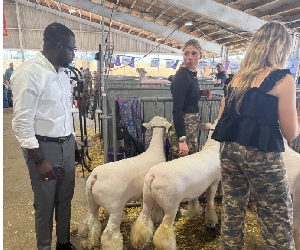
As part of the programme, our delegation had the opportunity to visit the Wisconsin State Fair Park in West Allis, Wisconsin, where we experienced one of the major agricultural showcases in the state.
The Wisconsin State Fair is not simply an entertainment event.
It is an important platform for celebrating agriculture, livestock, farming, education, entrepreneurship and the state's agricultural heritage.
The fair brings together farmers, livestock exhibitors, agricultural businesses, researchers, families and consumers.
Visitors have the opportunity to see livestock exhibitions, agricultural demonstrations and educational programmes.
There are also displays of Wisconsin-produced goods, horticultural products, textiles, crafts and culinary products.
The experience demonstrates how agriculture can be connected to education, tourism, business, entertainment, technology and local economic development.
That is an area Ghana can learn from.
Ghana needs an agricultural exhibition culture
Ghana can consider strengthening its own agricultural fairs and livestock exhibitions.
Such events should not merely be ceremonial occasions.
They could provide platforms where farmers compete, learn, display their livestock, meet buyers, access technology, interact with financial institutions and showcase locally produced agricultural products.
Imagine an annual national livestock exhibition where Ghanaian farmers can display their best cattle, sheep, goats, pigs and poultry.
Imagine agricultural students learning directly from successful farmers.
Imagine breeders showcasing improved breeds.
Imagine Ghanaian businesses exhibiting locally manufactured feed, farm equipment, veterinary products and processing technologies.
That can become a major platform for agricultural development.
There is a lesson in Wisconsin’s livestock sector
During the visit, we saw livestock breeds that demonstrated the level of investment that has gone into animal breeding, nutrition, management and agricultural technology.
Among the exhibits were cattle and pigs of impressive size and quality.
The lesson for Ghana should not be that we simply bring foreign breeds into the country and expect them to perform in exactly the same way.
Rather, Ghana should invest in research and carefully evaluate which breeds and genetic technologies can perform successfully under Ghanaian environmental and management conditions.
Where appropriate, Ghana could explore partnerships involving research, breeding, genetics, veterinary science, animal nutrition, agricultural technology and farmer training.
This could complement the work already being undertaken by Ghanaian farmers and institutions that are experimenting with improved livestock breeds and dairy production.
Ghana can build international agricultural partnerships.
Ghana should therefore explore opportunities for institutional partnerships with agricultural authorities, universities, research institutions, farmer organisations and private-sector players in Wisconsin and other parts of the United States.
Such partnerships could focus on improved livestock genetics and breeding;
artificial insemination and reproductive technologies;
dairy production;
animal nutrition and feed formulation;
veterinary services;
livestock disease management;
farm mechanisation;
agricultural technology;
farmer education and extension;
livestock processing and value addition; and
agricultural exhibitions and farmer competitions.
The objective should not be to copy Wisconsin.
The objective should be to learn from what works there and adapt those lessons to Ghanaian conditions.
Ghana has the potential
Ghana prides itself on agriculture as a major pillar of the economy. But if we continue to import large quantities of poultry, meat and other livestock products, it tells us that there is still a significant gap between our agricultural potential and our actual production capacity.
That gap represents an opportunity.
The answer is not only Nkoko Nketenkete.
We need a comprehensive livestock development strategy that brings together government, farmers, universities, research institutions, financial institutions, the private sector and international partners.
We need to invest in the farmer.
We need to invest in research.
We need to invest in breeds.
We need to invest in feed.
We need to invest in veterinary services.
We need to invest in processing and cold-chain infrastructure.
And we need to create a reliable market for locally produced livestock products.
The time to act is now
As a journalist with 15 years of experience, and now as someone who has personally benefited from the Nkoko Nketenkete intervention, I believe beneficiaries should not only express gratitude but also contribute ideas that can help improve public policy.
My experience at the Wisconsin State Fair has reinforced my belief that agriculture can be much more than subsistence farming.
It can be an industry.
It can create jobs.
It can support tourism.
It can generate foreign exchange.
It can attract young people.
It can stimulate manufacturing.
It can support scientific research.
And it can reduce Ghana's dependence on imported food.
Therefore, my appeal to the Government of Ghana is simple.
Do not abandon Nkoko Nketenkete.
Improve it, make it fairer, depoliticise access to it, resource genuine farmers and integrate it into a much broader national livestock development strategy.
Let us move from simply distributing birds to building sustainable poultry businesses.
Let us move from individual farmers to organised agricultural cooperatives.
Let us move from importing livestock products to producing more of what we consume.
And eventually, let us move from being an importer to becoming an exporter of quality Ghanaian livestock products.
Ghana can do it.
But it will require political commitment, continuity across successive governments, investment in research and technology, strong partnerships and, most importantly, a deliberate decision to make the Ghanaian farmer the centre of our agricultural transformation.
Nkoko Nketenkete can be the beginning but it must not be the end.
Ghana’s livestock transformation must go beyond Nkoko Nketenkete.

Copyright © 1994 - 2026 GhanaWeb. All rights reserved.










