



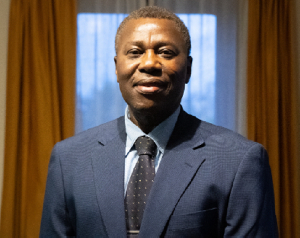
 Isaac Yaw Asiedu
Across Asia, a new technological race is taking shape. Japan is nurturing space startups, Taiwan is investing in satellite technology, India is expanding private-sector participation in space, and China is building satellite capabilities as its strategic competition with the United States intensifies.
Artificial intelligence is adding another dimension to this transformation.
This is not simply a race to launch rockets. It is a competition for technology, economic opportunity, data, security and future industrial power.
For Africa, the development raises an uncomfortable question: while other regions are preparing for the industries of tomorrow, what occupies our national conversation today?
Space Is Becoming Economic Infrastructure
Satellites are no longer primarily symbols of scientific prestige. They support telecommunications, weather forecasting, agriculture, navigation, disaster management, environmental monitoring, mineral exploration and national security.
Combined with artificial intelligence, satellite data can help governments detect illegal mining, monitor forests and water bodies, predict agricultural conditions, plan expanding cities and respond to floods and droughts.
These are not distant problems for Africa. They are among the continent's most immediate development challenges.
Africa therefore does not need a costly competition to put flags in space. It needs the technological capacity to use—and increasingly develop—the systems that are becoming essential to modern economies.
Africa Must Become More Than a Consumer
The deeper issue is technological dependence.
For decades, many African economies have exported raw materials and imported the technologies needed to transform them. The danger is that the same pattern could continue into the AI and digital era: Africa supplies minerals and consumers while others own the technologies, intellectual property and companies that generate the greatest value.
That must change.
African universities should be producing more engineers, AI specialists, data scientists, robotics researchers and advanced manufacturing professionals. STEM and TVET education must be connected more deliberately to industrial policy, entrepreneurship and national development.
The objective should not be to manufacture everything locally. It should be to develop sufficient technological capability so that Africa is not permanently dependent on others for systems critical to its economy and security.
But Our National Conversation Must Also Change
This is where Africa faces another challenge.
Too much public attention is consumed by partisan politics: who insulted whom, which politician defected, which party will win the next election and which political controversy dominates today's television discussion.
Political accountability matters. Corruption, unemployment, healthcare, education and the cost of living deserve vigorous debate. But politics should not consume the intellectual space needed to discuss the future.
How often do our major television and radio stations seriously debate artificial intelligence, robotics, biotechnology, satellite technology, advanced manufacturing or the future of African universities?
How often do scientists, engineers, researchers and technology entrepreneurs occupy the same prime-time platforms routinely given to politicians?
A country cannot prepare for tomorrow if almost its entire national conversation is about today's political contest.
Africa Needs a Development Competition
Imagine if African countries competed as fiercely over technological progress as political parties compete for power.
Which country can build the strongest research universities? Which can produce the most skilled engineers? Which can develop globally competitive AI companies? Which can transform its minerals into advanced products rather than exporting them raw?
That would be a competition capable of changing Africa.
The continent also does not need 54 separate and expensive space programmes trying to reproduce the same infrastructure. African countries can cooperate through shared satellite systems, research centres, data platforms and specialist training institutions.
African integration should therefore move beyond trade and free movement. It should increasingly include shared science, technology and research capacity.
The Future Will Not Wait
Asia's space race should be viewed in Africa not merely as foreign news, but as evidence of how rapidly the foundations of economic power are changing.
The countries investing today in AI, satellites, robotics and advanced manufacturing are positioning themselves for tomorrow's economy.
Africa cannot remain primarily a supplier of raw materials and a consumer of technologies developed elsewhere.
And it cannot allow endless partisan confrontation to crowd out serious discussion about its technological future.
Politics determines who governs. Knowledge, technology and productive capacity increasingly determine what a nation can become.
So alongside the familiar question, Who will win the next election?, Africa should begin asking more consequential questions:
What will Africa invent? What will Africa manufacture?
What technologies will Africa own? And where does Africa intend to stand in the global economy of 2050?
Those questions deserve far more space in Africa's national conversation.

Copyright © 1994 - 2026 GhanaWeb. All rights reserved.










