



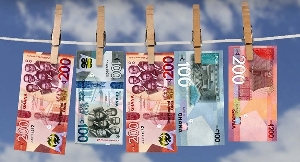
 Money is the legal tender for storing and exchanging value
1. Money is the legal tender for storing and exchanging value. It is a representation of value for the easy transaction of virtue.
2. Value must be virtuous; therefore, the efficiency of money is a function of increasing virtue. But our world is not increasing in virtue. It is increasing in vice. Wars, mistrust, inequality, sophistry and the scare of uncontrollable technology are worsening. The present is not desirable, and the future is not predictable. Humanity is undergoing a tricky transformation.
3. Is there another way, apart from cash, by which money can be more efficiently liquidated? The financial system of “cash” seems to be accelerating the promotion of vice more than the promotion of virtue. This situation is heading humanity in the direction of self-obliteration.
4. Values such as peace, quietness, honesty, godliness, goodwill, good faith, trust and unity need renewed pathways of diligence to attain financial capital for social impact. Diligent deception and audacious bad faith have, over the years, succeeded in establishing successful pathways to money.
5. Vice laundry (which is worse than money laundering) plays on the innate human desire to satisfy the inordinate appetites of the flesh and mind, to acquire cash, peddle influence and spread control. For example, in men and women respectively, the transient pleasure of sex and the vague security of material possessions are desires that are played upon by profit-driven businesspeople to make merchandise of even the poor. Traditional advertising and digital content are awash with these predatory economics.
6. The natural mechanisms of desire to satisfy inordinate appetites are founded on the same natural elements of desire to pursue reasonable appetites, such as good faith, honesty, godliness and trustworthiness. This is what our world must work for if we truly want to serve humanity.
7. The natural elements of desire include an understanding of knowledge. Leaders must capably explain the virtue in the knowledge of truth; otherwise, knowledge will produce vice, as we have today.
8. Every Christian is a leader because you live truth. You may not be a leader with a post ordained upon you. You don’t need that. If you remain in Jesus Christ, truth impersonated in practice, you will automatically find others following you. This calls for a diligent pursuit of truth on your side. You must be diligent in living out truth.
9. Thus, we are transitioning to the understanding of “money” as “truth in currency”. The character of value is virtue, and the summary of virtue is truth.
10. Truth is reality that is consistent with the past, present and future. Truth is stability, sustained goodness and eternal life. Every well-meaning Christian must thus commit diligently to spiritual, social and economic stability. Commitment to economic stability is vital to physical survival and thriving and is thus fundamental. If you don’t eat, you will die.
11. Whereas spiritual stability is most essential because there is life after death, and existence continues in consciousness in a place of eternal pleasure or eternal torment, economic stability must not be at the expense of spiritual wellbeing. This is a juncture of significant divide in human solidarity. For this reason, the role of spiritual leaders, because they engage both the secular world and the spiritual world, is of critical importance.
12. Economic stability is an essential component of spiritual stability. We have needs, both as individuals and as a human collective, and we have wants. Needs are necessary for survival; wants are not. Wants can be seen as additional supporting tissue that guards us from becoming needy. Someone who needs GH¢500 but wants GH¢1,000 has an extra GH¢500 to protect them from having less than GH¢500. Life is convenient when one has a larger buffer of acquired wants to protect acquired needs. Acquired needs make us comfortable. Acquired wants give us convenience, a margin of error that makes us feel free and at ease. Ease is dangerous for human survival and thriving.
13. Wants can be endless. They are dependent on the inertia of the individual.
14. The craving for and sustained acquisition of wants can make a want become a need, and people may commit suicide or receive life imprisonment because an insatiable quest for endless wants becomes a necessity for their survival. We leave such people behind bars, or they leave us.
15. The United Nations’ post-2030 plan, the “Pact for the Future”, has a central ambition to achieve “Freedom from fear and freedom from want for all”. Freedom from want has a number of dimensions: one may not want something, or one may want to have whatever one wants. If we train ourselves to become wanton, to have anything we want or desire, we would be where we are now: headed for doom. And some don’t really care. Some do. Do you?
16. It is the ambition to have whatever we want that makes vile become virtue. Because it is my human right to have whatever I want as a human being, it is right to have the evil I want and, in that sense, the evil I want is not evil. It is right. It is good for me. I must not be left behind; and if millions are like me, no one must be left behind. Is this thinking humanity? Yes, we will leave no one behind. Some will choose to walk backwards. We will come back for them without walking backwards. What is progress?
17. Economic development can translate into sustainable development if we work together to reaffirm the needs of humanity and train ourselves to maintain our necessities while giving up our wantonness. This means we must strategically focus on young people, children, babies and the unborn.
18. The global financial system is heavily dependent on wantonness. When people want something now, they do whatever they can to get it. The financial sector is engineered in a way to provide every desire of its decision-makers. If the elite in finance and business (FAB) want, not need, something now, immediately, in the short term, they will get it. That’s how the system has been built. They own the wealth and control it. They worked “tirelessly” to gain this control, so “they deserve” this outcome. And as part of the system they have designed, when the system crashes, the rest of us would bail them out, protect them and reinstall them. Because we must not leave them behind.
19. There must be a redefinition of profit that refocuses the concept on people, not money. Speed, immediacy and short-term selfish considerations are misleading us into recklessness.
20. The massive poor public pays the bills for failure when the few reckless elite in finance and business take high-risk, profit-making decisions. If they win, they take all the gains. But if they lose, we take all the pain. This can and must be addressed quickly.
21. The process to address this is ongoing and gaining momentum. In Ghana, there is a media station called Citi FM, whose anchor is a mature young man named Bernard Avle. He is streetwise, outspoken and thoughtful. There are many others like him in this beautiful country in sub-Saharan Africa. This is that place in the global economy where the PR system says all poverty abides. But people like Bernard and their teams are working hard to change the narrative for humanity.
22. There is massive inequity caused by the sophistry in the globalisation agenda because the same rules are applied equally to all in such a way that those States that were rendered weak by external imperialists have inadequate capacity and capability to match up with the advantaged human brotherhood. For example, the open market system dumped exported goods from developed economies onto the markets of struggling economies and crushed their local manufacturing and innovation industries, crippling them into economic disabilities without adequate remedy.
23. Reparation for the slave trade, the push for health sovereignty, redrawing the physical world map and trying alternatives through BRICS, while efforts to reform the UN proceed, are part of the transition we are all inevitably carrying with us.
24. If climate change is a hoax that tries to slow down Europe and the US so that China and Russia can catch up on industrialisation, and the recent warning about AI innovation outpacing legal frameworks is not trustworthy, what should we do? We must come back to the basics: are we chasing needs, or are we pursuing insane wantonness?
25. Goal 12 of the UN Sustainable Development Agenda is on responsible consumption and production. It is another way of admitting that we have to stop wantonness. But we insist that wantonness is a human right. We have a right to be wrong. I agree. Do we have a right to be responsible?
26. So let the media in Africa, the churches in Africa, the unions in Africa and the parents in Africa be more responsible and call out their irresponsible colleagues to whip them into line for the sake of our generations.
27. Africa is rising to contribute a critical mass of correction to the global financial system. The remedy is not to continue the model of wantonness but to guide us back from the path of extinction to the cradle of humanness: business means profit, and profit is human wellbeing, not wantonness.
28. But it’s not just Africa, but human beings everywhere who insist on being human instead of wicked depravities. We will leave them behind because they will not join in the thriving. Come along.

Copyright © 1994 - 2026 GhanaWeb. All rights reserved.










